
In This Article
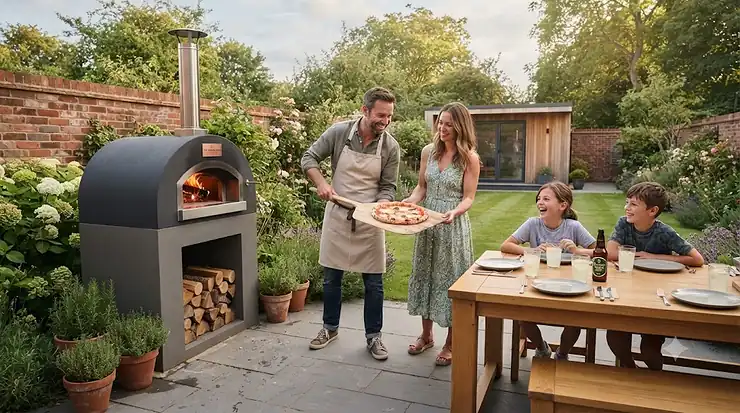
Somewhere between “shall we get a barbecue” and “shall we knock through to the garden and build a proper outdoor kitchen” lies a very specific rabbit hole: the built-in wood-fired pizza oven. It’s the appliance that turns a Saturday into an event. Once the fire’s roaring and the dome’s ticking with heat, nobody’s checking their phone — they’re hovering by the door with a peel in hand, arguing about whether the margherita needs thirty more seconds.
Unlike the tabletop pellet burners that dominate garden centre shelves each spring, a proper built-in wood-fired pizza oven is a permanent fixture — bricked, rendered, plumbed into your patio or outdoor kitchen worktop, and built to outlast several barbecues. That permanence is exactly why the decision matters more. You’re not choosing a gadget for this summer; you’re choosing the insulated chamber, the chimney flue, and the footprint that will define your garden for the next decade.
This guide walks through seven real, currently available UK ovens — from compact starter kits under £600 to serious modular builds that wouldn’t look out of place at a pizzeria — with honest analysis of who each one suits, what the spec sheets actually mean in practice, and what reviewers consistently flag as the good and the annoying. We’ll also get into the practical stuff nobody puts on the product page: how planning rules and smoke control legislation actually apply to garden ovens, how to keep an insulated chamber performing after year three, and what tends to go wrong with a badly specified chimney flue.
Prices below are given as ranges rather than fixed figures, since Amazon and specialist retailers adjust pricing frequently — always check the current price before buying.
What Is a Built-In Wood-Fired Pizza Oven?
A built-in wood-fired pizza oven is a permanent, fixed-position oven — typically a refractory brick or cast dome — installed into an outdoor kitchen, patio wall, or dedicated stand, with its own insulated chamber and chimney flue for smoke extraction. Unlike portable pizza ovens, it isn’t designed to be moved once assembled.
That fixed nature is the whole point. A built-in oven is bedded onto a solid, insulated base, its dome or chamber is sealed and rendered, and its flue is routed to draw smoke safely away from the cooking area. In return for the extra planning, you get a bigger cooking floor, better heat retention, and — because these things tend to become the centrepiece of the garden — a genuine outdoor kitchen focal point rather than a box that lives in the shed nine months a year.
If you’re weighing up whether smoke from a garden installation like this needs council sign-off, the government’s own guidance on smoke control area rules explains which fuels and appliances are affected — worth a five-minute read before you commit to a fixed structure.
Quick Comparison Table
For readers short on time, here’s the shape of the market at a glance before we go deeper.
| Oven | Type | Price Range | Best For |
|---|---|---|---|
| VITCAS Casa | Compact built-in kit | £500-£650 | Small gardens, first-time buyers |
| VITCAS-S Outdoor Clay Firebrick Pizza Oven | Compact built-in kit | £580-£700 | Tight patios, minimal assembly |
| VITCAS Double Casa | Mid-size built-in kit | £800-£1,300 | Families, regular entertaining |
| VITCAS-L Brick Outdoor Pizza Oven | Mid-large built-in kit | £950-£1,300 | Larger households, semi-commercial use |
| VITCAS Pompeii 120 DIY Kit | Traditional dome, build-your-own | £1,700-£2,400 | Purists who want a classic build |
| Fuochino Neo Forni | Fibreglass-shelled built-in oven | £1,400-£1,700 | Design-led outdoor kitchens |
| Fuochino Strada (modular kit range) | Commercial-grade modular kit | £800-£2,900 | Serious hobbyists and small caterers |
Even at a glance, the pattern is clear: this isn’t a market where more money buys “the same oven, but shinier.” Each price tier changes what you’re actually getting — chamber size, insulation depth, finish quality, and how much assembly graft is required. The two VITCAS compact kits solve the same problem (small space, low commitment) in near-identical ways, while the jump to the Pompeii 120 or the Fuochino Strada range reflects genuinely different construction, not just brand markup. If your garden can only take a metre of depth, don’t let the premium options distract you — the compact tier will cook a perfectly good pizza.
💬 Just one click — help others make better buying decisions too!😊
Top 7 Built-In Wood-Fired Pizza Ovens: Expert Analysis
1. VITCAS Casa — most compact built-in kit for small gardens
The VITCAS Casa solves the problem most first-time buyers actually have: not enough garden for a full-size dome. It arrives in six pieces, none heavier than 25kg, so two people can manhandle it into position without hired machinery.
Its oval, arch-shaped chamber holds one to two small pizzas at a time — modest, but proportionate to its compact external footprint. The kit includes a stainless steel chimney flue with cowl and damper, a cast iron door with a built-in thermometer, and the high-temperature silicone needed to seal the joints. Base insulation and any decorative render are bought separately, which keeps the entry price down but adds a step most buyers don’t anticipate.
This is the right call for households with a modest patio, first-time wood-fired cooks, or anyone nervous about committing serious money before they know whether the hobby sticks. Reviewers consistently report that assembly is genuinely quick — often under an hour for the shell itself — though several flag that skipping the recommended ceramic fibre insulation board underneath noticeably shortens how long the chamber holds heat.
Pros:
- ✅ Lightest components of any kit in this list
- ✅ Includes flue, door and thermometer as standard
- ✅ UK-made with quick, beginner-friendly assembly
Cons:
- ❌ Small chamber limits you to one or two pizzas at once
- ❌ Insulation board and render sold as separate extras
At around £500-£650, the VITCAS Casa is comfortably the cheapest genuine built-in option here, and represents strong value provided you budget for the insulation add-ons rather than treating the base kit as the finished product.
2. VITCAS-S Outdoor Clay Firebrick Pizza Oven — best for minimal-assembly tight patios
The VITCAS-S Outdoor Clay Firebrick Pizza Oven takes a slightly different construction route to the Casa — clay firebrick rather than cast refractory sections — but lands in a similar niche: small gardens, minimal fuss, everyday domestic cooking rather than catering-scale batches.
Firebrick construction brings a genuinely different thermal character. Clay firebrick heats and cools a touch faster than the heavier cast refractory used elsewhere in this list, which suits people who fire up the oven for a quick weeknight pizza rather than a slow four-hour Sunday cook. It’s designed for minimal assembly out of the box, which several buyers note is its strongest selling point over rival compact kits.
Aggregated review sentiment points to the same trade-off you’d expect from any small oven: excellent for one or two households eating together, noticeably tight if you’re trying to feed a garden full of people in one sitting. Reviewers who paired it with additional insulation blanket report meaningfully better heat retention than the out-of-the-box configuration.
Pros:
- ✅ Genuinely minimal assembly compared with rivals
- ✅ Compact footprint fits tight patios and courtyards
- ✅ Clay firebrick heats quickly for weeknight use
Cons:
- ❌ Limited capacity for entertaining larger groups
- ❌ Heat retention benefits from extra insulation not included
Priced around £580-£700, the VITCAS-S Outdoor Clay Firebrick Pizza Oven sits almost exactly alongside the Casa, so the decision between them comes down to whether you prefer the quicker heat-up of clay firebrick or the Casa’s slightly more traditional cast-refractory build.
3. VITCAS Double Casa — best mid-size pick for families and regular entertaining
Step up from the compact tier and the VITCAS Double Casa is where things start to feel like a proper garden fixture rather than a starter kit. Its internal chamber measures roughly 740mm x 600mm — enough to comfortably hold three to four pizzas cooking in rotation, which changes the entire rhythm of a garden gathering from “one at a time, everyone waits” to “keep them coming.”
Built in eleven refractory sections, none heavier than 25kg for manageable handling, the completed structure weighs around 300kg once assembled — a figure that matters because it tells you plainly this needs a solid, level, purpose-built base rather than a patch of decking. The kit includes the same cast iron door and thermometer combination as the smaller Casa, plus heat-resistant silicone for the joints.
What most buyers overlook about stepping up a size class is that the extra thermal mass genuinely changes cooking behaviour: a bigger chamber takes longer to reach temperature but holds that heat far longer afterwards, meaning you can bake bread on the residual warmth the next morning. Aggregated reviews consistently praise the capacity increase over the single Casa, with the main recurring gripe being that two people are genuinely needed to lift and position the heavier sections during the build.
Pros:
- ✅ Chamber comfortably fits 3-4 pizzas cooking at once
- ✅ Residual heat retained well enough for next-day baking
- ✅ Same trusted door, thermometer and flue components
Cons:
- ❌ Two-person build required for heavier sections
- ❌ 300kg finished weight needs a solid dedicated base
At roughly £800-£1,300, the VITCAS Double Casa is the natural landing point for families who entertain semi-regularly and have outgrown a compact oven’s one-at-a-time pace.
4. VITCAS-L Brick Outdoor Pizza Oven — best for larger households edging toward semi-commercial use
The VITCAS-L Brick Outdoor Pizza Oven is built from the same clay firebrick family as the VITCAS-S but scaled up considerably, arriving pre-built and insulated in four manageable sections rather than assembled entirely on-site brick by brick.
Its larger firing chamber holds three to four small pizzas per batch, with some listings noting capacity for five to six depending on size, positioning it as a genuine option for anyone flirting with small-scale catering or hosting frequent large gatherings. The pre-insulated construction is the standout detail here: rather than adding ceramic fibre board as an afterthought, VITCAS builds the insulation into the pre-built sections, which reviewers note noticeably improves out-of-the-box heat retention compared with kits that leave insulation entirely to the buyer.
Based on the spec comparison with its smaller siblings, the VITCAS-L trades some of the Casa range’s beginner-friendly simplicity for genuine cooking capacity — this is the oven for someone who’s already decided wood-fired cooking is a permanent part of how they entertain, not an experiment.
Pros:
- ✅ Pre-insulated sections improve out-of-the-box heat retention
- ✅ Capacity suits semi-commercial or large-gathering use
- ✅ Fewer, larger sections mean a faster overall build
Cons:
- ❌ Heavier individual sections than the compact tier
- ❌ Premium pricing versus the Casa range for similar brand
Expect to pay in the £950-£1,300 range, positioning the VITCAS-L Brick Outdoor Pizza Oven as the sensible upgrade path for anyone whose garden gatherings have outgrown a Double Casa’s rotation speed.
5. VITCAS Pompeii 120 DIY Kit — best for purists who want a classic dome build
If the word “authentic” matters to you, the VITCAS Pompeii 120 DIY Kit is the traditionalist’s choice in this line-up: a dome-shaped, wood-fired bread and pizza oven built from high-quality refractory materials in the UK, following the design that’s more or less unchanged since Roman times. For a longer read on where that shape actually comes from, the Wikipedia entry on masonry ovens covers the history in more depth than any product page will.
Unlike the Casa or VITCAS-L, the Pompeii 120 is explicitly suited to both indoor and outdoor installation, provided you’ve checked local building regulations and flue rules for either setting. The oven requires a fully supported, insulated base using ceramic fibre board — VITCAS is explicit that skipping this step compromises performance, and it’s not an area to cut corners on a build this substantial.
What the spec sheet won’t tell you, but the wider community of wood-fired cooks consistently notes, is that this style of dome takes noticeably longer to reach full temperature than the smaller Casa-style ovens — often ninety minutes to two hours for a proper first fire — but rewards that patience with exceptional, even heat distribution that holds for hours once established.
Pros:
- ✅ Traditional dome shape with excellent heat distribution
- ✅ Suitable for both indoor and outdoor installation
- ✅ UK-manufactured from premium refractory materials
Cons:
- ❌ Significantly longer heat-up time than compact kits
- ❌ Base insulation and support are non-negotiable extra costs
Pricing has varied noticeably between retailers and over time — expect somewhere in the £1,700-£2,400 range depending on current stock and seller — making the VITCAS Pompeii 120 DIY Kit a considered, longer-term investment rather than an impulse buy.

6. Fuochino Neo Forni — best design-led pick for a polished outdoor kitchen
Where the VITCAS range leans traditional, the Fuochino Neo Forni takes a different engineering approach entirely: a fibreglass outer shell wrapped around the refractory dome, which stays cool to the touch even when the inner chamber is running at 400°C.
That “cool wall” construction isn’t just a gimmick — it’s a genuine safety and design advantage for anyone building an oven into a family-used outdoor kitchen where children or pets might brush past it mid-cook. The fibreglass shell also resists the hairline cracking that can develop on painted render over several UK winters, and comes finished in cream or terracotta rather than requiring you to render and paint it yourself.
Here’s what to weigh against that convenience: the fibreglass shell is a sealed, factory-finished system, so it doesn’t offer the same scope for DIY customisation — tiling, custom paint, decorative brickwork — that a bare refractory dome does. If part of the appeal of a built-in oven is making it a personalised garden feature, that’s worth factoring in before you buy.
Pros:
- ✅ Cool-to-touch fibreglass shell even at high dome temperatures
- ✅ Weather-resistant factory finish, no rendering required
- ✅ Fully insulated for efficient heat retention
Cons:
- ❌ Factory finish limits DIY customisation options
- ❌ Premium pricing versus comparable-capacity brick kits
The full kit comes in around £1,400-£1,700, putting the Fuochino Neo Forni squarely in premium territory — justified for buyers who want the design polish of a finished product over the more hands-on character of a self-rendered brick oven.
7. Fuochino Strada (modular kit range) — best for serious hobbyists and small caterers
The Fuochino Strada range is the outlier here in scale: a genuinely modular, kit-form system manufactured by Fuochino’s own UK steel fabricator, spanning everything from a domestic-sized Piccolo through to commercial-capacity builds intended for events and small catering operations.
Construction uses aerogel insulation — a step up in thermal performance from the ceramic fibre board used elsewhere in this list — paired with a stainless glass-fronted door as standard rather than an optional extra, and a stainless steel chimney with a coolie hat cowl. Each kit ships with everything needed to complete the build, including a weatherproof render in a choice of finish colours, which removes a step that trips up buyers of the more basic VITCAS kits.
Reviewers consistently note that the range’s biggest strength is scalability: you can specify a size that matches your actual entertaining needs rather than being locked into a single fixed capacity, and the same construction quality carries through from the smallest domestic Piccolo to the largest commercial builds. The trade-off is straightforward — this level of specification and UK fabrication comes at a genuinely commercial price once you move up the range.
Pros:
- ✅ Genuinely scalable range from domestic to commercial capacity
- ✅ Aerogel insulation outperforms standard ceramic fibre board
- ✅ Complete kit includes render finish, door and chimney as standard
Cons:
- ❌ Larger builds require a full weekend and two-plus people
- ❌ Top of the range moves well into commercial-catering pricing
Pricing spans a wide £800-£2,900 depending on size specified, which makes the Fuochino Strada range less a single product and more a ladder — worth exploring in full if your outdoor kitchen ambitions might grow over the next few years.
Top 7 Built-In Wood-Fired Pizza Ovens: Specs & Value
| Oven | Chamber Capacity | Insulation | Build Complexity | Price Range |
|---|---|---|---|---|
| VITCAS Casa | 1-2 small pizzas | Ceramic fibre (extra) | Low, ~6 pieces | £500-£650 |
| VITCAS-S Outdoor Clay Firebrick Pizza Oven | 1-2 small pizzas | Ceramic fibre (extra) | Low | £580-£700 |
| VITCAS Double Casa | 3-4 pizzas | Ceramic fibre (extra) | Medium, ~11 pieces | £800-£1,300 |
| VITCAS-L Brick Outdoor Pizza Oven | 3-6 pizzas | Pre-insulated sections | Medium, 4 sections | £950-£1,300 |
| VITCAS Pompeii 120 DIY Kit | 3-5 pizzas | Ceramic fibre board required | High, full dome build | £1,700-£2,400 |
| Fuochino Neo Forni | 2-3 pizzas | Fully insulated + fibreglass shell | Medium | £1,400-£1,700 |
| Fuochino Strada range | Scales with model | Aerogel | Medium-High, scalable | £800-£2,900 |
Read across this table and the real story isn’t “premium beats budget” — it’s that insulation strategy and build complexity move independently of price. The VITCAS-L Brick Outdoor Pizza Oven actually pre-insulates its sections at a mid-tier price, while the VITCAS Pompeii 120 DIY Kit costs considerably more but requires you to source and fit that insulation yourself. If heat retention out of the box matters more to you than dome shape or brand heritage, the VITCAS-L quietly punches above its price bracket.
Setting Up Your Built-In Wood-Fired Pizza Oven: The First 30 Days
Getting a built-in wood-fired pizza oven installed is only half the job — how you treat it in the first month determines whether the insulated chamber performs well for a decade or develops problems within a season.
Start with curing, not cooking. Every refractory and firebrick oven in this guide contains residual moisture from manufacturing and from the mortar or silicone used to seal joints. Light small, low fires for the first several days — some manufacturers recommend a week of modest fires before attempting a full-temperature pizza bake — to let that moisture escape gradually rather than turning to steam that can crack the chamber. Skipping this step is the single most common reason new owners report hairline cracks within the first few uses.
Next, sort your base insulation before your first serious cook, not after. If your kit doesn’t include ceramic fibre board underneath the chamber, add it before lighting anything beyond a curing fire — heat lost downward into an uninsulated slab is heat you’ll never get back, and it’s far easier to fit before the oven’s been used than to retrofit later.
Finally, get into a maintenance rhythm: brush ash out after each session once fully cooled, check the chimney flue’s damper moves freely every few weeks, and inspect any external render or paint each spring for hairline cracks before they let moisture in. A wood-fired oven that’s cured properly and maintained lightly will comfortably outlast the outdoor kitchen it’s built into.
Real Gardens, Real Ovens: Three Outdoor Kitchen Case Studies
The small-garden starter. A young family with a modest terraced garden and a weekend habit of feeding two adults and two children wants wood-fired pizza without eating up half their patio. A compact kit like the VITCAS Casa or VITCAS-S Outdoor Clay Firebrick Pizza Oven fits both the footprint and the budget, and the one-to-two-pizza capacity actually matches how often they’ll realistically use it.
The regular entertainer building a proper outdoor kitchen. A couple who host monthly garden dinners for eight to ten people, and who are building out a full outdoor kitchen with worktop, sink and storage around the oven, need something that can keep pace with a crowd. The VITCAS Double Casa or VITCAS-L Brick Outdoor Pizza Oven slot naturally into that build, both physically — sized to sit within a worktop run — and functionally, with enough chamber capacity to keep pizzas coming rather than serving one at a time.
The hobbyist edging toward small-scale catering. Someone who’s started doing the occasional private party or market stall pop-up needs an oven that can handle sustained, back-to-back cooking without losing temperature. The Fuochino Strada range’s scalability is built for exactly this — start at a size that suits weekend use now, with the option of specifying a larger build if the side hustle grows.
Common Problems With Insulated Chambers and Chimney Flues
Every problem a built-in wood-fired pizza oven develops traces back to one of two systems: the insulated chamber, or the chimney flue. Here’s what actually goes wrong, and how the products in this guide address it.
Problem: the chamber loses heat too quickly between fires. This is almost always an insulation gap, not a design flaw — either the base wasn’t insulated with ceramic fibre board, or the dome’s ceramic fibre blanket was skipped to save cost during the build. Solution: retrofit ceramic fibre insulation board beneath the structure and a blanket layer over the dome before rendering; this alone can extend usable cooking time after the fire’s out from a couple of hours to most of a day.
Problem: smoke backs up into the cooking chamber instead of drawing up the flue. Usually caused by a damper left too far closed, an undersized flue diameter for the chamber, or a flue that’s too short to create sufficient draw. Solution: check the damper is fully open during active cooking, and if backdraught persists in certain wind conditions, consider extending the flue height — most manufacturers, including VITCAS, specify a minimum flue length for reliable draw.
Problem: render cracks appear after the first winter. Freeze-thaw cycles are brutal on exterior render that hasn’t fully cured or wasn’t reinforced with mesh before application. Solution: always apply render over wire mesh as instructed, avoid using the oven heavily in the first week after rendering, and touch up hairline cracks each spring before moisture gets underneath.
Problem: the oven never quite reaches pizza temperature. Often a thermal mass issue rather than an insulation one — a full brick dome genuinely needs ninety minutes or more to heat through, and rushing a bake before the stone floor itself is hot leads to a soggy base. Solution: use a laser thermometer on the floor, not just the built-in dome thermometer, and be patient with larger builds like the Pompeii 120.
Anyone planning to route a flue through a covered structure rather than a fully open garden position should check current planning guidance on outbuildings and permitted development rights before finalising the build, since combining an oven with a roofed structure can change what’s classed as permitted development.
Built-In vs Portable Pizza Ovens: Which Suits Your Outdoor Kitchen?
The honest comparison here isn’t “which cooks better pizza” — a well-cured built-in oven and a quality portable pellet oven can both produce excellent results. The real difference is what each demands of your garden and your habits.
A built-in wood-fired pizza oven commits you to a fixed position, a proper base, and — for anything beyond the smallest compact kits — a genuine construction project measured in days rather than hours. In return, you get a significantly larger thermal mass, better long-term heat retention, and an oven that becomes a permanent architectural feature of your outdoor kitchen rather than something stored away over winter. It’s also, almost without exception, cheaper to run per session once installed: a well-insulated chamber holds enough residual heat to bake bread the following morning off yesterday’s fire.
Portable ovens win on flexibility. They heat up in minutes rather than an hour-plus, cost a fraction of even the cheapest kit here, and can move with you if you rent, or simply want the option to take pizza night to a friend’s garden. What they sacrifice is thermal mass — most portable domes are thin-walled by necessity, so they lose heat fast and struggle with the kind of long, slow cooks that a built-in oven handles easily.
If your household cooks pizza three or four times a year, a portable oven is the sensible, lower-commitment choice. If wood-fired cooking is becoming a genuine weekly habit and you’re already planning an outdoor kitchen, the extra investment in a built-in oven — and specifically in getting its insulated chamber and chimney flue specified properly from the start — pays for itself in performance and longevity.
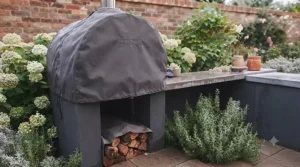
Common Mistakes When Buying a Built-In Wood-Fired Pizza Oven
The pitfalls here are remarkably consistent across manufacturers and price points, and nearly all of them are avoidable with a bit of upfront planning.
The most frequent mistake is buying on chamber diameter alone without checking whether the base insulation and stand are included. Several kits in this guide, including the VITCAS Casa and VITCAS Double Casa, price the oven itself competitively but leave the ceramic fibre board and any decorative render as separate purchases — buyers who don’t budget for these end up with an oven that underperforms on heat retention until they retrofit properly.
A close second is underestimating flue requirements. It’s tempting to treat the chimney as an afterthought, but an undersized or too-short flue causes persistent smoke problems that no amount of fiddling with the fire will fix. Always check the manufacturer’s minimum specified flue height rather than assuming any stainless pipe will do.
Buyers also frequently underestimate build time and labour, particularly for anything beyond the compact tier — the VITCAS Double Casa‘s 300kg finished weight, for instance, genuinely needs two people and a solid weekend, not a Saturday afternoon.
Finally, many buyers skip curing entirely in their excitement to cook the first pizza, which is consistently the cause of early hairline cracking across every masonry and refractory oven type — patience in week one saves years of performance.
Long-Term Cost & Maintenance of a Built-In Wood-Fired Pizza Oven
Total cost of ownership for a built-in wood-fired pizza oven breaks down into three buckets: the initial kit and base materials, ongoing fuel, and periodic maintenance.
Initial costs vary widely across this guide, from around £500 for the compact VITCAS Casa to nearly £2,900 for a top-spec Fuochino Strada build — but almost every kit carries hidden extras worth budgeting for upfront: ceramic fibre insulation board, render, and a proper base or stand can add anywhere from £100 to several hundred pounds depending on the kit’s starting specification.
Fuel costs are genuinely modest once you’re established. Kiln-dried hardwood logs, bought in bulk, typically work out cheaper per cooking session than a gas bottle refill for a portable oven, and a well-insulated chamber’s residual heat means a single firing can cook a full evening’s worth of pizzas plus a next-morning loaf of bread — squeezing more value from every load of logs.
Maintenance costs are low but not zero: expect to replace door seals or thermometers every few years, touch up render annually, and occasionally re-point mortar joints on brick-built ovens after a decade of thermal cycling. Compared with a gas or electric appliance with moving parts and a control board to eventually fail, a well-built masonry oven is a remarkably low-maintenance, long-lifespan investment — provided the insulated chamber and flue were specified correctly from day one.
Safety, Regulations & Chimney Flue Compliance Guide
Before you commit to a fixed installation, it’s worth understanding the two regulatory areas that actually apply to a garden pizza oven in the UK: smoke control and planning permission.
On smoke control, the good news for most buyers is straightforward: outdoor pizza ovens are generally treated differently from a chimney venting a building. As Oxford City Council’s smoke control guidance confirms, outdoor barbecues, chimineas, garden fireplaces and pizza ovens remain usable within a smoke control area, provided they don’t release smoke through the chimney of an actual building such as a summerhouse. In other words, a free-standing built-in oven in an open garden position is very unlikely to run into smoke control restrictions, but routing a flue through a roofed garden building changes that picture.
On planning permission, a built-in oven is usually treated as an ancillary garden structure rather than a building requiring its own consent, but this depends heavily on size, position, and whether it’s incorporated into a larger outbuilding. It’s always worth a quick check of current permitted development rules for your specific setup before finalising a design, particularly if the oven’s forming part of a covered outdoor kitchen structure rather than standing freely in the open.
On the practical safety side: always position the finished oven at a safe distance from fences, overhanging branches and boundary structures, fit a spark guard if cooking near anything flammable, and never leave an active fire unattended near children or pets — the fibreglass “cool wall” construction used on the Fuochino Neo Forni is a genuinely useful safety feature in households where that’s a real concern.
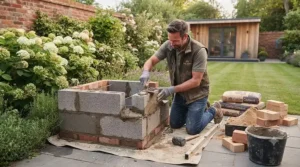
Frequently Asked Questions
❓ Do I need planning permission for a built-in wood-fired pizza oven?
❓ How hot does a built-in wood-fired pizza oven get?
❓ What's the difference between a built-in and a portable wood-fired pizza oven?
❓ Can a built-in wood-fired pizza oven be installed indoors?
❓ How long does an insulated chamber take to heat up before cooking?
Conclusion
A built-in wood-fired pizza oven isn’t a purchase you make lightly, and this guide has hopefully made clear why: you’re not comparing gadgets, you’re comparing small permanent structures, each with its own approach to insulation, chamber size, and flue design. The good news is that genuinely solid options exist at every budget — the compact VITCAS Casa and VITCAS-S Outdoor Clay Firebrick Pizza Oven prove you don’t need a huge garden or a huge budget to start cooking properly, while the VITCAS Double Casa and VITCAS-L Brick Outdoor Pizza Oven scale that same reliable construction up for families who entertain regularly.
For anyone chasing either tradition or design polish, the VITCAS Pompeii 120 DIY Kit and Fuochino Neo Forni sit at opposite ends of the same premium tier — one leaning into the classic dome build, the other into a modern, low-maintenance finish. And for households whose outdoor kitchen ambitions might genuinely grow into small-scale catering, the Fuochino Strada range’s scalability makes it worth a proper look before you commit to a fixed size.
Whichever tier you land on, the details that matter most rarely appear in bold on the product page: insulation depth, flue length, and a properly cured first month of use. Get those right, and a built-in wood-fired pizza oven should comfortably outlast the outdoor kitchen you build it into.
✨ Found the Right Oven for Your Garden?
🔍 Check current pricing and availability on any of the ovens above before you finalise your outdoor kitchen build — stock and prices shift, so it’s worth a last look before ordering.
Recommended for You
- 7 Best Wood-Fired Pizza Ovens Under £300 in 2026
- Wood-Fired Pizza Oven UK 2026: 7 Best Picks
- 7 Best BBQ for Summer Parties in 2026 (Honest UK Guide)
Disclaimer: This article contains affiliate links. As an Amazon Associate, I earn from qualifying purchases. If you purchase products through these links, we may earn a small commission at no additional cost to you.
✨ Found this helpful? Share it with your friends! 💬🤗
