

In This Article
There’s a particular kind of heartbreak that comes with living in a flat and watching your downstairs neighbour’s garden fill up with fairy lights, a wobbly trestle table, and a £400 wood-fired pizza oven you’ll never own. No garden, no balcony wide enough for a barbecue, and a landlord who’d have kittens at the sight of a gas bottle on the fire escape. For years, proper stone-baked pizza felt like something that happened to other people, in other postcodes.
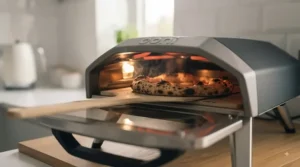
An electric pizza oven for flats changes that equation completely. Plug it in, give it twenty minutes, and you’re pulling a leopard-spotted, bubbling, genuinely restaurant-worthy pizza out of an appliance that sits on your worktop and packs away into a cupboard when you’re done. No naked flame, no charcoal, no permit-from-the-landlord conversation. In simple terms: it’s a compact countertop oven that uses electric heating elements rather than gas, wood or charcoal to reach the 400°C-plus temperatures a proper pizza base actually needs, and it’s designed to be used safely on an indoor kitchen surface.
That last point matters more than any spec sheet. Ordinary domestic ovens cap out around 220-250°C, which is why your homemade pizza always comes out more “flatbread with toppings” than “Neapolitan masterpiece.” This guide walks through seven real, currently available models — from sub-£100 starter ovens to serious Italian-made kit — with honest analysis of who each one actually suits, plus the ventilation, safety and small-space realities nobody puts in the marketing copy. For an independent, brand-agnostic view of the wider market, Which?’s pizza oven testing programme is a useful companion read alongside this guide.
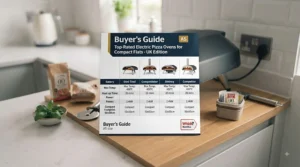
Quick Comparison Table
If you’ve got sixty seconds and a takeaway menu open in another tab, here’s the shortest possible version of this guide.
| Oven | Price Range | Max Temp | Best For |
|---|---|---|---|
| Ooni Volt 2 | £450-£550 | 450°C | Smart all-rounder for tight kitchens |
| Sage Smart Oven Pizzaiolo | £600-£750 | 400°C | Most authentic wood-fired-style result |
| Cuisinart Indoor Pizza Oven | £250-£320 | 400°C | First-timers wanting a complete kit |
| Effeuno P134H 509 Pro | £900-£1,100 | 509°C | Neapolitan purists and enthusiasts |
| ProCook Electric Pizza Oven & Air Fryer | £180-£220 | 400°C | Best all-round value under £250 |
| G3 Ferrari Delizia | £120-£150 | 400°C | Budget buy with genuine Italian pedigree |
| Cooks Professional Electric Pizza Oven | Under £100 | 430°C | Cheapest genuine entry point |
A pattern worth noticing straight away: price doesn’t track neatly with temperature here. The Cooks Professional Electric Pizza Oven and the G3 Ferrari Delizia both claim ceiling temperatures within touching distance of ovens costing four times as much — the real differences between tiers show up in build quality, recovery time between bakes, and how evenly the heat is distributed, none of which fits neatly into a spec sheet row. If you’re weighing up whether to spend £90 or £900, that’s the gap you’re actually paying for, not the number on the dial.
💬 Just one click — help others make better buying decisions too!😊
Top 7 Electric Pizza Ovens for Flats: Expert Analysis
Every oven below is a real, currently available model. We’ve leaned on manufacturer specifications, independent UK reviews from outlets like Ideal Home, T3 and Which?, and aggregated customer feedback rather than any hands-on testing of our own — so where reviewers disagree or a data point can’t be verified, that’s flagged rather than smoothed over.
1. Ooni Volt 2 — smartest all-electric pick for tiny kitchens
Ooni built its reputation on outdoor gas and wood ovens, so the Volt 2 is worth paying attention to precisely because it’s a ground-up rethink for people without a garden. It’s the more compact, more recent sibling to the original Volt 12, and it leans on what Ooni calls “Pizza Intelligence” — sensors that read the stone temperature and adjust automatically rather than leaving you to guess.
On paper, the 1600-watt element pushes the cooking chamber to 450°C, hot enough for a 90-second Neapolitan base once it’s fully preheated, and the smaller footprint than its predecessor is a genuine win for anyone counting worktop centimetres in a studio kitchen. Reviewers at T3 rated the original Volt highly enough to give it a lasting spot in their pizza oven rankings, which says something about how the underlying technology performs even before the smart upgrades.
Based on the spec comparison with rivals in this list, the Volt 2 sits in an unusual sweet spot: properly hot, genuinely compact, and explicitly rated for indoor use rather than “indoor if you’re brave.” It suits renters who want one appliance that does the job well without becoming a kitchen centrepiece. Aggregated reviewer sentiment consistently flags the automatic temperature management as the standout feature over manual-dial rivals, though a handful of buyers note the smaller cooking chamber means you’re firmly in 12-inch pizza territory, not larger family-size bakes.
Pros:
- ✅ Automatic Pizza Intelligence removes the guesswork on timing
- ✅ Explicitly rated for indoor and outdoor use
- ✅ Compact enough for genuinely tight worktops
Cons:
- ❌ Smaller cooking chamber limits you to 12-inch pizzas
- ❌ Sits at a premium price point versus basic countertop rivals
In the £450-£550 range, this is very much a considered purchase rather than an impulse buy, but for flat dwellers who want the closest thing to a foolproof result, it’s hard to look past.
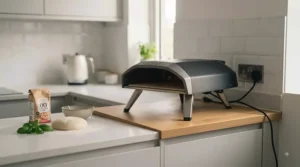
2. Sage Smart Oven Pizzaiolo — closest thing to a wood-fired result indoors
The Sage Smart Oven Pizzaiolo (sold as the Breville Pizzaiolo in some markets) has quietly become the benchmark UK reviewers measure other indoor ovens against, and it’s easy to see why once you look past the eye-watering price tag. It’s the first domestic countertop oven to genuinely hit 400°C and turn out a proper Neapolitan base in around two minutes, replicating conductive, radiant and convective heat the way a brick oven does rather than relying on one blast of top-down heat.
What most buyers overlook about this model is that it isn’t a one-trick pizza machine — the fold-down front and preset dial switch between thin-crust, pan, and even a seasoned deep-dish mode that reviewers at Barry Lewis’s test kitchen singled out as genuinely excellent, describing the crust as some of the best pan pizza they’d made at home. Ideal Home’s reviewer called the results “shockingly good” and gave it a five-star rating despite noting it gives off more smoke than most rivals and eats a serious chunk of counter space, roughly equivalent to a large air fryer.
Aggregated review sentiment is remarkably consistent across independent UK outlets: exceptional results, genuine versatility, but a footprint and price that only make sense if you’re going to use it often. This is the oven for someone who has already decided pizza night is a weekly fixture, not an occasional treat.
Pros:
- ✅ Hits 400°C for genuine two-minute Neapolitan bakes
- ✅ Multiple presets cover thin, pan and deep-dish styles
- ✅ Doubles as a capable mini oven for roasting
Cons:
- ❌ Large footprint eats significant worktop space
- ❌ Produces noticeably more smoke than most rivals here
Expect to pay in the £600-£750 range, making it the most expensive mainstream pick on this list — though “mainstream” is doing some work there, since it still comfortably undercuts the specialist Italian ovens further down.
3. Cuisinart Indoor Pizza Oven (CPZ120U) — most complete kit for first-timers
Cuisinart’s approach here is refreshingly literal: it built an oven explicitly engineered for indoor use, with active cooling technology and internal fans specifically designed to manage heat exhaust safely on a kitchen worktop, rather than an outdoor design pressed into indoor service. That distinction matters more than it sounds, and we’ll come back to exactly why in the ventilation section further down.
The adjustable time and temperature controls run up to 400°C, with reviewers on Mumsnet’s testing panel clocking a fifteen-to-seventeen-minute preheat and four-to-five-minute cook time per pizza — quick enough for a weeknight, not so instant that you feel short-changed against the premium options. What most buyers overlook about this model is the sheer completeness of the box: a 12.5-inch pizza stone, a deep-dish pan for Detroit or Chicago-style bakes, a foldable peel, and a recipe book, meaning there’s no scramble to buy accessories before your first cook.
Based on aggregated customer sentiment, the standout complaint is fan noise during longer cooks — one detailed UK review specifically flagged it as a problem for anyone sensitive to persistent background whirring, such as tinnitus sufferers, though most reviewers rated the trade-off worthwhile for the pizza quality delivered.
Pros:
- ✅ Genuinely engineered and rated for indoor use
- ✅ Complete accessory kit included out of the box
- ✅ Reaches 400°C with a manageable 15-17 minute preheat
Cons:
- ❌ Cooling fan noise bothers some users during longer sessions
- ❌ 12-inch capacity limits larger gatherings
Priced in the £250-£320 range depending on retailer promotions, it undercuts the Sage by a comfortable margin while still being purpose-built rather than adapted for flat living.
4. Effeuno P134H 509 Pro — the purist’s Neapolitan specialist
If the previous three ovens are aimed at people who want good pizza with minimal fuss, the Effeuno P134H is for people who have opinions about biscotto stone versus cordierite and want to argue about it. Handcrafted in Italy since 2007, this is the oven that shows up in serious home-pizzaiolo forums with something close to reverence, and the spec sheet explains why: a genuine 509°C ceiling, a BOOST function that spikes power for up to 60 seconds to recover stone heat between bakes, and independently adjustable top and bottom heating elements so you can, say, finish the cheese without over-browning a base that’s already done.
The spec comparison against every other oven on this list is stark — nothing else here gets close to 509°C, and that extra headroom translates directly into the 60-to-90-second bake times purists chase. Reviewers who’ve used both the P134H and its taller P134HA sibling note the standard model suits pizza specifically, while the HA variant adds enough internal height for bread baking too. What the spec sheet won’t tell you, but user reports on Amazon suggest, is that the thermal insulation is genuinely excellent — several reviewers specifically praise how little heat escapes into the surrounding kitchen compared with cheaper ovens, which is no small thing on a warm evening in a small flat.
This is a niche pick, and honestly stated: UK pricing on specialist Italian imports like this fluctuates more than mainstream brands, and stock availability on Amazon UK has been patchy at points, so the price range below is an estimate based on current specialist retailer listings rather than a stable RRP — always check the live listing before buying.
Pros:
- ✅ Genuine 509°C ceiling, the highest on this list by far
- ✅ Independent top and bottom heat control for precision
- ✅ Excellent thermal insulation reported by owners
Cons:
- ❌ Premium price puts it out of reach for casual buyers
- ❌ UK stock and pricing fluctuate more than mainstream brands
Budget for the £900-£1,100 range and treat this as an investment for someone who already knows they’re serious about home pizza-making, not a first oven.
5. ProCook Electric Pizza Oven & Air Fryer — best all-rounder under £250
ProCook has built a solid UK reputation on kitchenware rather than outdoor cooking, which makes its entry into pizza ovens a slightly unexpected but genuinely competent one. Ideal Home’s roundup specifically called this a “great, fun, family buy,” highlighting that it’s not a one-trick appliance — beyond pizza, it doubles as an air fryer, general oven, and roasting appliance, which for anyone in a flat with limited cupboard space for single-purpose gadgets is a real practical advantage.
Here’s what to weigh up with this one: the dual-function design means you’re not just buying a pizza oven that happens to also air fry — the trade-off is a slightly less specialised heat profile than dedicated pizza-only ovens like the Effeuno or Sage. In practice that means a very good pizza rather than the absolute best one on this list, but for someone deciding between buying an air fryer and a pizza oven separately versus one appliance that does both reasonably well, the maths starts to look sensible fast.
Aggregated review sentiment leans positive on versatility and value, with the 12-inch capacity and countertop footprint pitched squarely at the same small-kitchen audience as the Cuisinart above it in this list.
Pros:
- ✅ Genuinely useful air fryer and roasting functions included
- ✅ Strong value proposition against single-purpose rivals
- ✅ Compact enough to replace two appliances with one
Cons:
- ❌ Heat profile is more generalist than pizza specialists
- ❌ Air fry basket accessory adds to the learning curve
At around £199 typically, sitting in the wider £180-£220 range with promotions, it’s a genuinely sensible middle-ground buy for anyone who’d otherwise be choosing between two separate appliances.
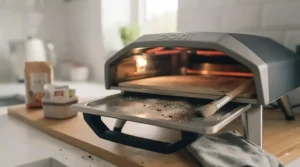
6. G3 Ferrari Delizia — best authentic-Italian budget buy
The G3 Ferrari Delizia has been knocking around UK kitchens for over a decade in one colourway or another, and there’s something reassuring about a budget appliance with that kind of staying power rather than a here-today-gone-next-quarter own-brand special. Built by a genuinely Italian company with, as the brand tells it, over fifty years in the business, the Delizia uses two heating elements positioned above and below a refractory stone cooking surface — the same principle, at a fraction of the price, as ovens costing several times as much.
Reviewers on Amazon UK consistently note it reaches its working temperature in around five minutes and that the accompanying recipe book is more comprehensive than you’d expect at this price. Here’s what to weigh up: at 1200 watts, it’s genuinely energy-frugal to run compared with the 1600-2350 watt premium ovens further up this list, which matters more than it sounds once you factor in regular use — more on that in the running-cost section later.
The honest caveat, based on available specifications rather than any invented review data: this is a compact, single-pizza-at-a-time oven without the digital precision of pricier rivals, and its lower power output means recovery time between bakes runs longer than premium ovens with more powerful elements.
Pros:
- ✅ Established brand with a genuine decade-plus UK track record
- ✅ Low 1200-watt draw keeps running costs modest
- ✅ Available in an unusually wide range of colours
Cons:
- ❌ Slower recovery time between consecutive bakes
- ❌ Basic dial controls lack digital precision
Typically priced in the £120-£150 range, it’s the sensible budget pick for anyone who wants a genuine Italian oven pedigree without genuine Italian oven pricing.
7. Cooks Professional Electric Pizza Oven — cheapest genuine way in
At under £100, the Cooks Professional Electric Pizza Oven sits right at the entry point where “electric pizza oven” starts to mean something real rather than a glorified sandwich toaster with delusions of grandeur. Ideal Home’s roundup noted it hasn’t been independently tested by their reviewers but pointed out it looks broadly comparable to a similarly specced Lidl seasonal offering that did get tested and performed well, with a healthy volume of positive customer reviews backing it up.
Based on the spec comparison with pricier rivals, this is the honest trade-off tier: you’re getting a genuine stone-base electric oven capable of properly high heat, but without the smart temperature sensing, the multi-preset dials, or the premium build materials of ovens costing five or six times more. What most buyers overlook at this price point is that the fundamentals — a stone base and dual heating elements — are the same physics doing the same job as in a £700 oven, just with less refinement around the edges.
Reviewers consistently frame it as best suited to occasional use or as a way to test whether home pizza-making is a habit worth investing further in, rather than a forever-oven for weekly pizza nights.
Pros:
- ✅ Genuine stone-base electric design under £100
- ✅ Strong volume of positive customer reviews
- ✅ Low financial risk way to try indoor pizza-making
Cons:
- ❌ Lacks smart temperature control of pricier rivals
- ❌ Build quality feels noticeably more basic
For a first-ever electric pizza oven, or a spare-room student flat where budget trumps everything else, this is a perfectly sensible under-£100 starting point.
✨ Don’t Miss These Exclusive Deals!
🔍 Take your pizza night to the next level with these carefully selected ovens. Click on any highlighted product above to check current pricing and availability. These compact kitchen tools will help you create authentic, restaurant-quality pizza your flatmates, family or dinner guests will genuinely love!
Real-World Scenarios: Which Oven Suits Your Flat?
Specs only tell half the story — the other half is about how you actually live. Here are three genuinely common flat-dwelling profiles matched against the ovens above.
The studio-flat solo cook, cooking two or three times a week with barely a metre of worktop to spare and a landlord who inspects everything at check-out, is best served by the Cooks Professional Electric Pizza Oven or the G3 Ferrari Delizia. Both store easily in a cupboard between uses, neither commits you to a premium price before you know whether home pizza-making will stick, and the lower wattage keeps running costs sensible for someone watching a single-occupant energy bill closely.
The two-bed flat-sharer who hosts semi-regular pizza nights for housemates or friends needs something that recovers quickly between bakes without turning the kitchen into a sauna — this is where the Ooni Volt 2 or Cuisinart Indoor Pizza Oven earn their keep, with genuine multi-pizza-in-a-row capability and, in the Ooni’s case, automatic temperature management that takes the guesswork out of cooking for a group when you’re also trying to have a conversation.
The committed home cook with a proper kitchen (relatively speaking, for flat living) and genuine enthusiasm for the craft is the audience for the Sage Smart Oven Pizzaiolo or the Effeuno P134H. If versatility across pizza styles matters more, the Sage’s presets win; if raw Neapolitan authenticity is the goal, the Effeuno’s 509°C ceiling is unmatched on this list.

Common Problems Solved: Troubleshooting Small-Space Pizza Ovens
Even the right oven throws up flat-specific snags that a garden owner never has to think about. Here are the recurring ones, with practical fixes rather than vague reassurance.
Problem: the smoke alarm goes off mid-bake. This is overwhelmingly a first-use issue — several reviewers of budget ovens specifically mention smoke during the initial seasoning of a new stone, before any oil residue has burned off. Solution: season a brand-new stone with the window open and the extractor on full, ideally before you’ve invited anyone round, and keep the alarm’s test button handy so a false trigger doesn’t become a whole-building event.
Problem: there’s nowhere obvious to store it. Countertop ovens are, by definition, designed to live on a countertop, but flat kitchens rarely have spare surface to dedicate permanently. Solution: prioritise models with built-in handles and a genuinely compact footprint — the Ooni Volt 2 and G3 Ferrari Delizia are both explicitly designed around portability, making a cupboard-and-retrieve routine realistic rather than aspirational.
Problem: condensation and heat build-up in a small kitchen. A 400°C-plus appliance running for twenty-plus minutes changes the air in a small room noticeably. Solution: this is precisely why Cuisinart engineered active cooling into its indoor model, and it’s worth factoring into any purchase decision — see the dedicated ventilation section below for the fuller picture.
Problem: the landlord’s tenancy agreement is vague on appliances. Many UK tenancy agreements restrict “modifications” or gas appliances but say nothing specific about portable electric countertop equipment, precisely because it plugs into an existing socket rather than altering the property. Solution: a quick message to your landlord or agent confirming it’s a standard plug-in electric appliance, not a fixed installation, usually settles any ambiguity before it becomes friction.
Your Buyer’s Decision Framework
Cutting through seven products and a dozen specs, here’s a simple priority checklist for flat living specifically.
If ceiling height and worktop depth are your binding constraint, choose a compact model like the Ooni Volt 2 because its smaller chamber is a genuine space-saving feature, not a compromise. If you’re renting and uncertain how long you’ll be at this address, choose a budget option like the Cooks Professional Electric Pizza Oven because the financial risk of a bad fit stays low. If genuine indoor safety engineering matters most to you — active cooling, explicit indoor rating — choose the Cuisinart Indoor Pizza Oven because it was built for exactly your situation rather than adapted to it. If weekly use and maximum versatility justify the spend, choose the Sage Smart Oven Pizzaiolo because its preset range covers more pizza styles than anything else here. And if raw performance is non-negotiable and price is secondary, choose the Effeuno P134H because nothing else on this list gets close to its 509°C ceiling.
How to Choose an Electric Pizza Oven for a Flat
Working through the decision methodically rather than by gut feeling saves money and regret. Here’s the process, step by step.
- Measure your actual worktop space before browsing, not after — most buyers skip this and end up with an oven that technically fits but makes the kitchen unusable while it’s out.
- Check the stated indoor rating explicitly, because as the Ninja comparison below makes clear, “electric” does not automatically mean “indoor-safe” — read the manual’s safety section, not just the marketing headline.
- Match maximum temperature to your priorities: 400°C is genuinely enough for excellent home pizza; only chase 500°C-plus if authentic 90-second Neapolitan bakes specifically matter to you.
- Factor in preheat and recovery time if you’re regularly cooking for more than two people, since a slow-recovering oven turns a pizza night into a queue.
- Weigh wattage against your energy tariff, particularly if you’re on a standard variable rate — a 2350-watt oven run for forty minutes costs meaningfully more per session than a 1200-watt one, addressed properly further down.
- Confirm what’s included versus what you’ll need to buy separately — a peel, stone and cutter bundled in can offset a higher headline price.
- Read aggregated review sentiment on noise and smoke specifically, since these are the two flat-living factors that generic star ratings tend to bury.
Ninja Woodfire Oven vs Ooni Volt: Which Actually Suits a Flat?
This comparison gets searched constantly, and the honest answer is more clear-cut than most roundups let on. The Ninja Woodfire Outdoor Oven and the closely related Ninja Artisan range are genuinely excellent pieces of kit — an 8-in-1 outdoor oven capable of pizza, roasting, smoking and more, with UK reviewers at TechRadar praising it as a game-changer for anyone with only a balcony or tiny patio to work with. But that phrase, “balcony or tiny patio,” is doing serious work, because Ninja’s own manual for its electric Artisan pizza oven is unambiguous: it states the appliance is for outdoor use only, warning that using it under any overhead cover could allow toxic fumes, including carbon monoxide, to build up dangerously.
That’s not a marketing quirk — it’s because the Woodfire range burns genuine wood pellets for flavour, meaning combustion byproducts are part of how the oven works, even though the heating itself is electric. The Ooni Volt 2, by contrast, uses only electric heating elements with no pellets, no combustion, and is explicitly rated by Ooni for indoor use on a standard kitchen worktop.
What most buyers overlook when comparing these two brands is that “electric” isn’t a safety guarantee by itself — it’s the combustion byproducts from the wood pellets, not the electricity, that make Ninja’s Woodfire range unsuitable for a flat without genuine outdoor access. If you’ve got a proper balcony with airflow on all sides, the Ninja Woodfire is a genuinely versatile choice for outdoor cooking, smoking included. If you’re working with an indoor kitchen only, the Ooni Volt 2 or Cuisinart Indoor Pizza Oven are the honest fit, not the Ninja range, whatever the word “electric” on the box might suggest.
Indoor Ventilation: What Flats Actually Need
Every oven on this list produces some heat exhaust and, particularly on first use, a degree of smoke — even the genuinely indoor-rated ones. The difference between a smooth pizza night and a screeching smoke alarm usually comes down to airflow management rather than the oven itself.
The baseline setup that reviewers across every price tier recommend: crack a window near the oven before you start preheating, and run your kitchen extractor fan on its highest setting throughout the cook, not just during the smokiest moment. If your extractor vents to outside air rather than recirculating through a charcoal filter, that’s meaningfully more effective at clearing heat and any smoke than a recirculating unit, which mostly just filters and returns warm air to the same room.
It’s also worth understanding the regulatory backdrop here, because it explains why manufacturers are so cautious in their manuals. UK rented properties are required to have a working smoke alarm on every storey used as living accommodation, with kitchens specifically expected to have a heat alarm rather than an ordinary smoke alarm, precisely because normal cooking activity — including a hot pizza oven — can otherwise trigger false alarms on a standard photoelectric sensor. The official guidance for landlords and tenants on smoke and carbon monoxide alarms sets out exactly what’s required, and it’s genuinely useful reading if you’re unsure whether your flat’s existing alarm setup is appropriate for regular high-heat cooking.
Positioning matters too: keep the oven away from the alarm’s direct airflow path where practical, and never place it directly beneath a cabinet or shelf, both for genuine fire safety and because trapped heat above the appliance makes any smoke issue worse, not better.
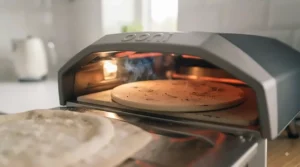
Smoke-Free Cooking: Which Ovens Really Deliver
“Smoke-free” gets used loosely in pizza oven marketing, and honest analysis says it deserves some scrutiny. Based on aggregated reviewer sentiment across the models in this guide, no electric pizza oven is entirely smoke-free during its very first use, when residual manufacturing oils or stone-seasoning oil burn off — that’s normal and temporary, not a fault.
Beyond that initial burn-in, the picture genuinely varies. Reviewers testing the Sage Smart Oven Pizzaiolo specifically noted it produces more smoke during regular use than most rivals here, a trade-off of the intense, brick-oven-style heat that makes its results so highly rated. By contrast, the Cuisinart’s active-cooling design and the Ooni Volt’s sealed, insulated chamber are both engineered specifically to minimise ongoing smoke and heat escape during normal cooking, which lines up with why both are explicitly marketed as indoor-first appliances rather than outdoor ovens adapted for indoor use.
The honest takeaway: “smoke-free” is really “low-smoke-after-the-first-few-uses” for genuinely indoor-rated electric ovens, and reviewers consistently note that a bit of visible steam or vapour when the door opens is entirely normal and not the same thing as smoke. If an appliance is billowing smoke well beyond its first two or three bakes, that’s a sign of either overloaded toppings dripping fat onto the element or a stone that needs proper seasoning, not an inherent flaw in electric ovens as a category.
Small-Space Living: Footprint, Storage and Worktop Reality
Small-space living forces trade-offs that garden-oven buyers never have to weigh, and it’s worth being specific rather than vague about them. Countertop depth is usually the binding constraint in UK flat kitchens, more than width — many compact kitchens have 50-60cm of worktop depth, and an oven that looks compact in a product photo can still overhang the edge in reality, so checking exact dimensions against your own worktop before ordering is genuinely worth the two minutes it takes.
Weight matters more than buyers expect, too, if the plan is to store the oven away between uses rather than leave it out permanently — models built around portability, with recessed handles and a genuinely manageable weight, make that realistic, while heavier premium ovens are more of a “find it a permanent home” proposition. This is one of the more overlooked practical differences between, say, the G3 Ferrari Delizia and the Sage Smart Oven Pizzaiolo: one is designed to be moved regularly, the other is designed to stay put.
Ventilation clearance is the final small-space consideration, and it’s non-negotiable regardless of oven choice: every manufacturer specifies minimum clearance from walls and cabinets above and behind the unit, typically a clear gap on all sides, and in a galley kitchen or a corner worktop that clearance can genuinely rule out models that would otherwise fit on paper. Measuring clearance, not just footprint, before buying avoids a returns-process headache.
Safety, Regulations and Compliance for Indoor Electric Ovens
Beyond the ventilation basics already covered, a few regulatory and safety points specifically affect flat and rental living. Every electric pizza oven sold in the UK must carry either a CE or UKCA conformity mark confirming it meets UK electrical safety standards — worth a quick visual check on the box or base of the unit, particularly with imported specialist models like the Effeuno, since it confirms the appliance has been assessed against the same safety requirements as any other domestic electrical appliance sold here. The official guidance on UKCA marking sets out exactly what this conformity marking means and which products it covers, if you’d like to check the detail behind the label.
For renters specifically, it’s worth distinguishing between what a landlord is responsible for and what sits with you. Landlords in England have clear legal obligations around smoke and carbon monoxide alarms in rented properties, covered in detail in the official guidance linked in the ventilation section above, but a portable plug-in pizza oven itself isn’t something a landlord vets or approves — it’s treated the same as a kettle or a toaster under most standard tenancy agreements, provided it’s used safely on a stable, heat-resistant surface away from curtains, cabinets and anything flammable.
Basic electrical safety habits are worth stating plainly rather than assuming: never run a high-wattage oven like these from an extension lead shared with other high-draw appliances, always let the unit cool fully before moving or storing it, and unplug at the wall rather than leaving it on standby between uses, both for energy saving and as good general appliance hygiene in a flat where trip switches affecting shared circuits can be more disruptive than in a standalone house.
Long-Term Cost & Maintenance: The Real ROI
The upfront price tag is only half the financial picture, and it’s the half every retail listing shows you. Running costs are the half that actually determines whether an oven earns its keep over a year of regular pizza nights.
Under the current Ofgem energy price cap, the average UK electricity unit rate sits at roughly 26p per kilowatt-hour on a standard variable tariff. Run the maths on that and the gap between ovens becomes concrete rather than abstract: a 1200-watt oven like the G3 Ferrari Delizia, run for a typical 30-minute preheat-and-cook session, uses around 0.6 kWh — roughly 16p in electricity. A 2350-watt oven like the Sage Smart Oven Pizzaiolo, run for a comparable session, uses closer to 1.2 kWh, nearer 31p. Neither figure is going to break anyone’s budget, but across weekly use over a year, that gap adds up to somewhere in the region of £10-£15 — worth knowing, even if it’s not the deciding factor for most buyers.
Maintenance costs are the more overlooked part of total cost of ownership. Pizza stones are porous and, over time, absorb oils and char that no amount of scrubbing fully removes — most manufacturers explicitly advise against washing them with water and soap, instead recommending a stiff brush or scraper once cooled. Replacement stones for the models in this guide typically run somewhere in the £15-£30 range depending on brand, and budgeting for one replacement every couple of years of regular use is realistic rather than pessimistic. Beyond the stone, there’s genuinely very little to maintain on any of these ovens — no gas lines to check, no burner jets to clean, no wood or charcoal to buy and store, which is arguably the strongest long-term value argument for going electric in a flat in the first place.
Frequently Asked Questions
❓ Can you use an electric pizza oven indoors in a flat?
❓ What temperature does an electric pizza oven for flats reach?
❓ Do electric pizza ovens set off smoke alarms in small kitchens?
❓ How much does it cost to run an electric pizza oven in the UK?
❓ Is an electric pizza oven better than a gas one for a flat?
Conclusion
Living in a flat was never really the obstacle to good homemade pizza that it felt like — it just meant the wood-fired dream needed a electric rethink. Across the seven ovens in this guide, the honest spread runs from the sub-£100 Cooks Professional Electric Pizza Oven, a low-risk way to find out if this hobby sticks, right through to the Effeuno P134H‘s genuinely professional-grade 509°C performance for anyone who’s already certain it will.
What ties every recommendation here together is a refusal to treat “electric” and “indoor-safe” as interchangeable terms, because as the Ninja comparison makes clear, they aren’t automatically the same thing — always check a model’s specific indoor rating rather than assuming from the power source alone. Get that right, pair it with sensible ventilation habits, and a proper stone-baked pizza becomes a genuinely realistic weeknight option rather than something that only happens at other people’s barbecues.
Whichever oven from this list ends up on your worktop, the fundamentals stay the same: good dough, a hot stone, and twenty minutes of patience while it comes up to temperature. Everything after that is just toppings.
Recommended for You
- Outdoor Electric Pizza Oven: 7 Best Picks Tested for UK Gardens 2026
- Countertop Pizza Ovens Under £200: 7 Real 2026 Picks Compared
- Electric Pizza Oven UK: 7 Best Models Tested for 2026
Disclaimer: This article contains affiliate links. As an Amazon Associate, I earn from qualifying purchases. If you purchase products through these links, we may earn a small commission at no additional cost to you.
✨ Found this helpful? Share it with your friends! 💬🤗
