In This Article
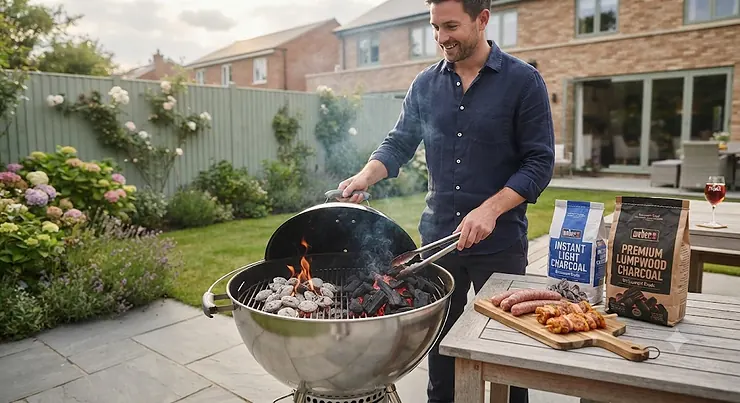
Instant light charcoal vs lumpwood is one of those debates that sounds simple until you’re standing in the garden aisle holding two bags that look almost identical, wondering why one costs half as much and lights itself. The short answer: instant light charcoal is lumpwood charcoal that’s been pre-soaked or impregnated with a paraffin-based accelerant so a single match gets it going, while plain lumpwood is just charred hardwood with nothing added, meaning it needs firelighters, a chimney starter, or some patience to get going properly.
That distinction sounds minor until you factor in taste, smoke, and what’s actually happening chemically while your food sits above the coals. Convenience charcoal has genuinely improved a lot of British barbecues that would otherwise never get lit at all — nobody’s pretending instant light is some kind of villain. But there’s a reason serious grillers and a fair few BBQ forums keep circling back to “does instant light charcoal taint the food,” and it’s not entirely folklore. This guide compares seven real, currently available charcoal products across both camps — budget to premium, instant and natural — with honest analysis of burn purity, lighting speed, and genuine value, plus a look at where firelighters and other natural lighting methods fit into the picture. According to RoSPA’s barbecue safety guidance, the lighting method matters for safety as much as flavour, so we’ll cover both angles properly.
Quick Comparison Table
Here’s the fast-scan version before the detail. All seven products below are real, currently listed charcoal products split across instant light and natural lumpwood, roughly ordered budget to premium within each camp.
| Product | Type | Best For |
|---|---|---|
| Big K Instant Light Lumpwood Charcoal (4x1kg) | Instant light | Budget convenience, quick weeknight BBQs |
| Bar-Be-Quick Instant Light Lumpwood Charcoal (13.5kg) | Instant light | Family gatherings, bulk buying |
| Big K Organic Restaurant Grade Instant Light Charcoal | Instant light | Convenience with less chemical taste |
| Big K Real Hardwood Lumpwood Charcoal (20kg) | Natural lumpwood | Budget bulk buyers who own a chimney starter |
| Log-Barn Restaurant Grade Lumpwood Charcoal (12kg) | Natural lumpwood | Large chunk, longer burns |
| Alderline Natural Restaurant Grade Lumpwood Charcoal (50L) | Natural lumpwood | Sustainable sourcing, cleaner taste |
| Kamado Joe XL Natural Reusable Lump Charcoal (9.1kg) | Natural lumpwood | Kamado owners, low-and-slow cooking |
The pattern here is straightforward once you see it laid out: instant light products cluster at the lower price point per session because convenience sells, while natural lumpwood tends to reward buying in bulk and pairing with a proper lighting method. Neither camp is universally “better” — it genuinely depends on how much you value speed versus burn purity, and whether you already own a chimney starter.
💬 Just one click — help others make better buying decisions too!😊
Top 7 Charcoal Products: Expert Analysis
1. Big K Instant Light Lumpwood Charcoal (4x1kg) — best budget instant option
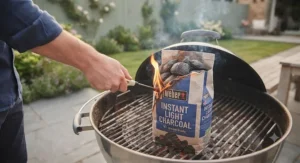
The Big K Instant Light Lumpwood Charcoal (4x1kg) is one of the UK’s most widely bought instant light products, and it’s easy to see why — the sealed bags are impregnated with a paraffin-based accelerant, so you place the whole bag in the barbecue, light the corner, and it’s typically ready to cook over in 15-20 minutes with roughly an hour of usable burn time. That single-match convenience is genuinely the entire selling point.
Based on the spec comparison against natural lumpwood, the trade-off is exactly what you’d expect: instant light charcoal carries a light paraffin odour during the first few minutes of ignition, which largely burns off before food goes on, but a few sensitive cooks still report a faint aftertaste on the first items cooked if they don’t wait long enough for full ash-over. Reviewers consistently praise the reliability and speed, particularly for spontaneous weeknight barbecues, while a recurring theme in aggregated feedback is that the lump sizes can be inconsistent — some pieces are notably smaller than others, described by more than one reviewer as “bitty” compared to premium lumpwood.
Pros:
- ✅ Genuinely one-match lighting, ready in 15-20 minutes
- ✅ Widely available and consistently priced
- ✅ Reliable performance across most standard BBQs
Cons:
- ❌ Faint paraffin odour noticeable during ignition
- ❌ Lump sizes can be inconsistent, some pieces very small
Price sits under £15 for the standard multipack at the time of research — check current pricing before you buy, as retailer offers shift often.
2. Bar-Be-Quick Instant Light Lumpwood Charcoal (13.5kg) — best for bulk family use
The Bar-Be-Quick Instant Light Lumpwood Charcoal (13.5kg) bulk pack solves the maths problem of instant light charcoal — buying single 1kg bags repeatedly gets expensive fast, so a ten-pack works out considerably cheaper per barbecue if you grill often through the summer. Each bag lights the same way as any instant light product: no separate firelighters needed, just a match to the corner.
What most buyers overlook about bulk instant light charcoal is storage — a 13.5kg box needs somewhere genuinely dry, since the accelerant-impregnated bags can be affected by damp storage over a full season, occasionally making ignition less consistent by late summer if kept in a shed prone to condensation. Aggregated review sentiment is generally strong on value and convenience for larger households or anyone hosting regularly, though a portion of reviewers flag that quality has felt slightly more variable batch to batch than the standard smaller bags, with some individual bags catching less evenly than others.
Pros:
- ✅ Strong per-bag value when bought in bulk
- ✅ No separate firelighters or accessories needed
- ✅ Ideal for households that barbecue frequently
Cons:
- ❌ Needs genuinely dry storage to stay reliable
- ❌ Some reported batch-to-batch inconsistency
Expect to pay in the £30-£40 range for the full ten-pack — always check the current price given how often bulk multipack pricing shifts.
3. Big K Organic Restaurant Grade Instant Light Charcoal (4x1kg) — best for less chemical taste in an instant product
The Big K Organic Restaurant Grade Instant Light Charcoal (4x1kg) sits in an interesting middle ground: it’s still an instant light product with an accelerant built in for one-match lighting, but it’s marketed and formulated toward restaurant-grade quality, meaning generally larger, more consistent lumps and a formulation aimed at reducing residual chemical taste versus entry-level instant light bags.
Here’s what to weigh: “restaurant grade” on an instant light product doesn’t mean chemical-free — it’s still impregnated charcoal, so purists chasing genuine burn purity should look at the natural lumpwood options further down this list instead. On paper, though, this is a sensible middle path for anyone who wants the one-match convenience but has been put off by the more noticeable paraffin taste on cheaper instant products. Reviewers frequently note improved consistency in lump size compared to standard instant light bags, with several mentioning less noticeable off-taste on the first round of food, while a smaller number remain unconvinced that any instant light product fully avoids a faint chemical edge during ignition.
Pros:
- ✅ More consistent lump sizes than standard instant light bags
- ✅ Formulated to reduce noticeable chemical taste
- ✅ Still offers full one-match convenience
Cons:
- ❌ Costs more than standard instant light charcoal
- ❌ Still not genuinely chemical-free despite “organic” naming
Pricing typically runs £12-£18 for the multipack — check the current price, as premium instant light lines fluctuate more than standard bags.
4. Big K Real Hardwood Lumpwood Charcoal (20kg) — best budget bulk natural option
The Big K Real Hardwood Lumpwood Charcoal (20kg) is pure carbonised hardwood with nothing added — no accelerant, no binder, just lump charcoal in a large bulk bag aimed at anyone who barbecues often enough to justify buying in genuine quantity. Because there’s no paraffin impregnation, it needs a proper lighting method: firelighters, a chimney starter, or an electric charcoal starter, since a single match to bare lumpwood generally won’t catch.
Based on the spec comparison with instant light alternatives, the honest trade-off here is a few extra minutes of active lighting effort in exchange for genuinely chemical-free burn purity — nothing in the smoke or ash beyond carbonised wood. Reviewers consistently highlight the value at this bulk size, with the cost per barbecue working out considerably lower than repeatedly buying instant light multipacks, while a recurring theme in feedback is variable lump sizing within the bag, which is a known characteristic of natural lumpwood generally rather than a fault specific to this brand.
Pros:
- ✅ Genuinely additive-free, pure carbonised hardwood
- ✅ Strong value per barbecue when bought in bulk
- ✅ Burns hot with minimal ash residue
Cons:
- ❌ Requires firelighters or a chimney starter to light
- ❌ Lump sizes vary noticeably within the bag
This bulk bag typically sits in the £35-£45 range — check current pricing, as 20kg bags are often subject to seasonal offers.
5. Log-Barn Restaurant Grade Lumpwood Charcoal (12kg) — best for larger chunks and longer burns
The Log-Barn Restaurant Grade Lumpwood Charcoal (12kg) is aimed squarely at buyers who’ve noticed that bigger lump sizes generally mean a longer, more controllable burn — useful if you’re cooking multiple rounds of food rather than one quick session. The restaurant-grade positioning reflects genuinely larger average chunk sizes than typical supermarket lumpwood, which matters more than it might sound for anyone doing slower cooks like whole chicken or ribs.
What the spec sheet won’t tell you, but reviewers note, is that larger lumps also mean slightly longer time to full ash-over before food should go on — patience pays off here more than with instant light charcoal, but the reward is a longer, steadier heat window once established. Aggregated feedback consistently praises the low ash and minimal spitting during cooking, both signs of genuinely well-carbonised hardwood rather than charcoal padded with off-cuts or bark, while a smaller number of reviews mention the 12kg bag can feel heavy and awkward to handle without a second person.
Pros:
- ✅ Larger chunks give longer, more controllable burns
- ✅ Low ash and minimal spitting during cooking
- ✅ Good value for catering-style or family gatherings
Cons:
- ❌ Takes longer to reach full ash-over than smaller lumps
- ❌ Heavy 12kg bag awkward to move solo
Pricing generally falls in the £18-£25 range — check current price at checkout, as multi-offer listings vary between sellers.
6. Alderline Natural Restaurant Grade Lumpwood Charcoal (50L) — best for sustainable sourcing and clean taste
The Alderline Natural Restaurant Grade Lumpwood Charcoal (50L) is produced from white alder, a fast-growing, sustainably managed hardwood, and marketed specifically around chemical-free, low-tar burn purity — genuinely relevant if flavour transfer to food is your main concern in the instant light charcoal vs lumpwood debate. The 50L bag size sits comfortably between the smaller multipacks and the heaviest bulk bags.
Based on the spec comparison with instant light options, this is close to the purist’s answer: no accelerant, no binders, and a wood source chosen partly for sustainability rather than just cost. Reviewers consistently describe the burn as clean and largely smoke-light once fully lit, with several specifically praising the absence of any chemical smell during lighting compared to instant light bags they’d previously used, while a handful note that — like most natural lumpwood — it still needs a chimney starter or firelighters to get going, so it’s not the pick if speed is your priority.
Pros:
- ✅ Sustainably sourced white alder hardwood
- ✅ Clean, largely smoke-light burn once established
- ✅ No chemical smell during the lighting process
Cons:
- ❌ Needs firelighters or a chimney starter to light
- ❌ Costs more per kilo than basic bulk lumpwood
Expect to pay in the £20-£30 range for the 50L bag — check current pricing before ordering, as sustainable-sourced lines often carry a modest premium.
7. Kamado Joe XL Natural Reusable Lump Charcoal (9.1kg) — best for kamado grills and low-and-slow cooking
The Kamado Joe XL Natural Reusable Lump Charcoal (9.1kg) is built specifically around ceramic kamado-style cookers, where genuinely long, controlled burns of up to 18 hours matter far more than instant lighting speed. It’s 100% natural lumpwood with no additives, and the “reusable” branding reflects a real practical benefit: unburned pieces left after a cook can be extinguished and reused next time rather than discarded, which meaningfully changes the cost-per-use maths over a season.
Here’s what most buyers overlook about kamado-specific charcoal: it’s generally larger and denser than standard bulk lumpwood, which matters because kamado grills rely on tight airflow control to hold low, stable temperatures for hours — smaller, inconsistent lumps burn through faster and disrupt that control. Reviewers consistently rate the burn purity and consistency highly, with several long-term kamado owners specifically noting the extended burn time as the standout benefit over cheaper lumpwood, while some feedback flags the price as a genuine premium compared to generic bulk bags, justified mainly if you actually own a kamado-style grill rather than a standard kettle BBQ.
Pros:
- ✅ Genuinely long burn times, up to 18 hours reported
- ✅ Reusable unburned pieces reduce cost-per-use over time
- ✅ Dense, consistent lumps suit precise airflow control
Cons:
- ❌ Premium pricing versus generic bulk lumpwood
- ❌ Overkill if you don’t own a kamado-style grill
This sits at the top of the range, typically £30-£45, reflecting the denser, purpose-bred lump sizing — check current price, particularly around kamado-specific retailers where it’s sometimes cheaper than on general marketplaces.
Top 7 Products: Full Specification Comparison
| Product | Type | Lighting Method | Best For | Price Range |
|---|---|---|---|---|
| Big K Instant Light Lumpwood Charcoal (4x1kg) | Instant light | Single match | Budget, speed | Under £15 |
| Bar-Be-Quick Instant Light Lumpwood Charcoal (13.5kg) | Instant light | Single match | Bulk family use | £30-£40 |
| Big K Organic Restaurant Grade Instant Light Charcoal | Instant light | Single match | Less chemical taste | £12-£18 |
| Big K Real Hardwood Lumpwood Charcoal (20kg) | Natural lumpwood | Firelighters/chimney | Budget bulk | £35-£45 |
| Log-Barn Restaurant Grade Lumpwood Charcoal (12kg) | Natural lumpwood | Firelighters/chimney | Longer, steady burns | £18-£25 |
| Alderline Natural Restaurant Grade Lumpwood Charcoal (50L) | Natural lumpwood | Firelighters/chimney | Clean taste, sustainability | £20-£30 |
| Kamado Joe XL Natural Reusable Lump Charcoal (9.1kg) | Natural lumpwood | Firelighters/chimney | Kamado, low-and-slow | £30-£45 |
Reading across the table, the instant light vs lumpwood split is really a speed-versus-purity trade rather than a quality gap. The Big K Instant Light Lumpwood Charcoal (4x1kg) and Big K Organic Restaurant Grade Instant Light Charcoal both win on convenience for anyone who barbecues spontaneously, while the Alderline Natural Restaurant Grade Lumpwood Charcoal (50L) and Kamado Joe XL Natural Reusable Lump Charcoal (9.1kg) justify their extra lighting effort through genuinely cleaner burn characteristics and, in the kamado’s case, dramatically longer usable burn time. Bulk buyers chasing pure value should note Big K Real Hardwood Lumpwood Charcoal (20kg) works out cheapest per barbecue by a clear margin.
Setting Up and Lighting Your Barbecue: Getting It Right First Time
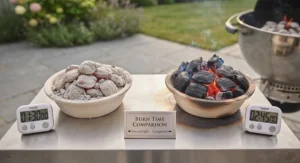
Whichever camp you land in, the first-of-season lighting mistakes are largely the same. With instant light charcoal, the most common error is impatience — lighting the bag and putting food on within five minutes, before the accelerant has properly burned off and the coals have ashed over grey. Wait until you see a consistent grey-white ash coating before cooking; this typically takes the full 15-20 minutes stated on the packaging, not less.
With natural lumpwood, the classic mistake is under-lighting: using too few firelighters or too little kindling for the volume of charcoal, resulting in patchy ignition where half the coals never properly catch. A chimney starter solves this reliably — fill it, place two firelighters underneath, and the natural chimney draught does the rest in around 15-20 minutes without any accelerant touching the charcoal directly. For either type, always light outdoors on a stable, non-flammable surface, and per gov.uk fire safety guidance, use enough charcoal to cover the base of the barbecue but not significantly more. Once finished, let coals burn down and cool fully before disposal — never bin hot ash.
Real-World Scenarios: Which Charcoal Suits Your Barbecue
The spontaneous weeknight griller who decides on a barbecue at 6pm is best served by the Big K Instant Light Lumpwood Charcoal (4x1kg) or Big K Organic Restaurant Grade Instant Light Charcoal — both deliver cooking-ready coals within 20 minutes with zero extra kit required.
The regular weekend host feeding a family or small group most weekends through summer should look at Bar-Be-Quick Instant Light Lumpwood Charcoal (13.5kg) for convenience at scale, or Big K Real Hardwood Lumpwood Charcoal (20kg) paired with a chimney starter if the slightly longer lighting time isn’t a dealbreaker and value per barbecue matters more.
The flavour-focused cook who’s noticed a faint aftertaste with instant products and wants genuine burn purity is the clearest case for Alderline Natural Restaurant Grade Lumpwood Charcoal (50L) or Log-Barn Restaurant Grade Lumpwood Charcoal (12kg) — both prioritise clean, additive-free carbonised hardwood over lighting speed.
The kamado grill owner doing genuine low-and-slow smoking sessions should go straight to the Kamado Joe XL Natural Reusable Lump Charcoal (9.1kg), since standard lumpwood or instant light bags simply aren’t dense or consistent enough to hold a controlled low temperature for many hours.
Buyer’s Decision Framework: Which Type Fits Your Situation
If speed is your absolute priority and you barbecue occasionally, choose an instant light option like the Big K Instant Light Lumpwood Charcoal (4x1kg) because one-match convenience genuinely outweighs a faint ignition smell for most casual cooks. If you’ve noticed any off-taste with instant products before, choose natural lumpwood like Alderline Natural Restaurant Grade Lumpwood Charcoal (50L) because eliminating the accelerant is the only way to fully rule out chemical taint. If cost-per-barbecue matters most and you barbecue often, choose Big K Real Hardwood Lumpwood Charcoal (20kg) paired with a reusable chimney starter, because the bulk pricing plus zero recurring firelighter cost wins over a season. And if you own a kamado-style grill, skip standard lumpwood altogether and choose Kamado Joe XL Natural Reusable Lump Charcoal (9.1kg), because purpose-bred density and reusability are built specifically for that cooking style.
Instant Light Charcoal vs Lumpwood: The Core Differences Explained
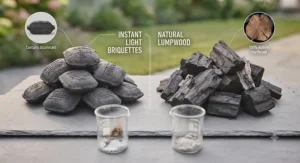
At the most basic level, both instant light charcoal and natural lumpwood start life the same way — hardwood carbonised slowly with limited oxygen until what remains is mostly pure carbon. The Briquette Wikipedia entry is a useful reference point here: while briquettes are a separate, compressed product made with binders, instant light lumpwood keeps the natural lump shape but adds a paraffin-based accelerant either soaked into the charcoal itself or contained in the outer bag material, designed to burn hot and fast enough to ignite the surrounding coals with a single match.
The practical difference that matters most to buyers is what happens during those first 15-20 minutes. Instant light charcoal burns off its accelerant during initial ignition, and by the time coals reach a proper ash-over, most of the paraffin should be fully combusted. Natural lumpwood skips that step entirely because there’s nothing to burn off — but it needs an external ignition source to get started in the first place. Neither is inherently “better” quality charcoal in terms of the wood itself; the difference is entirely in how it’s designed to be lit, and that design choice is what drives most of the taste, smell and cost differences buyers actually notice.
Instant Light Charcoal vs Firelighters: Which Actually Wins
| Method | Setup Effort | Speed to Ready | Extra Cost | Best For |
|---|---|---|---|---|
| Instant light charcoal | None — light the bag | 15-20 mins | Built into price | Convenience, spontaneous BBQs |
| Natural lumpwood + firelighters | Add 2-4 firelighters | 15-20 mins | Firelighters, ongoing cost | Slightly more control over ignition |
| Natural lumpwood + chimney starter | Fill chimney, light beneath | 15-20 mins | One-off chimney purchase | Best burn purity, reusable setup |
It’s a genuinely close race on raw speed — instant light charcoal and a well-used chimney starter both typically deliver cooking-ready coals in a similar 15-20 minute window, which surprises a lot of buyers who assume instant light must be dramatically faster. The real differentiator is what’s added to get there: instant light bakes the accelerant into the charcoal itself, standard firelighters (usually wax or paraffin-based cubes) sit separately and burn out before the coals take over, and a chimney starter uses nothing but paper and airflow. For anyone weighing instant light charcoal vs firelighters specifically, a chimney starter paired with natural lumpwood is generally the closest thing to “best of both worlds” — comparable speed to instant light, without any accelerant actually touching the charcoal.
The Lighter Fluid Taste Problem: What’s Really Happening
The lighter fluid taste some people report with instant light charcoal is real, but it’s worth understanding why it happens rather than assuming every barbecue using instant charcoal will taste of paraffin. The accelerant is designed to burn away completely during the 15-20 minute ignition window; by the time coals reach a proper grey-white ash-over, the vast majority of the volatile compounds have combusted. Where the taste problem actually originates is impatience — putting food on too early, before ignition is complete, means residual paraffin vapour is still present and can transfer to food, particularly anything with a high fat content that readily absorbs smoke and vapour.
Reviewers who’ve compared instant light and natural lumpwood side by side consistently report that waiting the full recommended time all but eliminates any noticeable off-taste, while cooking too early is the single most common cause of complaints. If you’re particularly sensitive to it, or you’ve had a bad experience before, natural lumpwood removes the variable entirely since there’s simply no accelerant present at any point in the cooking process.
Natural Lighting Methods: Chimney Starters and Chemical-Free Alternatives
For anyone wanting to avoid accelerants entirely while still lighting charcoal reliably, a handful of natural lighting methods consistently work well. A chimney starter — a metal cylinder that uses airflow and a small amount of burning paper underneath to ignite lumpwood from below — is the most popular chemical-free method and typically matches instant light charcoal for speed. Natural wood-wool firelighters, made from wood shavings and wax rather than petroleum-based accelerants, are a solid middle-ground option for anyone without a chimney starter who still wants to avoid paraffin-soaked cubes. Electric charcoal starters, which heat a coil placed among the coals until they catch, are another genuinely chemical-free option, though they need access to an outdoor power source. Whichever method you choose, per RoSPA’s guidance, never use petrol, paraffin, or other unapproved accelerants poured directly onto coals — it’s a genuine fire and burn risk, not just a taste issue.
Burn Purity: Ash, Smoke and What’s Actually in Your Charcoal
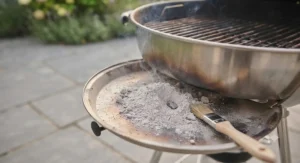
Burn purity comes down to two things: what’s in the charcoal to begin with, and how completely it combusts. Natural lumpwood, when properly carbonised, is close to pure carbon with no binders, accelerants or fillers — what you see is genuinely just charred hardwood. Instant light charcoal adds a paraffin-based accelerant, which is a petroleum derivative, though it’s specifically formulated to fully combust during ignition rather than persist through the cook. Neither type should leave meaningful residue in food once properly ashed over, but natural lumpwood removes the question entirely, which is exactly why flavour purists and professional kitchens overwhelmingly favour it.
Ash volume is a separate but related marker of purity — well-made lumpwood, natural or instant light, typically leaves relatively little ash because there’s minimal non-combustible material in the mix. Charcoal that leaves noticeably heavy ash, or visible white residue that isn’t fine and powdery, is often a sign of lower-grade wood sourcing, sometimes including bark or off-cuts rather than solid hardwood chunks — worth checking reviews for before buying either type.
Common Mistakes When Choosing BBQ Charcoal
The most common mistake is assuming instant light charcoal is automatically lower quality than natural lumpwood — in reality, premium instant light products like the Big K Organic Restaurant Grade Instant Light Charcoal use genuinely good hardwood, just with an accelerant added. The second is buying natural lumpwood without owning a reliable lighting method — a bag of pure lumpwood and a single match won’t get you anywhere, so factor in a chimney starter or firelighters as part of the purchase. The third is under-buying for the season; bulk options like the Big K Real Hardwood Lumpwood Charcoal (20kg) work out considerably cheaper than repeatedly restocking small bags. The fourth is ignoring lump size consistency — very small, dusty pieces burn through faster and less predictably than solid chunks, regardless of brand. Finally, many buyers judge charcoal purely on price per kilo without factoring in genuine burn time; a bag that lasts twice as long at 20% more cost is usually the better long-term value.
Safety Guide: Charcoal, Carbon Monoxide and Safe Lighting
Regardless of which charcoal type you choose, the core safety principles are identical and worth taking seriously. Charcoal barbecues produce carbon monoxide as they burn, and per RoSPA’s advice, a barbecue should never be used indoors or in any enclosed space such as a tent, garage, or under a covered awning, since carbon monoxide poisoning can occur without any visible warning signs. Never use petrol, paraffin, or other unapproved accelerants directly on coals beyond what’s built into an instant light product — doing so on natural lumpwood specifically is a genuine fire risk that safety bodies consistently warn against. Once cooking is finished, let the barbecue cool completely before moving or storing it, and never bring a smouldering barbecue indoors, as it continues producing carbon monoxide even after the flames are out. Dispose of cooled ash on bare soil or in a metal container, never directly into a household bin while still warm.
Frequently Asked Questions
❓ Does instant light charcoal taste different to lumpwood?
❓ Is natural lumpwood charcoal healthier than instant light?
❓ Can you light lumpwood charcoal without firelighters?
❓ How long does instant light charcoal take to be ready for cooking?
❓ Is a chimney starter better than instant light charcoal?
Conclusion
The instant light charcoal vs lumpwood decision really comes down to how much you value speed against burn purity, and whether you’re willing to own a chimney starter to get the best of both. For spontaneous, convenience-first barbecuing, the Big K Instant Light Lumpwood Charcoal (4x1kg) and Big K Organic Restaurant Grade Instant Light Charcoal deliver reliable, one-match results with only a minor taste trade-off if you wait for proper ash-over. For anyone chasing genuinely clean, additive-free burns, Alderline Natural Restaurant Grade Lumpwood Charcoal (50L) and Big K Real Hardwood Lumpwood Charcoal (20kg) deliver that purity, provided you’ve got firelighters or a chimney starter to hand. And if you’re cooking low-and-slow on a kamado grill, the Kamado Joe XL Natural Reusable Lump Charcoal (9.1kg) is in a category of its own.
Whichever direction you land on, the biggest factor in taste and safety alike isn’t actually the charcoal type — it’s patience. Wait for full ash-over, follow basic outdoor safety guidance, and either camp will serve you well through a British barbecue season.
✨ Don’t Miss These Exclusive Deals!
🔍 Take your next barbecue to the next level with these carefully selected charcoal picks. Click on any highlighted item to check current pricing and availability. Whether you value speed or pure, clean flavour, these options will help create genuinely great food your family will love!
Recommended for You
- Best Instant Light Charcoal: 7 Top UK Picks for 2026
- Restaurant Quality Briquettes for Home BBQ: 7 Best Picks (2026)
- 7 Best Long-Lasting Briquettes for BBQ in 2026
Disclaimer: This article contains affiliate links. As an Amazon Associate, I earn from qualifying purchases. If you purchase products through these links, we may earn a small commission at no additional cost to you.
✨ Found this helpful? Share it with your friends! 💬🤗
