
In This Article
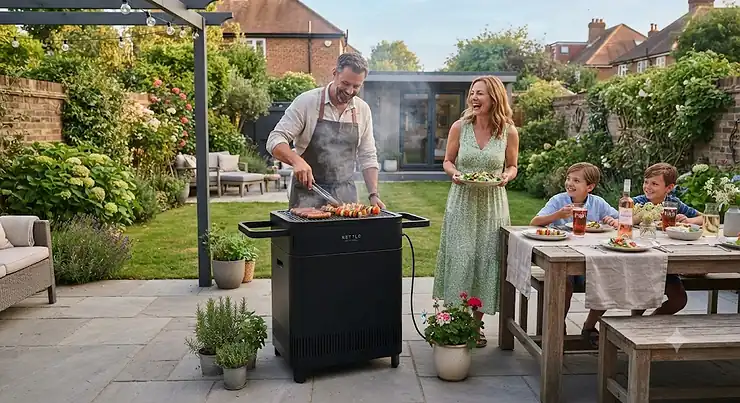
There’s a particular kind of British optimism that comes with wheeling a barbecue out of the shed the moment the sun threatens to stick around for more than an afternoon. Then comes the faff: the charcoal that won’t catch, the gas bottle that’s mysteriously empty, the smoke drifting straight into next door’s washing line. An outdoor electric bbq sidesteps all of that. Plug it in, flick a dial, and you’re grilling within fifteen to twenty minutes — no naked flame, no fuel runs, no apologising to the neighbours.

So, what is an outdoor electric bbq? It’s a barbecue grill powered by mains electricity rather than charcoal or gas, using a heating element beneath the cooking plate to sear, grill and sometimes smoke food outdoors. It’s particularly suited to flats, courtyards and smaller gardens where open flames simply aren’t practical or permitted.
This guide digs into seven genuine, currently available models — from sub-£100 freestanding grills to premium multi-function units that smoke as well as sear — based on real specifications and aggregated review sentiment from UK retailers and independent testers. We’ll cover garden electric barbecue options for renters and families, patio electric bbq picks for tight courtyards, and the practical electric outdoor cooking know-how that Amazon listings never quite get around to mentioning, including a nod to the RHS guidance on using electricity safely in the garden, since plugging a 2,000-watt appliance into a damp patio isn’t something to wing it on. Whether you’re after garden grilling electric convenience or simply patio barbecue solutions that won’t set off the smoke alarm, there’s a model below built for your situation.
Quick Comparison Table: Outdoor Electric BBQ at a Glance
| Model | Power | Best For | Price Range |
|---|---|---|---|
| Char-Broil Patio Bistro Cube E | Mains electric, up to 320°C | Compact balconies & city patios | Around £230 |
| Weber Lumin Compact | 2.2kW, up to 315°C | Sear, smoke, steam versatility | £350-£400 range |
| Ninja Woodfire Electric BBQ & Smoker | Mains electric + pellets | Smoky flavour without charcoal | £220-£350 range |
| Weber Q 1400 Electric | Mains electric | Classic, no-fuss grilling | Around £350 |
| Tower T14054 Standing Electric BBQ | 2200W | Budget family gatherings | Under £100 |
| George Foreman Indoor/Outdoor 22460 | Variable temp control | Beginners & small households | Under £100 |
| COSTWAY 2-in-1 Electric & Table Grill | 2000W, 2-zone | Tightest budgets | Under £80 |
Looking at the spread above, the gap between the cheapest and priciest model isn’t really about how well each one cooks a sausage — it’s about versatility and build longevity. The Char-Broil and Weber Lumin justify their higher price tags with genuine multi-function cooking (steaming, smoking, precise searing), while the Tower and George Foreman models nail the basics for a fraction of the outlay. If you’re feeding four people on a Tuesday evening rather than hosting twenty for a christening, the budget end of this table will do everything you actually need.
💬 Just one click — help others make better buying decisions too! 😊
Top 7 Outdoor Electric BBQ Models: Expert Analysis
1. Char-Broil Patio Bistro Cube E
The standout feature here is speed: this compact electric grill reaches a genuinely impressive 320°C in around 20 minutes, which puts it within touching distance of a half-decent gas barbecue. It runs on Char-Broil’s TRU-Infrared technology, distributing heat evenly across the plate rather than leaving you with the classic “scorched in the middle, raw at the edges” problem that plagues cheaper electric grills. The cube design and three-metre power cord mean it’ll happily sit on a balcony floor, a tabletop, or a paved courtyard without needing extra clearance.
Based on the spec comparison, this is the pick for anyone living somewhere a charcoal or gas barbecue simply isn’t allowed — many UK leasehold agreements and apartment blocks ban open-flame cooking outright, and this model sidesteps that restriction entirely while still delivering a proper sear. Reviewers consistently note that it maintains heat well once up to temperature, making it forgiving for first-time outdoor cooks, though the trade-off is an absence of genuine smoky flavour compared with charcoal.
Real-world testers report easy clean-up and a lid that traps heat effectively, with one tester for a major UK lifestyle title describing the set-up as “switch it on and get cooking.” A common observation across reviews is that batching similar foods together (all the sausages, then all the skewers) works better than juggling several different items at once on its single grilling surface.
Pros: fast heat-up, even cooking, very low maintenance. Cons: limited smoky character versus charcoal; needs a nearby power socket.
Available from major UK retailers including Amazon, the Patio Bistro Cube E typically sits around the £230 mark, making it a premium-tier electric BBQ that earns its price through genuine performance rather than gimmicks — solid value if you grill more weeknights than weekends.

2. Weber Lumin Compact
Weber’s first serious foray into electric grilling stands out for one reason above all: versatility. The Lumin Compact doesn’t just grill — switch the cooking plates and it’ll steam, smoke with wood chips, or sit on its lowest setting as a warming tray for guests serving themselves seconds. Drawing 2.2kW (roughly the same as a kettle), it reaches 250°C in about 12 minutes and tops out at 315°C in around 18, which is genuinely quick for an electric appliance pulling double duty as a smoker.
What most buyers overlook about this model is that it uses porcelain-enamelled cast iron grates rather than thin stamped metal, meaning it retains heat far better mid-cook and won’t drop temperature dramatically the moment you open the lid to check a chicken thigh — though Weber itself note that heat does fall away quickly if the lid is left open, so a quick peek rather than a leisurely stare is the move here. There’s no digital temperature probe; instead you’re working off an analogue gauge mounted in the lid, which feels closer to using a traditional gas barbecue than a smart appliance.
Aggregated customer sentiment on Weber’s own site and independent reviewers alike is strongly positive, with buyers praising how “easy and quick to use” it is after years of fighting with charcoal consistency. The main criticism that surfaces repeatedly is price: at £350-£400 depending on configuration, it’s a genuine investment, particularly once you factor in the optional stand.
Pros: smoke and steam functionality, excellent heat retention, near-fully-assembled out of the box. Cons: premium price; no digital temperature readout.
For renters or flat-dwellers craving the full barbecue experience without an open flame, the Weber Lumin Compact remains one of the most capable garden electric barbecue options on the UK market.
3. Ninja Woodfire Electric BBQ Grill & Smoker
Here’s the standout: this is the only model in our line-up that genuinely tackles the “but electric doesn’t taste smoky” objection head-on. A built-in smoker box burns wood pellets purely for flavour rather than fuel, meaning a single scoop infuses a proper woodfired character into anything from corn-on-the-cob to a full rack of ribs, all while the main cooking is still handled by electricity. Across its seven functions — grill, smoke, air fry, roast, bake, reheat, dehydrate — it behaves less like a barbecue and more like an outdoor multi-cooker that happens to live in your garden.
In practice, this means a single appliance can replace a barbecue and a portable air fryer, which matters if storage space is at a premium. The cooking plate measures 37 x 28cm, generous enough for eight burgers or two racks of ribs, and the unit ships with an RCD safety plug along with IPX4 weather resistance, so it’s been built with British drizzle specifically in mind rather than retrofitted for it.
Reviewers and Amazon customer feedback repeatedly flag the smoky flavour as a genuine surprise for an electric appliance, with several noting it’s “easy to clean and store” after use. A recurring minor gripe is the power switch’s awkward placement underneath the unit, and the lack of a built-in cover means a separate weatherproof cover (sold separately) is worth budgeting for if it’s living outside year-round.
Pros: genuine smoky flavour, seven cooking functions, weather-resistant build. Cons: power switch placement is fiddly; pellets are an ongoing consumable cost.
Pricing has fluctuated since launch, with the standard OG701UK seen anywhere from around £220 to £350 depending on retailer and bundle — always check current price, as third-party sellers and Amazon-exclusive variants carry different inclusions.
4. Weber Q 1400 Electric
If the Lumin is Weber’s clever, do-everything sibling, the Q 1400 is the no-nonsense original: a classic electric barbecue built around a single job, done properly. Its porcelain-enamelled cast iron grate covers a 43 x 32cm cooking surface, paired with a rapid-heating element that gets to temperature noticeably faster than budget electric grills relying on thinner heating coils.
The real-world meaning of that cast iron grate is consistency — rather than hot spots and cool patches, food cooks evenly across the whole surface, which is the single biggest complaint levelled at cheaper electric BBQs. A removable catch pan handles drips without the greasy mess that builds up under freestanding grills lacking proper drainage, and the 6-foot power cord gives genuine flexibility for positioning away from the house.
What most buyers overlook here is that, unlike the Lumin, the Q 1400 doesn’t try to be a smoker or a steamer — and for plenty of households, that simplicity is the appeal rather than the limitation. Reviewers comparing it directly against the Lumin and the Ninja Woodfire note it sits as a straightforward middle-ground option: pricier than budget freestanding grills, but considerably simpler to operate than its more feature-packed Weber sibling.
Pros: even heat distribution, sturdy cast iron build, simple controls. Cons: no smoking or steaming function; similar price to more versatile rivals.
Sitting in the £350 range, the Q 1400 makes most sense for buyers who’ve already decided they want a reliable, fuss-free electric grill and have no interest in extra cooking modes.
5. Tower T14054 Standing Outdoor/Indoor Electric BBQ
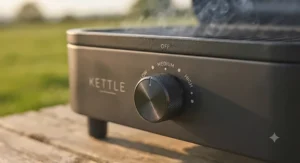
This is where budget buyers should start looking. The Tower T14054 runs at 2200W and uses what Tower calls its Cerasure+ non-stick coating, which the brand claims is three times stronger than conventional non-stick surfaces — in practical terms, that means less oil needed for cooking and considerably less scrubbing afterwards. Three heat settings are controlled via simple dial with an indicator light confirming when the grill’s reached temperature, removing the guesswork that comes with unmarked dials on cheaper models.
The genuinely clever bit of design here is that it’s freestanding with a removable stand, so the same unit works as an outdoor barbecue for a garden party or, lid and stand removed, as a flat indoor grill for a rained-off evening. An oil collection groove channels fat into a removable tray, and the whole thing disassembles for storage — useful if your shed space is, like most British sheds, already at capacity.
Aggregated customer feedback on Amazon highlights the versatility of moving between indoor and outdoor use as the standout benefit, with reviewers noting it’s “relatively easy to clean and reasonably efficient” even if it won’t deliver the deep char of a charcoal grill. The trade-off for the low price is a simpler, less premium build than the Weber models — expect plastic components alongside the stainless steel, rather than the cast iron heft further up this list.
Pros: genuinely dual-purpose indoor/outdoor design, easy-clean coating, three-year guarantee available on registration. Cons: lighter-duty build quality; basic three-setting temperature control.
At well under £100, the T14054 represents some of the best value in this entire round-up for anyone prioritising flexibility over fine-grained temperature control.
6. George Foreman Indoor/Outdoor BBQ Electric Grill (22460)
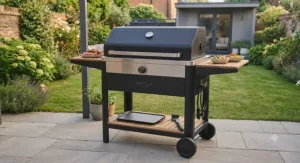
George Foreman built a household name on indoor grilling, and this model extends that pedigree outdoors with a 1,500cm² cooking surface — sizeable enough to handle a proper family-sized spread of burgers, chicken and vegetables in one sitting. A variable temperature control paired with a viewing gauge lets you dial in precise heat rather than relying on vague high/medium/low markings, and the whole unit can be used with or without its stand, switching between freestanding garden use and tabletop convenience.
Here’s what the spec sheet won’t tell you outright: removable non-stick plates make this one of the simplest models in our round-up to actually clean, since they lift straight out for a wash rather than requiring in-situ scrubbing. The drip tray is similarly removable, addressing one of the most common irritations with budget electric grills, where grease pools become a genuine chore. This matters more than it sounds, because cleaning friction is the single biggest reason cheap barbecues end up abandoned at the back of the shed after a single summer.
User feedback is mixed but broadly positive on portability and ease of cleaning, though some reviewers note that cooking larger batches back-to-back can trigger an automatic cut-off as the unit manages its own temperature, meaning patience is occasionally required between rounds. For smaller households grilling for two to four people regularly, this isn’t likely to be an issue.
Pros: large cooking surface for the price, simple variable temperature control, dishwasher-friendly removable parts. Cons: can pause between large batches; less premium materials than mid-range rivals.
Typically priced under £100, this is a strong garden electric barbecue choice for first-time buyers who want a trusted brand name without premium-tier spending.
7. COSTWAY 2-in-1 BBQ Electric & Table Grill
The lesser-known alternative on this list, and arguably the best value for genuinely tight budgets. The COSTWAY 2-in-1 runs at 2000W across a two-zone non-stick grilling plate, meaning you can run different temperatures across each half — searing on one side while gently keeping food warm on the other, a feature usually reserved for pricier models. A condiment shelf and adjustable temperature dial round out a feature set that punches well above its price point.
Based on the spec comparison against the Tower and George Foreman models, the genuine differentiator here is the dual-zone plate; it’s the only sub-£80 option in this round-up offering independent heat zones rather than a single uniform cooking surface. Like the Tower, it’s designed as a removable-stand unit, allowing indoor table use as well as outdoor patio cooking, which gives renters and students in particular a single appliance that adapts to wherever they happen to be living.
Reviewers consistently flag straightforward assembly and removable parts as highlights, with the trade-off being a lighter, less weather-hardy construction than the premium models further up this list — sensible for occasional use, less so if it’s left outdoors uncovered through a full British winter. If you cannot verify hands-on long-term durability data for a budget import brand like this, the honest takeaway is to treat it as a strong starter barbecue rather than a decade-long investment.
Pros: genuinely useful dual-zone cooking, low price, indoor/outdoor flexibility. Cons: lighter build for heavy, frequent use; limited brand track record compared with Weber or Tower.
Generally available under £80, the COSTWAY model rounds out this list as the budget pick for anyone testing whether electric grilling suits their lifestyle before committing to a pricier model.
Top 7 Products: Specs & Value Comparison
| Model | Cooking Surface | Key Feature | Best For |
|---|---|---|---|
| Char-Broil Patio Bistro Cube E | Wide single plate | 320°C in 20 minutes | Balconies & courtyards |
| Weber Lumin Compact | Twin cast iron plates | Sear, smoke, steam, warm | Versatility seekers |
| Ninja Woodfire Electric BBQ & Smoker | 37 x 28cm | 7 cooking functions + pellets | Smoky flavour without charcoal |
| Weber Q 1400 Electric | 43 x 32cm cast iron | Even, consistent heat | No-fuss reliability |
| Tower T14054 | Large, 8 chicken breasts | Indoor/outdoor 2-in-1 | Budget flexibility |
| George Foreman 22460 | 1,500cm² | Removable, dishwasher-friendly parts | Family-sized budget grilling |
| COSTWAY 2-in-1 | 2-zone plate | Independent heat zones | Tightest budgets |
Reading across this table, the clearest pattern is that smoking and steaming capability (Weber Lumin, Ninja Woodfire) commands a price premium of roughly £150-£250 over the simplest standing grills. If flavour complexity matters more to you than convenience, that premium is arguably justified; if you mainly want burgers cooked evenly without setting off a smoke alarm, the Tower or George Foreman will do the job for a fraction of the outlay.
Benefits vs Traditional Charcoal and Gas Barbecues
| Factor | Outdoor Electric BBQ | Charcoal BBQ | Gas BBQ |
|---|---|---|---|
| Set-up time | 1-2 minutes | 15-30 minutes | 5-10 minutes |
| Smoky flavour | Limited (unless pellet-equipped) | Strongest | Mild |
| Running cost | Predictable, mains electricity | Cheap per use, bulky fuel storage | Moderate, gas refills needed |
| Mess & clean-up | Minimal | Significant ash disposal | Moderate |
| Balcony/flat suitability | Generally permitted | Often banned | Often banned |
The trade-off is fairly stark once you see it laid out: electric models win comprehensively on convenience and are frequently the only legal option for balconies and many rented properties, but charcoal still wins decisively on raw smoky flavour for purists. Gas sits in the middle, offering speed without true smokiness, much like the better electric models. For most weeknight grilling and the bulk of UK garden parties, the convenience and easy clean-up of electric outdoor cooking will outweigh the flavour gap, particularly with a pellet-equipped model like the Ninja Woodfire narrowing that difference considerably.
Practical Usage Guide: Getting the Most from Your Outdoor Electric BBQ
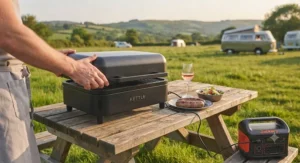
Setting up an outdoor electric bbq for the first time is mercifully simple, but a few habits in the first month make a genuine difference. Always run a visual check of the cable and plug before each use — exposure to damp grass and garden weather is harder on flex insulation than most people assume, and the Electrical Safety First guidance on garden electrics recommends using an RCD-protected socket for every single outdoor appliance, barbecues included, since a single nicked cable without RCD protection turns a minor fault into a serious shock risk.
Preheat fully before adding food rather than rushing — most of these models need their full 10-20 minutes to reach searing temperature, and adding meat too early simply steams rather than chars it, leaving you with grey, unappetising results. Clean the grill plate while it’s still warm rather than stone cold; baked-on residue lifts far more easily with residual heat than once it’s fully cooled and hardened overnight.
A common first-month mistake is overcrowding the cooking surface, which drops the overall plate temperature and extends cooking time across the board. Cook in two smaller batches rather than one cramped one, and keep a meat thermometer to hand rather than guessing by colour — a habit that pays off in both food safety and consistently better results over your first dozen cookouts.
Real-World Scenarios: Matching the Right Model to Your Life
Picture a young couple in a second-floor flat with a small balcony and a strict no-open-flame clause in their tenancy agreement. For them, the Char-Broil Patio Bistro Cube E or Tower T14054 makes obvious sense — compact, plug-and-play, and entirely compliant with most leasehold restrictions on naked flame cooking.
Now picture a family of five with a proper garden, hosting regular weekend get-togethers and keen on more adventurous cooking — smoked ribs, the occasional whole chicken. The Ninja Woodfire Electric BBQ Grill & Smoker fits that brief precisely, offering genuine smoky depth alongside enough cooking capacity for a crowd, without the multi-hour commitment a traditional offset smoker demands.
Finally, picture a retired couple downsizing from a large garden to a courtyard property, wanting reliable, simple grilling without fuss or learning curve. The Weber Q 1400 or George Foreman 22460 both deliver consistent, predictable results without the steeper feature set of pricier multi-function models — exactly the low-friction experience that suits occasional, relaxed weekend cooking.
Problem → Solution: Common Outdoor Electric BBQ Pain Points
Uneven cooking is the most frequent complaint across budget electric grills, and the fix usually lies in rotating food periodically rather than assuming the plate heats perfectly uniformly — cast iron models like the Weber Q 1400 minimise this issue structurally, but cheaper stamped-metal plates benefit from a manual turn halfway through cooking.
Limited smoky flavour frustrates buyers switching from charcoal, and short of a pellet-equipped model like the Ninja Woodfire, a simple liquid smoke marinade or smoked paprika rub closes much of that gap without needing a different appliance entirely.
Food safety is the pain point people think about least until it matters most. The Food Standards Agency’s BBQ food safety guidance notes that undercooked burgers are a particular risk since people mistakenly treat them like steak, when minced meat needs cooking all the way through; using a meat thermometer rather than judging by colour alone solves this reliably regardless of which grill you’re using.
Power cable reach catches out plenty of first-time buyers too — measure the distance from your nearest outdoor RCD-protected socket to your intended grilling spot before ordering, since most of these units ship with cables between 1.8 and 3 metres, and a cheap, poorly rated extension lead is not a safe workaround outdoors.
How to Choose the Right Outdoor Electric BBQ
- Measure your available outdoor space first, including clearance from walls and fences, since even compact electric grills need ventilation room around them.
- Decide whether smoky flavour matters enough to justify the premium of a pellet-equipped model like the Ninja Woodfire over a straightforward grilling-only unit.
- Check your tenancy agreement or building rules for any restrictions on outdoor cooking appliances, particularly on balconies.
- Confirm there’s an RCD-protected outdoor socket within reach of your cable length, or budget for a qualified electrician to install one.
- Factor in cooking surface size against your typical household or guest numbers — undersized grills mean longer, frustrating multi-batch cooking sessions.
- Weigh build materials: cast iron retains heat better than thin stamped plates but adds weight and, usually, price.
- Check for removable, dishwasher-friendly parts if low-maintenance clean-up matters more to you than ultimate searing performance.
Outdoor Electric BBQ vs Gas and Charcoal: Which Suits Your Garden?
The honest answer depends almost entirely on where you live and how often you’ll actually use it. Electric outdoor cooking wins decisively for flats, balconies, and rented properties where open-flame restrictions apply, and it edges ahead for anyone who simply wants speed and minimal mess on a Tuesday evening rather than a weekend production. Charcoal remains unmatched for genuine smoky depth and that unmistakable barbecue char, but it demands more time, more cleanup, and frequently more storage space for fuel.
Gas sits as the traditional middle ground for larger gardens, offering speed without the restrictions electric appliances avoid by design, though it shares electric’s relative shortfall on smokiness. For most suburban and urban UK households without unrestricted garden space, an outdoor electric bbq increasingly represents the pragmatic default rather than a compromise — particularly as pellet-equipped hybrid models continue narrowing the flavour gap that once made electric the clear underdog.
Common Mistakes When Buying an Outdoor Electric BBQ
Buying based purely on wattage is a frequent misstep — a higher wattage figure alone doesn’t guarantee even heat distribution if the underlying plate material is thin and prone to hot spots, so specs should always be read alongside genuine cooking surface material and reviewer feedback on consistency.
Underestimating cooking surface size relative to household needs is another common error; buyers regularly purchase compact models intended for two people, then find themselves running three or four cooking batches for a family barbecue, which defeats much of the convenience electric grilling promises.
Ignoring power cable length until after delivery causes genuine frustration — measure your actual outdoor socket distance before ordering rather than assuming “it’ll probably reach.”
Finally, skipping a cover purchase for models left outdoors year-round shortens lifespan considerably; UK weather is hard on electrical housings, and a £20-£30 cover is cheap insurance against an otherwise avoidable repair bill.
What to Expect: Real-World Performance
In day-to-day use, the gap between premium and budget electric grills shows up most clearly in consistency rather than peak temperature — most models in this round-up can sear convincingly, but cheaper units lose heat faster once food hits the plate and recover more slowly, extending overall cooking time noticeably across a full meal. Reviewers across multiple models note that closing the lid as much as possible during cooking preserves heat far more effectively than constantly checking progress, a habit borrowed naturally from gas grilling but easy to forget on a first outing.
Cleaning realistically takes five to fifteen minutes depending on model, with removable plates and drip trays cutting that time roughly in half compared with fixed, in-situ cooking surfaces. Expect genuinely faster startup than charcoal across the board — typically under twenty minutes from plug-in to cooking-ready, versus thirty-plus minutes for charcoal to reach a stable, ash-grey cooking state.
Long-Term Cost & Maintenance
Running cost on an outdoor electric bbq is more predictable than gas or charcoal, since you’re paying a known electricity rate rather than fluctuating fuel prices, though the upfront unit cost for premium multi-function models is noticeably higher. A typical hour-long cook on a 2kW model costs a small handful of pence at current UK domestic electricity rates, making running costs genuinely negligible compared with the unit’s purchase price over its lifespan.
Maintenance largely comes down to keeping the heating element free of grease build-up and storing the unit somewhere dry between uses; models with a properRCD-protected plug, as explained in this overview of residual current devices, also benefit from an occasional test of the trip function to confirm the safety mechanism is still working correctly, particularly after a damp winter spent in storage. Expect a well-maintained mid-range model to last five to eight years with reasonable care, while budget units may need replacing closer to the three-to-five-year mark, particularly if left exposed to the elements without a cover.
Safety, Regulations & Compliance Guide
Every outdoor electric bbq should be used on an RCD-protected circuit, full stop — this isn’t optional advice, it’s the single most important safety habit for any mains-powered appliance used outdoors, where damp ground and occasional rain create genuine shock risk that simply doesn’t apply to gas or charcoal models. UK-sold electrical appliances must carry CE or UKCA marking confirming they meet relevant safety standards, and it’s worth checking for this marking on the unit or packaging before purchase, particularly with lesser-known import brands.
Position any electric grill on stable, level, non-flammable ground, away from fences, sheds and overhanging branches, and never leave it unattended while in operation, regardless of how hands-off electric cooking feels compared with tending charcoal. Keep children and pets at a sensible distance from the hot cooking surface, which can remain dangerously hot for some time after switching off, even without visible flames to signal the risk.
Garden Electric Barbecue Choices for UK Gardens and Renters
For households with a proper garden but no interest in charcoal mess, a garden electric barbecue offers genuine middle ground — enough cooking capacity for family gatherings without the ash disposal, fuel storage, or fire risk management that charcoal demands. The Tower T14054 and George Foreman 22460 both suit this use case particularly well, offering freestanding garden positioning with the option to bring the grill plate indoors when British weather inevitably interrupts an evening cookout.
Renters in particular benefit from garden grilling electric setups precisely because most tenancy agreements that ban gas and charcoal barbecues — citing fire risk to shared structures — have no equivalent restriction on electric appliances, provided there’s safe, RCD-protected access to an outdoor socket. This single distinction explains much of the recent growth in electric barbecue sales across UK rental and leasehold properties.
Patio Electric BBQ: Footprint and Solutions for Tight Spaces
A patio electric bbq genuinely lives or dies on footprint, since courtyards and paved areas rarely offer the generous clearance a full-sized charcoal kettle barbecue demands. The Char-Broil Patio Bistro Cube E and COSTWAY 2-in-1 both address this directly with compact, often stand-removable designs that tuck against a wall or fold down for storage between uses.
For genuine patio barbecue solutions where space is at an absolute premium, prioritise models offering a removable stand over fixed-leg designs, since the flexibility to switch between tabletop and freestanding use effectively doubles your usable configurations without needing two separate appliances. Pairing a compact electric grill with a small folding table solves the prep-space problem that often catches patio cooks out, particularly when juggling raw and cooked food without a dedicated worksurface nearby.

Frequently Asked Questions
❓ Can I use an outdoor electric bbq on a balcony?
❓ Is an outdoor electric bbq as good as charcoal for flavour?
❓ How much does it cost to run an outdoor electric bbq?
❓ Do I need a special socket for an outdoor electric bbq?
❓ How long does an outdoor electric bbq take to heat up?
Conclusion: Finding Your Perfect Outdoor Electric BBQ
There’s no single “best” outdoor electric bbq, only the right match for your space, budget and how seriously you take your weekend grilling. If you’re working with a balcony or rented flat, the Char-Broil Patio Bistro Cube E or Tower T14054 solve the open-flame restriction problem outright. If smoky depth genuinely matters to you, the Ninja Woodfire Electric BBQ Grill & Smoker closes that gap further than any other model here. And if you simply want reliable, no-fuss grilling without learning a new system, the Weber Q 1400 or George Foreman 22460 deliver exactly that.
What unites every model on this list is the core promise of electric outdoor cooking: less faff, less mess, and considerably more spontaneity than waiting for charcoal to catch on a rare sunny Tuesday. Whichever model you land on, prioritise RCD-protected power, sensible positioning away from anything flammable, and a proper cover if it’s living outdoors year-round — the rest is just deciding how many burgers you realistically need to fit on the plate at once.
✨ Don’t Miss These Exclusive Deals!
🔍 Take your garden grilling to the next level with these carefully selected models. Click through to check current pricing and availability before your next sunny weekend rolls around. These picks will help you create authentic barbecue memories your family and friends will genuinely love! 🍔⚡
Recommended for You
- Best Indoor Electric Barbecue for Apartment UK 2026: Top 7 Expert Picks
- Best George Foreman Alternative UK 2026: 7 Health Grills Reviewed
- Best Smokeless Indoor BBQ UK 2026: 7 Top Electric Grills Reviewed
Disclaimer: This article contains affiliate links. As an Amazon Associate, I earn from qualifying purchases. If you purchase products through these links, we may earn a small commission at no additional cost to you.
✨ Found this helpful? Share it with your friends! 💬🤗
