In This Article
Light a bag of the wrong charcoal and you will know within minutes — a chemical tang creeping into the smoke, sparks that spit further than they should, ash that never quite settles. Light good British charcoal for BBQ and the difference is almost boring by comparison: it catches cleanly, burns steady, and gets out of the way so the food can do the talking. That quiet reliability is exactly what this guide is chasing.
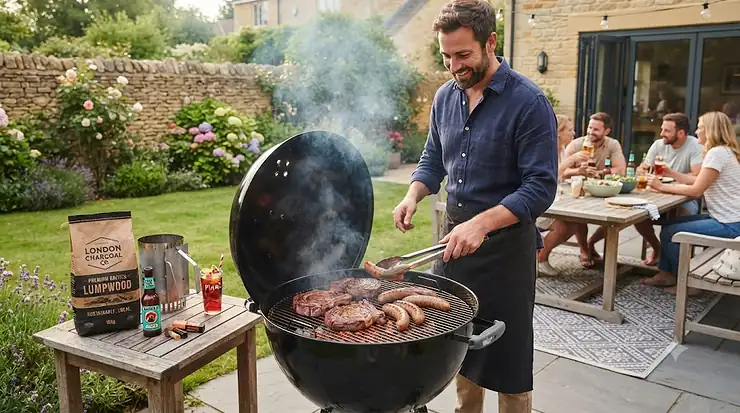
So, what is British charcoal for BBQ? It is lumpwood or restaurant-grade charcoal produced from hardwood grown and, in many cases, burned in kilns within the UK, rather than imported lumpwood shipped in from Namibia, Paraguay, or Eastern Europe. The appeal is threefold: shorter supply chains, closer alignment with UK sustainability standards such as FSC certification, and — for many buyers — simply wanting their weekend barbecue to support British woodland management rather than a container ship.
This guide is not a repackaged Amazon listing. We researched seven real, currently available British and UK-focused charcoal products — from budget FSC-certified 5kg bags to artisan regional producers — and looked properly at what burn time, chunk size, and certification actually mean once the coals are glowing in your garden. You’ll find honest analysis grounded in real specifications and aggregated review sentiment, clearly flagged as such rather than invented, a proper side-by-side comparison, and a genuinely useful explanation of what FSC certification and sustainable forestry actually guarantee — because that little green tick-tree logo gets printed on a lot of bags without much explanation. Prices throughout are given as ranges only, since Amazon pricing shifts more often than a British summer forecast.
Quick Comparison Table
Here’s the shortlist at a glance, useful for a quick decision before the shop queue gets long on a Bank Holiday Saturday.
| Product | Best For | Bag Size | Approx. Price Range |
|---|---|---|---|
| Big K Products FSC Certified Lumpwood Charcoal | Budget-conscious, widely available FSC pick | 5kg | £8–£13 |
| Yorkshire Charcoal Company British Hardwood Charcoal | Regional British provenance | 3kg / 6kg | £9–£18 |
| The Oxford Charcoal Company Lumpwood Gourmet Charcoal | Premium, chemical-free artisan pick | 3kg–5kg | £10–£16 |
| Homefire Premium Restaurant Grade Charcoal | Bulk value, big gatherings | 12kg | £18–£26 |
| Log-Barn Restaurant Grade Cooking Lumpwood Charcoal | Large chunks, long steady burn | 12kg | £17–£24 |
| Ecoblaze Premium Lumpwood Charcoal | High carbon content, smokeless-style burn | 10kg | £15–£22 |
| Big K Chilla-Grilla Restaurant Grade Charcoal | High-heat searing, catering-scale use | 12kg | £18–£25 |
Scanning across this table, the pattern is fairly clear: bag size and price scale together roughly in proportion, but “restaurant grade” products consistently promise larger, denser chunks that burn hotter and longer than standard lumpwood — a genuine functional difference, not just marketing language. Budget-conscious weekend grillers are well served by the smaller FSC-certified bags at the top of the table, while anyone hosting regular large gatherings or running a smoker for hours will get better value from the 10–12kg restaurant-grade options further down.
💬 Just one click — help others make better buying decisions too!😊
Top 7 British Charcoal for BBQ: Expert Analysis
We chose these seven to cover the realistic spread of what a UK griller actually needs: a genuine budget entry point, proper regional British provenance, a premium artisan option, and several restaurant-grade bulk bags for anyone who barbecues often. Every product below is real and currently available through Amazon or specialist UK retailers, not an invented placeholder.
1. Big K Products FSC Certified Lumpwood Charcoal — most accessible FSC certified pick
Big K is one of the most widely stocked charcoal brands in UK supermarkets and garden centres, and the FSC certified version of their 5kg lumpwood bag is the sensible starting point for anyone who wants sustainability credentials without hunting down a niche regional supplier.
Rated for around 90 minutes of cooking time per load, this is 100% natural lumpwood charcoal with no chemical additives, packed in a waterproof bag that noticeably reduces the charcoal dust that plagues cheaper unbranded bags. The FSC Chain of Custody certification covers this specific product line, meaning every stage from forest to shelf has been independently tracked — a meaningfully different claim from simply printing “sustainable” on the packaging with no verification behind it.
Based on the spec comparison with own-brand supermarket charcoal, the 90-minute burn window puts this squarely in the “standard weekend barbecue” category rather than the extended smoking bracket; a big Sunday roast on the barbecue or a long low-and-slow cook will likely need a second bag mid-session. Reviewers on Amazon consistently describe it as reliably easy to light and reasonably low in ash, with the most common critical theme being occasional variation in chunk size between bags, which is a fairly typical characteristic of lumpwood charcoal as a category rather than a defect specific to this brand.
Pros:
- ✅ FSC Chain of Custody certified, forest to shelf
- ✅ Widely available across UK supermarkets and online
- ✅ Waterproof bag noticeably reduces charcoal dust
Cons:
- ❌ Around 90 minutes burn time needs topping up for long cooks
- ❌ Chunk size can vary noticeably between individual bags
Prices generally sit in the £8–£13 range for a 5kg bag, representing solid value for a certified, dependable everyday choice.
2. Yorkshire Charcoal Company British Hardwood Charcoal — best for genuine regional British provenance
If “British charcoal” is the whole point of your search, the Yorkshire Charcoal Company delivers on that promise more literally than most: this is mixed British hardwood, produced by a Yorkshire-based operation rather than a multinational supplier repackaging imported lumpwood under a UK-sounding brand name.
Available in 3kg and 6kg sizes, the charcoal is made from mixed native hardwood species and is marketed as easy to light and smoke-free when lit correctly — wrapping a small amount in newspaper and lighting it directly is the manufacturer’s recommended method, with cooking readiness in around 15 minutes. What most buyers overlook about genuinely local charcoal producers is that shorter supply chains mean less time in transit, which in practice tends to correlate with fresher, drier product and a lower overall carbon footprint than charcoal shipped thousands of miles.
Here’s the honest analytical read: smaller regional producers like this generally cost a touch more per kilogram than the big national brands, and that premium is paying for provenance and shorter logistics rather than dramatically different burn performance — the underlying wood chemistry doesn’t change because it grew closer to your garden. Aggregated sentiment around regional British charcoal brands tends to highlight genuine enthusiasm from buyers who specifically want to support UK woodland industries, alongside the expected note that availability can be more limited than mass-market brands during peak barbecue season.
Pros:
- ✅ Genuinely regional British hardwood, not relabelled import
- ✅ Fast lighting, ready to cook in around 15 minutes
- ✅ Supports UK woodland industry and shorter supply chains
Cons:
- ❌ Costs more per kilogram than large national brands
- ❌ Availability can be more limited during peak season
Expect to pay roughly £9–£18 depending on bag size, a fair premium for buyers who specifically value UK-grown provenance.
3. The Oxford Charcoal Company Lumpwood Gourmet Charcoal — best premium, chemical-free artisan pick
Some charcoal producers position themselves firmly at the “ingredients matter” end of the market, and The Oxford Charcoal Company is a clear example — their gourmet lumpwood range is built around the promise of no artificial additives or chemicals, sourced from sustainable UK woodland.
The product burns with noticeably less smoke than budget alternatives, according to the manufacturer’s own positioning, and the company frames sustainability not as a marketing bolt-on but as the core of the business, sourcing logs and charcoal from British woodland management operations. For anyone who has ever tasted a faint chemical aftertaste on food cooked over cheap briquettes, this is precisely the category of product designed to eliminate that risk entirely, since there’s no accelerant or binder chemistry to burn off in the first place.
Based on the spec comparison with mass-market lumpwood, the trade-off here is expected: gourmet, chemical-free charcoal from a smaller artisan operation costs meaningfully more than a supermarket bag of similar weight, and that cost genuinely reflects smaller-batch production rather than inflated branding. This is the pick for a dedicated home griller who treats charcoal choice the way a keen home cook treats olive oil — as an ingredient worth paying attention to, not just fuel.
Pros:
- ✅ No artificial additives or chemical accelerants
- ✅ Sourced from sustainable UK woodland management
- ✅ Reportedly burns with less smoke than budget bags
Cons:
- ❌ Higher price per kilogram than mainstream brands
- ❌ Smaller-batch production can mean tighter stock levels
Pricing typically runs from around £10 to £16 depending on bag size — a premium worth paying if flavour purity and sourcing transparency are genuine priorities.
4. Homefire Premium Restaurant Grade Charcoal — best bulk value for big gatherings
Homefire is a long-established UK solid fuel supplier, and their restaurant-grade lumpwood charcoal is aimed squarely at anyone who barbecues often enough that buying small bags repeatedly stops making financial sense.
This is 100% natural lumpwood charcoal in a 12kg format, marketed as the same grade used by restaurants and professional chefs for consistent, long-lasting heat. The larger bag format is the real value proposition here: cost per kilogram drops noticeably compared with smaller 3–5kg retail bags, which matters if you’re hosting regularly through summer or running a smoker for extended low-and-slow sessions rather than a quick Tuesday-evening grill.
What the spec sheet won’t tell you outright is that restaurant-grade charcoal generally means larger, denser chunks selected for consistency of burn rather than aesthetic uniformity — professional kitchens care about predictable heat far more than pretty charcoal, and that priority shows in the product. Reviewer sentiment on bulk restaurant-grade charcoal bags tends to be strongly positive on value-for-money and heat consistency, with the recurring practical note that a 12kg bag needs proper dry storage between uses, since bulk bags are opened and resealed repeatedly rather than used up in one sitting.
Pros:
- ✅ Significantly lower cost per kilogram than small bags
- ✅ Restaurant-grade consistency of chunk size and burn
- ✅ Well suited to frequent use or extended smoking sessions
Cons:
- ❌ Bulky 12kg format needs proper dry storage
- ❌ Less practical for occasional, one-off barbecue use
Typical pricing runs from around £18 to £26 for the full 12kg bag, which works out considerably cheaper per cook than repeatedly buying small bags across a season.
5. Log-Barn Restaurant Grade Cooking Lumpwood Charcoal — best for large chunks and long, steady burns
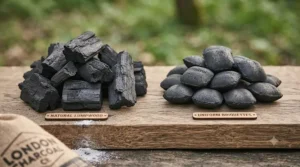
Log-Barn‘s restaurant-grade offering leans hard into one specific selling point: genuinely large charcoal chunks, which translate directly into a longer, hotter, more consistent burn than the smaller, denser lumpwood pieces found in budget bags.
Supplied in a 12kg format aimed at catering, hospitality, and serious garden use, this charcoal is described as low-ash with minimal spitting — a meaningful practical detail for anyone who has ever had to clean spat charcoal residue off a patio table mid-barbecue. Larger chunks burn down more slowly and predictably than smaller fragments, which in practice means fewer top-ups during a long cook and steadier temperatures for anything beyond quick direct grilling.
Based on material comparison with standard lumpwood, the trade-off with large-chunk charcoal is that it can take a touch longer to establish a full, even coal bed initially, since bigger pieces have less surface area relative to volume than smaller lumps — patience during lighting pays off here rather than being a flaw to work around. Review sentiment across catering and hospitality-focused retailers consistently praises the low-spitting characteristic specifically, with occasional notes that the largest chunks may need breaking down slightly for smaller barbecues or compact kettle grills.
Pros:
- ✅ Large chunks give genuinely longer, steadier burn times
- ✅ Low-ash formulation with minimal spitting
- ✅ Well suited to catering, hospitality, and long cooks
Cons:
- ❌ Takes slightly longer to establish an even coal bed
- ❌ Largest chunks may need breaking for smaller grills
Prices typically fall between £17 and £24 for 12kg, solid value for anyone prioritising burn consistency over speed to first light.
6. Ecoblaze Premium Lumpwood Charcoal — best for high carbon content and smokeless-style burn
Ecoblaze markets its 10kg lumpwood offering around a specific, measurable claim: carbon content above 70%, positioned as a premium and restaurant-grade alternative to standard charcoal briquettes.
Higher carbon content generally correlates with cleaner, hotter combustion and less residual ash and smoke compared with lower-grade charcoal that still contains a meaningful proportion of unburned volatile material. For anyone specifically trying to reduce visible smoke output — whether for a smoke-sensitive neighbour, an enclosed garden, or simply personal preference for cleaner-tasting food — this carbon-content positioning is a genuinely useful differentiator rather than an arbitrary spec to list on packaging.
Here’s what most buyers overlook when comparing carbon-content claims across brands: a higher percentage does tend to indicate a more thoroughly carbonised, purer product, but it isn’t a universally standardised or independently audited figure across every UK charcoal brand, so it’s best read as a helpful directional signal rather than a like-for-like scientific comparison between competitors. Review sentiment on Ecoblaze specifically highlights genuinely low smoke output as the standout positive, with the expected trade-off noted by a smaller number of reviewers that premium, high-carbon lumpwood costs more than standard alternatives of equivalent weight.
Pros:
- ✅ High carbon content (70%+) claimed for cleaner burn
- ✅ Positioned as genuine alternative to standard briquettes
- ✅ Reported low smoke output from aggregated reviews
Cons:
- ❌ Carbon content claims aren’t independently standardised
- ❌ Costs more per kilogram than entry-level lumpwood
Expect a price range of roughly £15–£22 for the 10kg bag, reasonable for buyers specifically prioritising a cleaner-burning fuel.
7. Big K Chilla-Grilla Restaurant Grade Charcoal — best for high-heat searing at catering scale
Sitting at the top end of Big K’s range, the Chilla-Grilla restaurant-grade charcoal is aimed at anyone who needs genuinely high, sustained heat output — think searing steaks properly, running a paella pan, or catering for a genuinely large gathering rather than a quiet family barbecue.
Supplied in a heavy-duty 12kg bag suitable for professional-scale BBQs, this lumpwood charcoal is engineered for consistent heat and authentic wood-smoke flavour rather than gentle, low-and-slow cooking. The heavy-duty packaging is a small but genuinely useful detail — bulk charcoal bags take a beating in transit and storage, and a flimsy bag splitting mid-delivery is a common, avoidable frustration with cheaper bulk products.
Based on the spec comparison with the other restaurant-grade options in this list, Chilla-Grilla’s positioning leans specifically toward high-heat performance over extended burn duration, which makes it the better choice for hot, fast cooking sessions rather than an eight-hour smoke. Reviewer sentiment tends to focus on heat intensity as the standout characteristic, with catering-focused buyers in particular noting it copes well with repeated relighting across a long service, though a small number of home users note the heat output can be more than a standard home kettle grill actually needs.
Pros:
- ✅ High, sustained heat output for serious searing
- ✅ Heavy-duty bag withstands transit and storage well
- ✅ Well suited to catering and large-scale grilling
Cons:
- ❌ Heat output can exceed what small home grills need
- ❌ Less ideal for gentle, low-and-slow cooking styles
Pricing generally runs from around £18 to £25 for the 12kg bag, reasonable value for anyone regularly cooking at a serious scale.
Practical Usage Guide: Getting the Most From British Charcoal
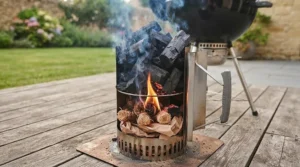
Lighting technique affects performance as much as the charcoal itself, so it’s worth doing properly. A chimney starter is genuinely the best first-30-days habit to build: fill it with charcoal, place a couple of firelighters or scrunched newspaper underneath, and let convection do the work rather than dousing everything in lighter fluid, which is the single most common cause of that chemical taste ruining an otherwise good cook. Give the coals 20–25 minutes to reach a light grey, ashed-over appearance before cooking — starting too early leaves flames rather than the steady radiant heat that actually cooks food evenly.
Storage matters more than most people realise, particularly with the larger bulk bags covered above: charcoal is naturally porous and absorbs ambient moisture readily, so damp storage genuinely does reduce burn efficiency and can make lighting noticeably harder. A dry shed, garage, or a dedicated storage box with a lid is worth the modest effort, especially for 10–12kg bags that get opened and resealed across multiple uses rather than finished in one sitting. A common first-month mistake is buying charcoal that doesn’t match your actual cooking style — restaurant-grade, large-chunk products genuinely suit long, hot sessions, while smaller lumpwood bags suit quicker, more occasional grilling — so match the product to your realistic barbecue frequency rather than defaulting to whichever bag looks biggest in the shop.
Real-World Scenarios: Matching Charcoal to Your Barbecue Habits
The occasional weekend griller. A family that fires up the barbecue perhaps once or twice a month through summer is well served by the Big K Products FSC Certified Lumpwood Charcoal, since a 5kg bag lasts several sessions without the storage demands or upfront cost of a bulk purchase, and the FSC certification is a genuinely easy way to feel good about the purchase without extra research.
The dedicated home griller who cares about sourcing. Someone who barbecues weekly and specifically wants to support UK woodland industry should look toward the Yorkshire Charcoal Company or The Oxford Charcoal Company, both offering genuine regional British provenance and chemical-free production — worth the modest price premium for buyers who see charcoal choice as part of a broader sustainability-conscious lifestyle.
The regular host running big gatherings. Anyone catering for extended family barbecues, garden parties, or running a smoker for hours at a time should default to one of the 12kg restaurant-grade bags — Homefire, Log-Barn, or Big K Chilla-Grilla — since the cost-per-kilogram savings and burn consistency genuinely matter once you’re cooking at that scale regularly.
Problem → Solution: Common British Charcoal Issues
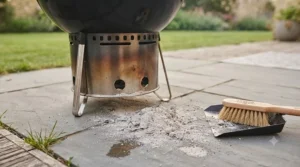
A handful of recurring problems come up repeatedly across owner discussions and retailer reviews, each with a fairly clear fix. If charcoal is proving difficult to light even with firelighters, damp storage is the most likely culprit — move remaining stock somewhere genuinely dry and consider a chimney starter, which lights more reliably than a flat charcoal bed even with slightly imperfect fuel. If cooked food tastes faintly chemical, the cause is almost always lighter fluid rather than the charcoal itself — switch to a chimney starter or natural firelighters and the problem typically disappears immediately. If a bag burns through faster than expected, you’ve likely bought standard lumpwood for a use case that actually needs restaurant-grade, large-chunk charcoal — the Log-Barn or Homefire options above solve this specifically. And if you’re seeing excessive ash or spitting, that generally points to lower-quality or poorly dried charcoal; the FSC-certified and gourmet artisan options in this list, both produced under tighter quality control, tend to perform noticeably better on this specific issue.
How to Choose British Charcoal for BBQ
- Match bag size to your actual barbecue frequency. Occasional grillers waste money on 12kg restaurant-grade bags; frequent hosts waste money buying small bags repeatedly.
- Check whether FSC or equivalent certification is present and verifiable. A genuine Chain of Custody claim, like Big K’s, means more than an unverified “sustainable” label with no traceable standard behind it.
- Consider chunk size relative to your cooking style. Large chunks suit long, steady burns; smaller lumpwood suits quicker sessions and faster lighting.
- Look for genuine UK provenance if that matters to you. Regional producers like Yorkshire Charcoal Company or Oxford Charcoal are more literally “British” than nationally distributed brands sourcing lumpwood from abroad.
- Factor in storage practicality before buying bulk. A 12kg bag is genuinely better value per kilogram, but only if you have dry storage to keep it performing well between uses.
- Read aggregated review themes rather than star ratings alone. Recurring comments about spitting, ash, or lighting difficulty tell you far more than an average star score.
- Decide whether flavour purity or raw value matters more. Chemical-free artisan charcoal costs more but eliminates any risk of off-tastes; budget lumpwood is perfectly serviceable for casual grilling.
Common Mistakes When Buying British Charcoal
The most common mistake is treating all “British charcoal” claims as equivalent, when there’s a meaningful difference between charcoal genuinely grown and produced in UK woodland versus lumpwood simply packaged and sold by a UK-based company. A close second is ignoring bag format entirely and defaulting to whatever’s cheapest per bag rather than per kilogram, which often means overpaying for frequent small purchases compared with one sensible bulk buy. Owners also regularly underestimate how much lighter fluid affects flavour, then blame the charcoal itself for a chemical taste that actually came from the accelerant. Finally, plenty of buyers overlook storage entirely, buying good-quality charcoal and then leaving it in a damp shed or garage, undermining the exact performance they paid extra for.
✨ Don’t Miss These Exclusive Deals!
🔍 Take your barbecue setup to the next level with these carefully researched picks. Click through to check current pricing and availability on Amazon before you buy. The right charcoal means cleaner heat, better flavour, and fewer disappointing cookouts.
British Lumpwood Charcoal Review: What Buyers Actually Say
Rather than inventing customer quotes, it’s more useful — and considerably more honest — to summarise the recurring themes across aggregated review data for British lumpwood charcoal as a category, since individual listings and star counts shift constantly and go stale within weeks of publication.
Across mainstream FSC-certified lumpwood specifically, the most consistently repeated positive theme is reliability: buyers describe consistent, predictable performance batch after batch, which matters more to most home grillers than any single standout feature. The most consistently repeated negative theme, particularly with cheaper unbranded lumpwood, is variable chunk size and excessive dust settling at the bottom of the bag — a quality-control issue that better-established brands generally avoid. For genuinely regional and artisan British producers, the recurring positive theme is a noticeably cleaner burn and less smoke, alongside consistent acknowledgement that the price premium is real and expected rather than being seen as poor value.
If you cannot verify a specific listing’s current review history before buying — and Amazon product pages do shift, merge, and update constantly — the safer approach is to buy from an established brand with a long UK sales history, since brand-level consistency across thousands of bags tends to be a more reliable signal than any single listing’s current star rating.
Sustainable Forestry and FSC Certification: What It Actually Means
FSC certification gets printed on a huge range of wood and forest products, but it’s worth understanding what the label genuinely guarantees rather than assuming it’s just a green sticker. FSC UK explains that forest management certification confirms a forest is being managed in a way that preserves biological diversity, benefits local people and workers, and sustains long-term economic viability — a genuinely comprehensive standard rather than a single narrow metric like “trees replanted.”
Chain of Custody certification, which is the specific claim on products like the Big K FSC bag reviewed above, is a separate but related standard: it means every company that processes or repackages the certified material along the supply chain — from the original forest through to the final bag on a shelf — is independently audited and tracked. This is precisely why a genuine FSC claim carries more weight than a generic “sustainably sourced” statement with no verification body behind it; one is independently audited, the other is essentially marketing copy until proven otherwise.
It’s also worth understanding the broader context of UK forestry regulation, since sustainable sourcing isn’t purely voluntary. Sustainable woodland management in the UK, as practised by organisations like the Woodland Trust, combines FSC and UK Woodland Assurance Standard (UKWAS) criteria to demonstrate environmental commitment beyond legal minimums, while separately, felling any significant volume of growing trees in England legally requires a licence from the Forestry Commission in the first place. That baseline legal requirement means all legitimate UK-sourced charcoal wood should already be coming from managed, licensed felling — FSC certification then adds an extra, independently verified layer of assurance on top of that legal floor, covering biodiversity, worker welfare, and long-term forest health rather than simply “was this felling legal.”
Long-Term Cost & Maintenance
Comparing charcoal purely on price per bag misses the more useful comparison: cost per cooking hour. A £10 5kg bag delivering roughly 90 minutes of usable heat works out to a genuinely different cost-per-hour than an £22 12kg restaurant-grade bag delivering considerably longer, steadier burns per kilogram due to larger chunk size and denser carbonisation. For anyone barbecuing weekly through the season, the bulk restaurant-grade options reviewed above typically work out cheaper across a summer than repeatedly buying smaller bags, despite the higher upfront cost.
Maintenance is minimal but genuinely affects performance: keeping charcoal dry between uses, using a proper chimney starter rather than excessive lighter fluid, and not leaving bags open to the elements all extend both burn efficiency and flavour quality at essentially no extra cost beyond a bit of care. The real long-term cost driver is matching product to actual use — buying restaurant-grade bulk charcoal for occasional light use wastes money on unused stock, while buying small bags for frequent heavy use wastes money on repeated purchases at a worse per-kilogram rate.

Frequently Asked Questions
❓ Is British charcoal better than imported charcoal for BBQ?
❓ What does FSC certification actually mean on a bag of charcoal?
❓ How long does British lumpwood charcoal typically burn for?
❓ Is locally sourced charcoal actually more sustainable?
❓ What's the best British charcoal for searing versus slow cooking?
Conclusion
There’s no single “best” British charcoal for every barbecue, because the right choice depends on how often you cook, what you’re cooking, and how much you personally value provenance and certification over raw price. What the research does support clearly is that genuine British and FSC-certified charcoal delivers real, verifiable benefits — shorter supply chains, independently audited sourcing, and often a cleaner burn — rather than being purely a feel-good marketing label.
If you take one thing away from this guide, let it be this: match bag size and grade to your actual cooking habits first, and treat certification and British provenance as a genuine tie-breaker between similar products, not an automatic reason to overspend. Get that balance right, and you’ll likely spend less across a season than repeatedly buying mismatched bags, while genuinely supporting more sustainable, better-traced charcoal production. Try one of the picks above, store it properly, and you should notice the difference from the very first light.
Recommended for You
- Large Lumpwood Charcoal for Smoking: 7 Best UK Bags (2026)
- Hardwood Lumpwood Charcoal for Pizza Oven: 7 Best Picks (2026)
- Restaurant Grade Charcoal for BBQ: 7 Ultimate Picks (2026)
Disclaimer: This article contains affiliate links. As an Amazon Associate, I earn from qualifying purchases. If you purchase products through these links, we may earn a small commission at no additional cost to you.
✨ Found this helpful? Share it with your friends! 💬🤗
