
In This Article
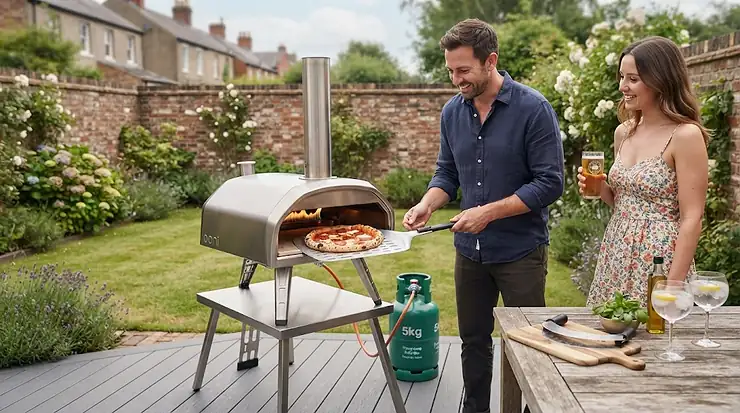
There’s a particular kind of smugness that settles over a person the moment they pull a bubbling, leopard-spotted pizza off a stone that’s just hit 450°C in their own back garden. No delivery driver, no soggy box, no “your order is 12 minutes away” lie. Just you, a propane bottle, and roughly ninety seconds between raw dough and dinner. A portable gas pizza oven is a compact outdoor appliance, usually fuelled by a propane canister, that heats a stone or steel cooking floor to restaurant-level temperatures in minutes rather than hours, letting you cook Neapolitan-style pizza at home without a brick chimney or a planning application. That’s the short version. The longer version — the one that actually matters when you’re choosing between seven very different boxes on a shelf — is what this guide is for.
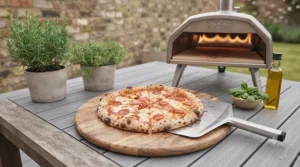
We’ve dug through real specifications, real UK retailer listings, and genuine aggregated customer sentiment for seven ovens that are actually available to buy, spanning proper budget kit through to the sort of thing serious home cooks save up for. According to the Health and Safety Executive, LPG is used as a fuel in a range of applications including heating and cooking appliances, and it’s flammable and heavier than air, meaning it can settle in low spots if it leaks — so before we even get to crust texture, we’re going to talk honestly about handling gas safely, because that’s not optional garnish on this topic, it’s the main course. If you’ve been eyeing up a portable gas pizza oven for weekends in the garden, camping trips, or just because you’re tired of pizza that arrives lukewarm, you’re in the right place.
What Is a Portable Gas Pizza Oven?
A portable gas pizza oven is a lightweight, propane-fuelled cooking appliance with a stone or steel base, usually reaching 400–500°C within 15–20 minutes, designed to be carried, folded, and used on a tabletop, patio, or campsite rather than built permanently into a garden. Unlike wood-fired models, gas versions offer near-instant ignition and consistent, dial-controlled heat with none of the ash or smoke management. The broader history of the pizza oven stretches back to wood-fired masonry designs, with gas and electric versions only becoming widespread relatively recently.
Quick Comparison Table
| Oven | Fuel Type | Max Temp | Weight | Best For |
|---|---|---|---|---|
| Ooni Koda 12 | Propane | ~500°C | ~10kg | Best all-round beginner pick |
| VonHaus Gas Pizza Oven | Propane | ~400-430°C | ~7-11kg | Cheapest full accessory kit |
| George Foreman 12″ Dual Fuel | Propane / wood pellet | ~500°C | ~9kg | Budget flexibility, two fuel types |
| Witt Piccolo Rotante 13″ | Propane | ~500°C | ~13kg | Hands-free rotating stone |
| Ooni Koda 16 | Propane | ~500°C | ~18kg | Bigger pizzas, bigger gardens |
| Gozney Roccbox | Propane / wood (add-on) | ~500°C+ | ~22.6kg | Premium build quality |
| Delivita Diavolo | Propane | ~450°C | ~20kg | Ultra-portable camping/beach use |
Look at that spread and a pattern jumps out immediately: weight and price climb together, but not in a straight line. The VonHaus Gas Pizza Oven undercuts almost everything here while still bundling a hose, regulator, and carry bag, which makes it the obvious entry point if you’re not sure pizza ovens are “your thing” yet. At the other end, the Gozney Roccbox carries a noticeably higher kerb weight than the rest of the field, and that’s not a design flaw — it’s the trade-off for the kind of insulation and stone thickness that holds heat between pizza number three and pizza number seven at a garden party.
💬 Just one click — help others make better buying decisions too!😊
Top 7 Portable Gas Pizza Ovens: Expert Analysis
We’ve grouped these across budget, mid-range, and premium so you can see exactly where your money buys you what — and where it doesn’t.
1. Ooni Koda 12 — best all-round beginner pick
The Ooni Koda 12 is the oven most people picture when they hear “portable gas pizza oven,” and there’s a reason it’s become something of a default recommendation. It’s a 12-inch propane-powered unit that reaches roughly 500°C in about 15 minutes, using an L-shaped burner that throws heat across the whole stone rather than just the back, which matters more than it sounds. A single-piece cordierite stone and folding legs keep the whole thing compact enough to store in a shed or car boot, and it ships with a 37 mbar regulator and gas hose already sorted, so there’s no separate trip to a hardware shop before your first bake. Based on the spec comparison with rivals in this price bracket, the Koda 12 earns its reputation less through any single standout feature and more through refusing to have an obvious weak point — it’s not the cheapest, not the biggest, not the most feature-laden, but it does the fundamentals better than almost anything else near its price. It suits first-time pizza oven buyers who want minimal fuss and a huge amount of online community support (recipes, troubleshooting, accessories) rather than experimenting with wood or dual-fuel setups. Reviewers consistently report that preheating discipline matters enormously with this oven — rushing the 15-minute warm-up leads to a pale, underbaked base, while patience delivers genuinely leopard-spotted crusts. One in-depth review called it one of the lightest units on the market, capable of making great 12-inch pizzas in minutes without being prohibitively expensive, though it also flagged that the metal exterior gets hot to the touch during use, which is worth knowing if you’ve got curious kids or pets nearby.
Pros:
- ✅ Reaches high heat in around 15 minutes
- ✅ Comes with hose and regulator included
- ✅ Huge community of recipes and accessories
Cons:
- ❌ Exterior casing gets very hot in use
- ❌ 12-inch stone limits pizza size for big groups
Expect to pay somewhere in the £280-£330 range at the time of research, though prices fluctuate, so always check current price before buying. For a first oven that you’ll actually use every weekend rather than once and forget, this remains a genuinely strong value pick.
2. VonHaus Gas Pizza Oven — cheapest full accessory kit
If your priority is trying portable pizza-making without committing serious money, the VonHaus Gas Pizza Oven is where most budget-conscious buyers land, and it’s easy to see why. This tabletop unit runs on propane, reaching between roughly 400°C and 430°C depending on conditions, and — unusually for the price — arrives with a genuinely complete kit: pizza stone, peel, chopping board, cutter, carry bag, gas hose, and regulator all included, whereas pricier rivals often sell peels and covers separately. The steel body weighs somewhere around 7-11kg depending on the exact model variant, light enough for one person to carry between the shed and the patio without a second thought. What most buyers overlook about entry-level ovens like this one is that “budget” doesn’t have to mean “compromised” on the accessories that actually matter day-to-day — it’s the stone, the hose, and the carry case that determine whether you use an oven weekly or let it gather dust, and VonHaus ticks all three boxes at once. It’s best suited to families or garden-party hosts who want an easy weekend treat rather than obsessive Neapolitan-purist results, and to anyone testing the water before spending three times as much on a premium model. Aggregated customer feedback across retailer sites is broadly positive, with buyers repeatedly praising the fast heat-up and describing results as noticeably better than takeaway, while some reviewers note the flame runs hot even on lower settings and needs active attention to avoid scorched crusts.
Pros:
- ✅ Full accessory kit included in the box
- ✅ Genuinely budget-friendly entry point
- ✅ Lightweight steel build, easy to carry
Cons:
- ❌ Runs hot even on lower dial settings
- ❌ Lower max temperature than premium rivals
At around £130-£160, this sits firmly at the affordable end of our line-up, and the value verdict is straightforward: for anyone unsure they’ll use a pizza oven more than a handful of times a summer, it’s very hard to argue against.
3. George Foreman 12″ Portable Dual Fuel Pizza Oven — budget flexibility, two fuel types
The George Foreman 12″ Portable Dual Fuel Pizza Oven takes a different angle on affordability: instead of stripping back features, it adds a second fuel option. This 4000W unit switches between propane gas for quick weeknight cooking and wood pellets for a smokier, more “authentic” result at weekends, with piezo push-button ignition and a heat-resistant stone capable of reaching roughly 500°C. On paper this means you get two ovens’ worth of cooking style for one price, and in practice that’s roughly how it plays out — gas for convenience, pellets when you’ve got time to enjoy the process. Foldable legs and an included carry bag keep it genuinely portable at around 9kg, and the stainless steel or powder-coated body is built to survive being lugged to a friend’s patio rather than staying permanently installed. This is the pick for buyers who can’t decide between “fast and easy” and “smoky and traditional,” or households that already trust the George Foreman name from indoor grilling and want a familiar brand extending outdoors. Real customer reports frequently mention the dramatic learning curve in the first few bakes — the oven’s intensity means dough needs rotating roughly every 20 seconds or one side chars while the other stays pale, a detail that catches first-timers out more than with slower-heating rivals. Once that rhythm clicks, though, reviewers describe turning out a crisp, bubbly crust in around 90 seconds, which is competitive with ovens costing considerably more.
Pros:
- ✅ Genuine dual-fuel flexibility, gas or pellets
- ✅ Reaches around 500°C for authentic results
- ✅ Portable at roughly 9kg with carry bag
Cons:
- ❌ Steep learning curve for the first few bakes
- ❌ 1-year guarantee shorter than some rivals
Pricing typically sits in the £150-£190 range, making it one of the more interesting value propositions here simply because you’re not choosing between fuel types at purchase — you get both.
4. Witt Piccolo Rotante 13″ — hands-free rotating stone
Danish brand Witt built its reputation on the larger Etna Rotante ovens before shrinking the concept into the Witt Piccolo Rotante 13″, and the headline feature is right there in the name: a motorised, rotating pizza stone. Rather than manually turning your dough every 20-30 seconds to avoid hot spots, a near-silent 40dB motor spins the stone continuously beneath a C-shaped burner, and the oven reaches roughly 500°C in about 15 minutes, cooking a pizza in 60-90 seconds. Here’s what to weigh: automatic rotation genuinely does remove the single biggest skill barrier in gas pizza-oven cooking, which is judging when and how far to turn the dough. For anyone who’s burned three pizzas in a row on a manual oven trying to get the rotation timing right, that’s not a gimmick, it’s the whole point. It suits buyers who want consistently even bakes without developing “pizza peel hands,” and anyone cooking for a crowd where attention is constantly split between guests and the oven. Reviewers who’ve compared it against Witt’s larger Etna range note the Piccolo delivers essentially the same cook quality in a size that suits smaller patios and balconies, though the compact footprint does mean it can only take 13-inch pizzas rather than anything larger. Aggregated feedback highlights the removable stone shelf as a genuine time-saver for cleanup, a detail that’s easy to dismiss until you’ve scraped burnt cheese off a fixed stone by hand.
Pros:
- ✅ Motorised rotating stone removes manual turning
- ✅ Near-silent 40dB motor
- ✅ Removable stone shelf simplifies cleaning
Cons:
- ❌ 13-inch limit caps pizza size
- ❌ Heavier than basic tabletop models at ~13kg
Expect a price somewhere in the £300-£350 range at the time of research. For the specific problem of consistent, even cooking without babysitting a peel, this is arguably the most focused solution in the whole line-up.
5. Ooni Koda 16 — bigger pizzas, bigger gardens
Scale up the Koda formula and you get the Ooni Koda 16, a 16-inch propane oven aimed squarely at people who’ve outgrown 12-inch pizzas — whether that’s a larger family, regular entertaining, or simply wanting a pizza night that doesn’t involve six separate bakes. It reaches around 500°C using the same reliable L-shaped burner design as its smaller sibling, and critically, it’s one of the few models in this category that can also be converted to run on natural gas rather than propane bottles, which matters if you’ve got an existing garden gas point and don’t fancy swapping cylinders all summer. What most buyers overlook about “going bigger” is that a 16-inch stone doesn’t just mean bigger pizzas — it means more usable cooking area for things like flatbreads, roasted vegetables, or fish, extending the oven’s use well beyond pizza night. This is the pick for households who entertain regularly, or anyone who’s used a 12-inch model and found themselves wishing for one more slice per pizza. At roughly 18kg it’s noticeably heavier and less pocket-portable than the Koda 12 or the VonHaus, so “portable” here means “movable between patio and shed” rather than “fits easily in a rucksack.” Reviewers repeatedly note that stepping up from 12-inch to 16-inch models changes the cooking rhythm — more room means less frantic rotation and a slightly more relaxed bake, even at the same blistering temperature.
Pros:
- ✅ 16-inch stone suits bigger households
- ✅ Natural gas conversion option available
- ✅ Same fast, reliable L-shaped burner as Koda 12
Cons:
- ❌ Around 18kg — less pocket-portable
- ❌ Higher price bracket than smaller Ooni models
Pricing generally falls in the £400-£450 range. If your garden sees regular pizza parties rather than the occasional solo bake, the extra stone space earns its keep quickly.
6. Gozney Roccbox — premium build quality, dual fuel
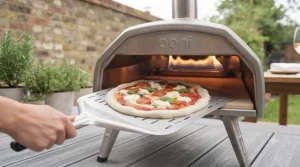
The Gozney Roccbox occupies the top shelf of this list for a reason: it’s built like a tank and cooks like a professional oven, at a price that reflects both. It’s lit by a single 14,330 BTU propane injector that snaps into a quick-fit gasket on the base, and the thick corderite stone plus heavy insulation mean it holds heat exceptionally well through back-to-back bakes — a real advantage if you’re cooking for more than four or five people in one sitting. Gas consumption runs to roughly 300-400 grams per hour depending on use, and a separate wood-burning attachment is available for anyone who wants to switch fuel types later without buying a whole new oven. Based on the spec comparison, the Roccbox’s silicone exterior cover is a genuinely clever touch that most budget ovens skip entirely — it stays cooler to the touch than bare steel casings, which matters a great deal around children or a crowded patio. This oven suits serious home cooks and anyone who’s already owned a cheaper model and wants a step up in consistency and build quality, rather than first-time buyers dipping a toe in. Independent testing found it reaches optimal temperature in around 20-30 minutes on gas — a touch longer than some rivals — but reviewers consistently note that once it’s hot, results are exceptional and repeatable. One review summed it up as well-built but pricey, noting it’s among the most expensive outdoor pizza ovens available and can be difficult to cool down quickly once it’s reached temperature.
Pros:
- ✅ Exceptional heat retention across multiple bakes
- ✅ Cooler-to-touch silicone exterior
- ✅ Optional wood-burner attachment for versatility
Cons:
- ❌ Among the priciest ovens in this category
- ❌ Longer preheat time than some rivals
Prices typically sit around £400-£450 range, occasionally higher depending on colour and bundle. For buyers who see this as a long-term kitchen investment rather than a summer novelty, the build quality genuinely justifies the outlay.
7. Delivita Diavolo — ultra-portable for camping and beach trips
Where the Roccbox is about staying power, the Delivita Diavolo is about going anywhere. This gas-fired oven folds down into its own carry bag, reaches roughly 450°C, and is designed from the ground up for people who genuinely want pizza at a campsite, on a beach trip, or tucked into a caravan awning — not just “portable” in the sense of moving it from kitchen to patio once a year. Setup is about as simple as this category gets: unfold the legs, connect the gas, and you’re ready, with a manual 360° turning dial on the stone that helps compensate for the fact that, like most compact ovens, it runs a little cooler at the front than the back. Here’s what to weigh: at roughly 20kg it isn’t the lightest oven on this list by weight, but its dimensions and included carry bag make it dramatically easier to transport and load into a car boot than boxier alternatives, which is the kind of portability that actually matters for camping trips. It’s best suited to buyers who prioritise travel and simplicity over bells and whistles, and who don’t mind a no-frills package — there’s no pizza peel or storage cover bundled in, so budget for those separately. It earned a BBC Gardeners’ World Magazine Best Buy award for best basic pizza oven, with external reviewers praising its sturdy, well-made feel despite the light-enough-to-carry design, and a two-year warranty backs up that build confidence.
Pros:
- ✅ Genuinely camping and travel-friendly design
- ✅ Simple setup — legs, gas, cook
- ✅ Two-year warranty for peace of mind
Cons:
- ❌ No peel or cover included as standard
- ❌ Runs cooler at the front than the back
Expect a price around £240-£280 at the time of research. If your pizza oven needs to survive being strapped to a roof rack more often than it sits on a patio, this is the most purpose-built option on our list.
Practical Usage Guide: Setting Up and Running Your Oven
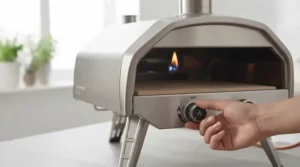
Getting a new portable gas pizza oven right in the first month makes the difference between it becoming a weekly ritual or an expensive garden ornament. Start by choosing a stable, flat, non-flammable surface — a wooden picnic table works, but keep the oven at least a metre from fences, umbrellas, or overhanging branches, since the exterior casing on most models genuinely does get hot enough to scorch nearby materials. Before your very first bake, run the oven on a low flame for 15-20 minutes with nothing inside; this “curing” step burns off any manufacturing residue and lets the stone acclimatise gradually, reducing the risk of thermal shock cracking a brand-new cordierite surface. Once you’re cooking properly, resist the urge to rush preheating — a stone that looks hot but hasn’t fully soaked through will scorch a crust on the outside while leaving it pale and underdone in the middle, a common first-month mistake. A common error in the early weeks is overloading pizzas with wet toppings; excess moisture from fresh mozzarella or sliced tomatoes steams rather than crisps in a 60-90 second cook window, so pat toppings dry and use less than instinct suggests. For maintenance, let the stone cool completely before brushing off flour and burnt bits with a stiff brush — never water, which can crack a hot stone instantly — and check the gas hose for kinks, cracks, or wear every few uses, replacing it well before it looks obviously damaged. Store the regulator and hose disconnected and coiled loosely rather than tightly bent, since sharp creases are where hoses typically fail first.
Real-World Scenarios: Which Oven Suits Your Life
Picture three different buyers walking into this decision. First, a young couple in a new-build with a small paved patio and no shed storage to speak of — for them, a lightweight, fold-flat option like the VonHaus Gas Pizza Oven or Ooni Koda 12 makes sense, since both pack away into a cupboard between uses and don’t demand a permanent outdoor footprint. Second, a family of five who host regular Sunday get-togethers and are tired of cooking pizzas one at a time — here the extra stone space on the Ooni Koda 16 earns its higher price tag quickly, because feeding a crowd from a 12-inch oven means standing over it for the better part of an hour. Third, a couple who camp three or four weekends a summer and want proper pizza at the campsite rather than instant noodles — the Delivita Diavolo‘s dedicated carry bag and simple two-step setup were built with exactly this person in mind, and its slightly lower 450°C ceiling is a fair trade for genuine grab-and-go usability. None of these buyers are wrong, and none of these ovens are universally “best” — the right choice depends entirely on where the oven will actually live and how often it’ll be hauled somewhere new.
Problem → Solution: Common Portable Gas Pizza Oven Issues
Even good ovens throw up predictable problems, and most have straightforward fixes. If your crust is burning on top before the base cooks through, the stone likely hasn’t finished preheating — extend warm-up time by five minutes and check the flame is reaching the back of the chamber evenly. If the base stays soggy despite a hot stone, the culprit is usually excess flour or semolina left under the dough acting as insulation; dust lightly rather than heavily, and slide the pizza off the peel with a firm, confident motion rather than a hesitant shuffle. If the oven struggles to reach advertised temperatures on a cold or windy day, that’s largely physics rather than a fault — wind strips heat from an open-fronted design surprisingly fast, so a simple windbreak or repositioning against a wall can restore normal performance. If you’re getting inconsistent results between the front and back of the pizza, that’s the classic “hot back, cooler front” trait shared by most single-burner ovens, solved by rotating the dough with a peel every 15-20 seconds rather than leaving it static. Finally, if the gas regulator hisses or you smell gas at any connection point, stop immediately, turn off the cylinder, and check the joint with a soapy water solution rather than a naked flame — a genuine leak needs the hose or regulator replaced, not tightened and hoped for.
✨ Ready to Fire Up Your Own Garden Pizzeria?
🔍 Compare current prices and availability on any of the ovens above before your next weekend cook-up — stock and pricing shift regularly, so it pays to check before you commit.
How to Choose a Portable Gas Pizza Oven
- Decide how portable “portable” needs to be. A patio-only oven can weigh 15-20kg without issue; a camping oven realistically needs a proper carry bag and a weight you can lift into a car boot unaided.
- Check maximum temperature against your pizza style. Neapolitan-style thin bases want 450°C-plus for that 60-90 second cook; thicker, pan-style bakes are more forgiving and work fine at lower heat.
- Look at what’s actually included. Some ovens bundle a hose, regulator, peel, and cover; others sell these separately, which can add £30-£60 to your real-world spend.
- Match stone size to your household. A 12-inch stone suits one or two people cooking casually; anything larger than that and a 16-inch model saves real time over an evening.
- Consider fuel flexibility. Pure propane models are simplest to run; dual-fuel options add wood or pellet capability but usually cost more and take slightly longer to master.
- Factor in storage realistically. Foldable legs and a compact footprint matter enormously if you don’t have shed space, less so if the oven will live permanently on a patio.
- Read aggregated review themes, not star ratings alone. A 4.5-star average tells you little; recurring complaints about, say, hose quality or uneven heat tell you a great deal more.
Common Mistakes When Buying a Portable Gas Pizza Oven
The single most common mistake is buying on maximum temperature alone. A headline figure of “500°C!” sounds impressive, but if an oven can’t sustain that heat evenly across the stone, or takes 40 minutes to get there in typical UK garden conditions, the number is mostly marketing. A second frequent error is ignoring accessory costs — an oven that looks like the cheapest option on a comparison table can end up pricier once you’ve bought a peel, cover, and a compatible regulator separately, so always price the complete kit rather than the bare unit. Buyers also regularly underestimate storage requirements, purchasing an oven that reaches its full potential outdoors but then has nowhere sensible to live over winter, leading to rust or weather damage on units left exposed. Another overlooked detail is checking the regulator type matches standard UK propane cylinders — some imported models ship with fittings suited to other markets and need an adaptor, an unwelcome surprise on the first cook of the season. Finally, plenty of first-time buyers skip reading aggregated review sentiment about gas hose durability specifically, focusing entirely on cooking results, when hose quality is one of the more common long-term failure points across this entire product category.
Portable Gas Pizza Oven vs Wood-Fired Pizza Oven
The gas-versus-wood debate comes down to a genuine trade-off between convenience and craft, not a simple “better or worse” answer. Gas ovens like every model on our list ignite in seconds, hold a steady temperature via dial control, and involve zero ash or flavour-wood management, which is precisely why they suit weeknight use — you can realistically decide on pizza at 6pm and be eating by 6:45pm. Gas pizza ovens use propane or natural gas for fast, predictable heat, and temperature stays stable between pizzas, meaning faster recovery when feeding a crowd, whereas wood-fired models generally demand active fire management throughout the cook. Wood-fired ovens, by contrast, impart a genuine smoky depth of flavour that gas simply cannot replicate, and there’s an undeniable theatre to tending an open flame that some cooks find part of the appeal rather than a chore. Wood-fired ovens typically need 45 to 90 minutes to reach cooking temperature, against 15 to 20 minutes for gas — a gap that matters enormously on a weeknight but barely registers during a leisurely weekend gathering. The practical verdict: if pizza night needs to fit around a normal evening, gas wins comfortably; if the process itself is part of the entertainment and you’ve got time to spare, wood-fired earns serious consideration instead.
| Factor | Gas Oven | Wood-Fired Oven |
|---|---|---|
| Preheat time | 15-20 minutes | 45-90 minutes |
| Flavour profile | Clean, consistent | Smoky, variable |
| Cleanup | Minimal | Ash and soot |
| Weeknight practicality | High | Low |
| Best For | Regular use, convenience | Occasional, flavour-focused cooking |
This comparison makes the appeal of dual-fuel options like the George Foreman 12″ Portable Dual Fuel and the Gozney Roccbox obvious — they let you default to gas midweek and switch to wood when a weekend allows the extra time. For anyone still undecided, the honest answer is that most UK households cook pizza on weeknights and weekends both, which is exactly the gap dual-fuel models exist to fill.
Propane Pizza Oven for the Garden: Setup, Space and Safety
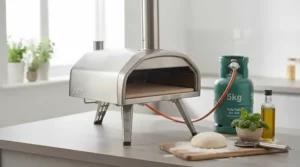
Turning any propane pizza oven for garden use into a safe, permanent-feeling fixture starts with positioning. LPG is supplied in canisters, cylinders, and bulk storage tanks, and for a domestic garden setup that means a standard propane cylinder connected via hose and regulator, positioned upright, on firm ground, well clear of the oven’s hot exterior and any doorways or air bricks where escaping gas could accumulate. Never operate a propane pizza oven inside a garage, conservatory, or any partially enclosed space — these ovens are designed exclusively for open-air outdoor use, and because LPG is heavier than air it can settle in low spots such as drains and basements, presenting a fire, explosion, or suffocation hazard if used somewhere poorly ventilated. Keep a metre or more of clearance on all sides for airflow and to protect fences, decking, or plants from radiant heat, and always cook on a level, stable surface — a wobbling oven with an open flame is a genuinely dangerous combination. For further detail on handling and storing gas cylinders safely at home, the Health and Safety Executive’s guidance on liquefied petroleum gas is a useful reference point before your first setup: HSE guidance on LPG.
Lightweight Design: Why Portability Actually Matters
It’s tempting to treat “lightweight design” as a marketing checkbox, but in practice it shapes how often an oven actually gets used. An oven that requires two people to lift, or that can’t realistically be carried up steps to a raised patio, tends to migrate from “weekly treat” to “special occasion only” within a season — not because the owner’s enthusiasm faded, but because the friction of setup became a genuine barrier. Compare the roughly 7-10kg range of the VonHaus Gas Pizza Oven and Ooni Koda 12 against the near-20kg heft of the Gozney Roccbox or Delivita Diavolo, and it’s clear these aren’t interchangeable in daily practice, even though all four claim some degree of portability. What most buyers overlook is that weight interacts directly with storage: a lightweight oven can be tucked into a cupboard or car boot without ceremony, while a heavier model often ends up living permanently outdoors under a cover, exposed to weather regardless of intent. For anyone genuinely planning to move their oven between locations — patio to campsite, garden to a friend’s barbecue — prioritising sub-12kg models will save real frustration over a full summer of use.
Tabletop Use: Getting the Most from a Compact Footprint
Every oven on this list is designed for tabletop use rather than a permanent built-in installation, which brings its own set of practical considerations. First, check your table or surface can handle sustained heat — a lightweight garden table isn’t necessarily rated for an appliance radiating several hundred degrees for 20+ minutes at a stretch, and a proper heat-resistant mat or stand is a sensible, inexpensive addition. Second, position the oven so its open front faces away from foot traffic and prevailing wind, since both flying embers-equivalent heat blasts and wind-induced temperature swings are common tabletop complaints in aggregated reviews. Third, remember that a tabletop oven’s compact stone means less thermal mass than built-in alternatives, so it cools faster between bakes — plan your cooking order so the largest or thickest pizzas go in first while the stone is at its hottest. Finally, tabletop ovens genuinely benefit from a simple lazy Susan or turntable placed underneath, letting you rotate the entire unit rather than just the pizza inside it, which some home cooks find easier than manoeuvring a peel in a tight space.
Gas Hose and Regulator: Safety Guide and Compliance
The gas hose connecting your cylinder to the oven is, unglamorously, the single most safety-critical component in this entire setup, and it deserves more attention than most buyers give it. Always use the hose and regulator supplied by the manufacturer, or a verified compatible replacement rated for outdoor propane use — mixing components from different systems is a common and entirely avoidable source of leaks. Before every session, particularly early in the season after winter storage, inspect the full hose length for cracking, perishing, or soft spots, and test every connection point with a soapy water solution rather than simply listening for hissing, since small leaks are often silent. The installation and safe use of propane in cylinders is covered by UK codes of practice, including guidance on domestic and commercial installations under the Gas Safety (Installation and Use) Regulations 1998, and while most of that framework targets commercial settings, the underlying principles — secure connections, proper ventilation, regular inspection — apply directly to garden use too. Liquid Gas UK’s own consumer guidance stresses that butane and propane are stored as liquid under pressure, with propane sitting at roughly 7 bar at 15°C, which is why a damaged hose or loose fitting can release gas rapidly rather than gently. For a more detailed breakdown of safe handling, see Liquid Gas UK’s safety guidance on propane and butane cylinders. As a rule of thumb, replace any hose showing visible wear every two to three years regardless of appearance, and never use an extension hose beyond what the manufacturer supplies.
Gas Pizza Oven Deals: Price Ranges, Value and Long-Term Cost
Chasing gas pizza oven deals is sensible, but value only makes sense when you look past the upfront figure to what an oven actually costs to run and maintain over several years. A cheaper oven bought on sale still needs a compatible regulator, periodic hose replacement, and occasionally a stone if it cracks from thermal shock — costs that narrow the gap between budget and mid-range options more than the sale price alone suggests. Running costs themselves are low across this category: a standard propane cylinder typically fuels many pizza-making sessions before needing a refill or exchange, making cost-per-pizza genuinely competitive with a single takeaway order after only a handful of uses.
| Oven | Price Range | Included Accessories | Value Verdict |
|---|---|---|---|
| VonHaus Gas Pizza Oven | £130-£160 | Full kit (stone, peel, hose, bag) | Best entry-level value |
| George Foreman 12″ Dual Fuel | £150-£190 | Carry bag, paddle | Strong value, two fuel types |
| Ooni Koda 12 | £280-£330 | Hose, regulator | Best long-term community/support value |
| Delivita Diavolo | £240-£280 | Carry bag only | Good value for travel use |
| Witt Piccolo Rotante 13″ | £300-£350 | None standard | Justified by rotation feature |
| Ooni Koda 16 | £400-£450 | Hose, regulator | Worth it for larger households |
| Gozney Roccbox | £400-£450 | Peel included | Premium but durable long-term |
Reading across this table, the clearest pattern is that included accessories can offset a higher sticker price faster than expected — the Gozney Roccbox including a peel narrows its real-world cost gap against rivals that charge extra for one. Meanwhile, buyers chasing the lowest possible entry cost should weight the VonHaus Gas Pizza Oven‘s complete kit heavily, since it removes several follow-on purchases entirely. As with all outdoor cooking equipment, remember that displayed prices fluctuate regularly, so always check current price before finalising a purchase decision rather than relying on any figure quoted here.
Long-Term Cost and Maintenance
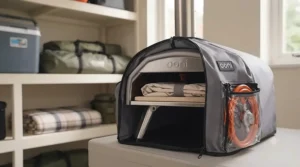
Beyond the initial purchase, portable gas pizza ovens are relatively cheap to keep running, but not entirely maintenance-free. Budget for an occasional replacement hose every two to three years as a safety precaution rather than waiting for visible failure, typically a modest cost compared to the oven itself. Stones can crack under thermal shock, particularly if cold food or moisture contacts a fully heated surface, so a spare stone or careful handling is worth factoring into total cost of ownership on models where the stone is user-replaceable. Covers matter more than they seem: an oven left uncovered outdoors through a British winter will corrode or degrade far faster than one properly protected, and a decent weatherproof cover is one of the cheapest investments that meaningfully extends an oven’s working life. Over a three-to-five-year ownership window, the total cost of running any oven in this list — cylinder refills, an occasional hose, a cover, maybe a replacement stone — tends to be modest next to the initial purchase price, which is worth remembering when premium models like the Roccbox look expensive on day one.
Frequently Asked Questions
❓ How hot does a portable gas pizza oven get?
❓ Can I use a portable gas pizza oven on a balcony?
❓ Do gas pizza ovens need a special propane cylinder?
❓ How long does a propane cylinder last for a portable pizza oven?
❓ Is a portable gas pizza oven safe to use on decking?
Conclusion
There’s no single “best” portable gas pizza oven in this line-up, and honestly, that’s the whole point of comparing seven of them properly rather than crowning one winner and moving on. If you want the safest, most widely-supported starting point, the Ooni Koda 12 remains hard to beat. If budget is the deciding factor and you want everything included in one box, the VonHaus Gas Pizza Oven does that better than anything else here. Families who entertain regularly should look seriously at the Ooni Koda 16, campers and beach-trip regulars belong with the Delivita Diavolo, and anyone chasing that final ten percent of build quality and consistency should be saving for the Gozney Roccbox. Wherever you land, the fundamentals stay the same: respect the gas hose and regulator, give the stone time to properly preheat, and keep the whole setup somewhere genuinely open-air. Do that, and pizza night stops being a treat you order in and starts being something you actually make.
Recommended for You
- Dual Fuel Pizza Oven Review: 7 Best UK Picks for 2026
- Gas Pizza Ovens Under £200: 7 Best Budget Picks for 2026
- Best Gas Pizza Ovens for UK Gardens in 2026 (Beginner-Friendly)
Disclaimer: This article contains affiliate links. As an Amazon Associate, I earn from qualifying purchases. If you purchase products through these links, we may earn a small commission at no additional cost to you.
✨ Found this helpful? Share it with your friends! 💬🤗
