
In This Article
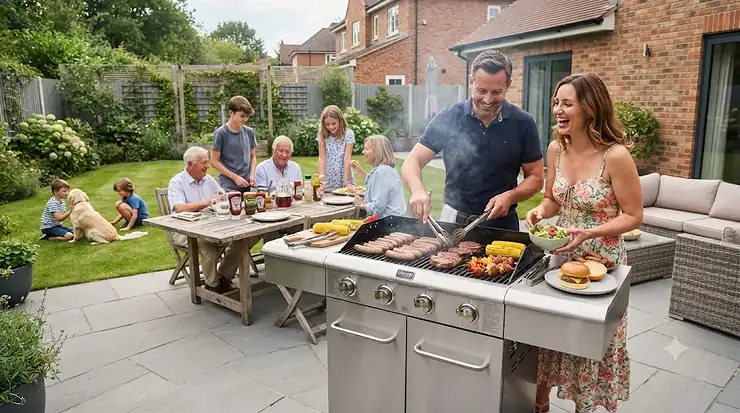
Standing over a barbecue with six hungry kids, three cousins and a father-in-law who “just wants his steak a bit more done, please” is a very particular kind of stress test. A bbq for large family use isn’t just a bigger version of the two-person grill you had in your twenties — it’s a grill designed to run several cooking zones at once, hold enough heat to recover fast after the lid goes up and down forty times, and survive a season of proper, regular use rather than the odd bank holiday. In plain terms: a bbq for large family cooking is any grill with enough burners, grate space and heat output to feed eight to twenty people in one sitting without a queue forming at the tongs. As the Wikipedia entry on barbecue grills notes, modern grills range from simple portable units to elaborate multi-burner setups, and it’s that range that makes picking the right size genuinely confusing for larger households. This guide walks through seven real, currently available UK models, spread across budget, mid-range and premium, so you can match the right one to your garden, your guest list and your Sunday routine — no vague “great for families!” marketing spin, just honest analysis of what each grill actually does well.
Quick Comparison Table
| Model | Fuel Type | Cooking Capacity | Price Range | Best For |
|---|---|---|---|---|
| CosmoGrill Pro Deluxe 7 Gas Burner 6+1 | Gas | Up to 18-20 people | £300-£380 range | Biggest gas capacity on a budget |
| CosmoGrill Outdoor XL Smoker | Charcoal | Up to 10 people | £120-£180 range | Best entry-level charcoal |
| Char-Broil Gas2Coal 330 Hybrid | Gas + Charcoal | 4-6 people (comfortably 6-8 stretched) | £350-£470 range | Flexibility between fuels |
| CosmoGrill Outdoor XXL Smoker | Charcoal | 15+ burgers at once | £150-£220 range | Charcoal flavour at scale |
| Landmann Triton MaxX 4.1 | Gas | 8-10 people | £450-£500 range | Mid-range build quality |
| Weber Genesis E-315 | Gas | 6-8 people | around £850-£950 | Long-term premium reliability |
| Kamado Joe Classic Joe I | Charcoal/Ceramic | 8-10 people, low-and-slow | £700-£900 range | Serious smoking and roasting |
Looking at the spread above, the gap between the cheapest and priciest option here isn’t really about how many burgers each grill can physically hold — it’s about how consistently it holds temperature under pressure and how long the metal, grates and burners survive weekly use. Budget-friendly options like the CosmoGrill Pro Deluxe 7 Gas Burner 6+1 genuinely out-muscle far pricier grills on raw capacity, while the Weber Genesis E-315 and Kamado Joe Classic Joe I justify their price tags through build quality and warranty rather than sheer size. If your family barbecues most weekends through summer, that durability gap matters more than the headline capacity number.
💬 Just one click — help others make better buying decisions too!😊
Top 7 BBQ for Large Family: Expert Analysis
1. CosmoGrill Pro Deluxe 7 Gas Burner 6+1 — biggest capacity for the money
The standout feature here is sheer scale: six individually adjustable stainless steel burners plus a dedicated side burner, delivering a combined heat output north of 12kW across a 77 x 42cm cooking grate. In practice that means you can run a hot zone for searing burgers, a medium zone for chicken thighs and a low zone for keeping veg skewers warm, all at the same time, without one dish stealing heat from another — something a two or three-burner grill simply cannot do. Based on the spec comparison, this is the grill for households who regularly cater for 15-20 people rather than the standard family of four; CosmoGrill themselves size it for parties up to that range, and the enamelled grates and V-shaped flame tamers help it survive repeated big cook-ups without warping. Reviewers consistently note that assembly is the sticking point — two people, roughly two to three hours, with the gas side-burner connection singled out as the fiddliest part — and that the gas regulator and hose are sold separately, so budget an extra £15-£20 and half an hour before your first cook. One buyer specifically mentioned hosting a 50-person garden party on this model and finding it “a bit of a whopper” that performed exactly as hoped. At this price point, the value proposition is hard to beat for anyone who needs restaurant-scale output without a restaurant-scale budget.
Pros:
- ✅ Six independently controlled burners plus a side burner
- ✅ 77 x 42cm grate genuinely caters for 18-20 guests
- ✅ Removable grease tray and enamelled grates ease cleaning
Cons:
- ❌ Regulator and gas hose not included, add to your order
- ❌ Assembly instructions for the side burner are unclear
CosmoGrill sits in the budget-to-mid bracket, typically listed around £300-£380, and for that outlay you’re getting more usable cooking area than grills costing twice as much — making it a genuinely strong value pick for anyone who entertains often.
2. CosmoGrill Outdoor XL Smoker — best entry-level charcoal starter
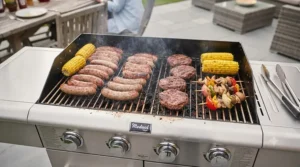
What most buyers overlook about this model is that it isn’t just a grill — the height-adjustable charcoal tray with an external crank handle turns it into a basic smoker too, letting you raise or lower the coal bed to control temperature the way pricier kamados do. The 58 x 42.5cm enamelled steel grate and 1.4kg coal capacity are enough to handle a proper family fry-up of burgers, chicken and sausages in one batch, and the two foldable side tables give you somewhere to rest plates without balancing them on a garden wall. On paper this means beginners get real temperature control without the £700+ outlay of a ceramic kamado. A verified test review measured the assembled unit at 124 x 66 x 113cm and 24kg, describing it as “large enough to cook a lot of food – easily enough for a party of 10,” while also flagging that solo assembly took around two hours and that the folding side tables require loosening screws rather than using proper hinges, which is a bit more fiddly than the marketing photos suggest. What the spec sheet won’t tell you, but reviewers note, is that this barbecue should be stored under cover in bad weather despite the heat-resistant paint finish, since the powder-coated steel isn’t fully weatherproof long-term.
Pros:
- ✅ Height-adjustable coal tray for genuine temperature control
- ✅ Under-storage area keeps plates and condiments to hand
- ✅ Doubles as a smoker for slow-cooked whole chicken
Cons:
- ❌ Side tables fold via loosened screws, not true hinges
- ❌ Best stored under cover; not fully weatherproof long term
Typically priced in the £120-£180 range, this is the sensible first “proper” family charcoal grill before stepping up to something like the XXL or a kamado.
3. Char-Broil Gas2Coal 330 Hybrid — best of both fuels
The standout feature is genuinely unique among this line-up: a patented charcoal tray that converts the grill from gas to charcoal cooking in under 60 seconds with no tools, letting the gas burners themselves light the coals rather than reaching for lighter fluid. Three stainless steel burners sit under solid cast-iron grates, and Char-Broil’s own listing sizes the standard cooking area for 4-6 people comfortably, stretching to 6-8 if you’re happy to run a couple of extra batches through the warming rack. Here’s what to weigh: for a large family this isn’t the single grill that replaces everything else, but as a genuinely flexible weekday-to-weekend option — gas for a quick Tuesday dinner, charcoal for a proper Saturday cook-up — it earns its keep in a way single-fuel grills can’t. One verified buyer review summed it up neatly, noting fast heating, even heat distribution and that having the flexibility of “either gas or charcoal… gives you the convenience of gas and the flavour of charcoal in one unit.” Larger households of seven or more will likely want to pair this with a second grill like the CosmoGrill XXL Smoker for big gatherings, using the Gas2Coal for regular family meals in between.
Pros:
- ✅ Converts gas to charcoal cooking in under a minute
- ✅ Cast-iron grates hold heat well for consistent searing
- ✅ Side burner and lid thermometer aid precise cooking
Cons:
- ❌ Standard capacity suits 4-6 people, not 10+
- ❌ Two wheels only, less stable to reposition than four-caster rivals
Prices for the Gas2Coal 330 range roughly £350-£470 depending on retailer and edition, positioning it as a solid mid-range choice for flexibility rather than raw scale.
4. CosmoGrill Outdoor XXL Smoker — charcoal flavour at real scale
The headline number here is capacity: CosmoGrill states the grill handles over 15 burger patties and 15 sausages simultaneously, backed by two full cast-iron grates across a 73 x 42.5cm cooking area. Based on the spec comparison with the smaller XL model, the extra grate space and 2.7kg charcoal capacity make a genuine difference when you’re cooking for ten-plus rather than six, since you’re not constantly rotating food on and off to make room. The height-adjustable coal tray with a stainless-steel crank handle gives four heat settings, useful for running a low-and-slow zone for chicken thighs alongside a hot zone for steaks. Reviewers consistently praise the cast-iron grates for retaining heat “so once it’s hot, it stays hot,” reducing how often you need to flip food, though one verified buyer noted a minor missing part on delivery that CosmoGrill’s customer service resolved without a full return — worth knowing before you commit to the two-hour, two-person assembly. Reviewers consistently note this is comfortably large enough for both a big weekend party and, on quieter weeks, a smaller family meal without feeling like overkill.
Pros:
- ✅ Cooks 15+ burgers and sausages in a single batch
- ✅ Four-setting adjustable coal tray for precise heat zones
- ✅ Dishwasher-safe grill racks on some components
Cons:
- ❌ Heaviest of the CosmoGrill charcoal range at around 30kg
- ❌ Ships in two boxes; assembly can take two hours for two people
Expect to pay somewhere in the £150-£220 range, which for genuine 15-plate-at-once capacity remains one of the strongest value picks in this entire guide.
5. Landmann Triton MaxX 4.1 — best mid-range build quality
What most buyers overlook about this model is the MaxX zone: a recessed 800°C infrared side burner that sears steaks far hotter than a standard side burner, sitting alongside four infinitely adjustable 3.0kW stainless steel main burners across a 65 x 44cm cast-iron cooking area. Landmann’s patented PTS (Power Thermal Spreading) system is designed specifically to eliminate the cold spots that cheaper grills suffer from, and the double-walled hood with a built-in thermometer retains heat noticeably better during indirect cooking, such as roasting a whole chicken with the lid down. On paper this means a family of eight to ten gets consistent results across the entire grate rather than one corner running hotter than another — a common complaint with entry-level gas barbecues. The modular cooking system also lets you swap the centre grate section for a pizza stone or griddle plate, adding versatility beyond straightforward grilling. Landmann has manufactured barbecues since 1966 and has traded in the UK since 1984, and that heritage shows in details like the lockable casters and brushed stainless-steel cabinet doors, which feel a step up from the CosmoGrill range without reaching Weber pricing.
Pros:
- ✅ 800°C infrared MaxX zone for restaurant-style searing
- ✅ PTS system gives even heat with no cold spots
- ✅ Modular grate accepts pizza stone and griddle accessories
Cons:
- ❌ Delivered on a pallet due to weight; check access beforehand
- ❌ Sits at a noticeably higher price than entry CosmoGrill models
Retailers list the Triton MaxX 4.1 in the £450-£500 range, making it the natural step-up once you’ve outgrown a budget grill but aren’t ready for Weber money.
6. Weber Genesis E-315 — best premium gas for long-term reliability
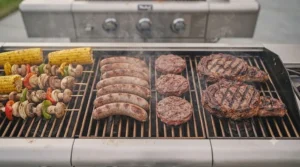
The standout feature is Weber’s PureBlu burner system: three tapered, porcelain-enamelled burner tubes engineered to generate consistent pressure and even flame distribution across the entire 513 square inch cooking surface, addressing the uneven-heat complaint that dogs cheaper multi-burner grills. Reviewers consistently note that the porcelain-coated cast-iron grates hold heat exceptionally well for searing, and the Flavorizer bars vaporise dripping fat into genuine barbecue smoke flavour while funnelling excess grease safely into a removable catch pan, cutting flare-ups significantly. What the spec sheet won’t tell you, but long-term owners note, is that Weber backs the Genesis line with a 12-year limited warranty on major components, reflecting real confidence in the cast-aluminium cookbox and stainless-steel burners lasting well beyond a typical three-to-five-year grill lifespan. Based on the spec comparison, Weber itself sizes a 3-burner Genesis for families and versatile indirect grilling, comfortably feeding six to eight people, with a second cooking level doubling as extra capacity or a warming rack for bigger gatherings. The storage cabinet is deep enough to house a full 13kg gas bottle, which matters more than it sounds for larger households running through gas faster.
Pros:
- ✅ PureBlu burners deliver genuinely even heat distribution
- ✅ Backed by a 12-year limited warranty on core components
- ✅ Extra cooking level adds capacity for bigger gatherings
Cons:
- ❌ Premium pricing well above CosmoGrill or Landmann equivalents
- ❌ Base 3-burner capacity tops out around 6-8 people
Weber Genesis E-315 pricing typically sits around £850-£950, positioning it firmly as the buy-it-once option for families who barbecue year-round rather than a handful of times each summer.
7. Kamado Joe Classic Joe I — best for serious smoking and roasting
The standout feature is thermal mass: thick ceramic (“kamado”) walls that retain heat with extraordinary consistency, letting this grill hold a steady low temperature for hours-long smoking sessions or spike up for a blistering pizza-oven-style sear, all on the same charcoal load. A verified test report recorded the Classic Joe I running over five hours at 120°C on a single load of fuel, and successfully smoking a 2.5kg brisket for a family party with tender, smoky results — genuinely restaurant-calibre output most gas or standard charcoal grills can’t replicate. Reviewers consistently note it delivers better heat retention than Weber’s own charcoal flagship, the Master-Touch, though it trades that for portability: the ceramic body is heavy and effectively a permanent garden fixture rather than something you wheel in and out of a shed each week. What most buyers overlook about this model is that it isn’t purely a smoker — a family can just as easily use it as a very capable everyday grill, and the adjustable top damper and bottom draft vent give precise control from a 110°C smoke up to a 300°C+ sear, useful for feeding a mixed crowd wanting both slow-cooked ribs and quick-seared vegetables.
Pros:
- ✅ Exceptional heat retention for multi-hour smoking sessions
- ✅ Versatile enough to sear, roast, bake and smoke
- ✅ Ceramic body built to last many seasons outdoors
Cons:
- ❌ Heavy and effectively fixed in one garden spot
- ❌ Highest purchase price of the seven grills featured here
Positioned at the premium end around £700-£900, the Classic Joe I suits families who see barbecuing as a genuine hobby rather than an occasional summer activity.
Setting Up and Maintaining Your Family BBQ
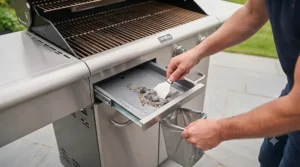
Getting a large-capacity grill running smoothly from day one saves a lot of frustration later. Start by assembling on a flat, stable surface — ideally with a second pair of hands, since several of the grills above genuinely benefit from it, particularly when lifting a fully-built hood into place. Before the first cook, run every gas model on a moderate heat for 15-20 minutes with the lid closed to burn off manufacturing residue, and season cast-iron grates with a light coat of cooking oil to prevent early rusting. In the first 30 days, the most common mistake is under-cleaning: a quick brush-down after every single use, rather than a deep clean once a month, is what actually prevents the sticking and flare-ups that ruin food. For charcoal models, empty the ash pan once it’s cool rather than letting it build up, since a packed ash tray restricts airflow and makes the next cook harder to light. Gas models need their grease trays checked and changed once roughly half full — leaving them longer is one of the more common causes of dangerous flare-ups. A basic maintenance schedule — wire-brush after each use, deep-clean monthly, cover check weekly — will add years to almost any grill on this list.
Real Family Scenarios: Which BBQ Actually Fits Your Household
Consider three genuinely common household types. First, a family of five who barbecue most weekends through summer and want reliable, everyday cooking without ceremony: the CosmoGrill Outdoor XL Smoker or the Char-Broil Gas2Coal 330 Hybrid both fit, offering enough capacity without the footprint or price of the largest grills here. Second, a household that regularly hosts extended family — grandparents, in-laws, a rotating cast of cousins — for gatherings of 15-20 people several times a year: the CosmoGrill Pro Deluxe 7 Gas Burner 6+1 or the CosmoGrill Outdoor XXL Smoker genuinely earn their keep here, since their capacity is built around exactly that scenario rather than stretched to cope with it. Third, a family with a dedicated garden entertaining space and a real interest in cooking as a hobby, not just a summer chore: the Weber Genesis E-315 or Kamado Joe Classic Joe I reward the investment with consistency and versatility that casual grills can’t match, particularly if slow-smoked meats are part of the plan. Matching the scenario to the grill, rather than buying on price or looks alone, is what actually determines whether a barbecue gets used every week or abandoned under a tarpaulin by August.

Common Family BBQ Problems, Solved
Even a well-chosen grill runs into predictable snags with a large family in tow. Uneven cooking across the grate is usually a burner or coal-distribution issue rather than a technique problem — models with a proper heat-spreading system, like Landmann’s PTS or a kamado’s ceramic mass, solve this structurally rather than through constant food rotation. Running out of space mid-cook, a classic large-family headache, is best solved by choosing a grill with a genuine warming rack (several models above include one) so cooked food can rest off the direct heat while the next batch goes on, rather than everyone waiting for one single serving. Flare-ups from dripping fat, which can genuinely ruin a batch of sausages, are minimised by flame tamers and grease-management systems — features present on every gas model featured here, and worth checking on any grill you’re considering. Finally, running out of gas mid-party is an avoidable panic: keep a spare 5kg or 13kg cylinder on hand if you’re using a 3+ burner grill regularly, since larger burner counts simply consume gas faster.
How to Choose a BBQ for Large Family Cooking
Picking the right grill for a big household comes down to a handful of genuinely load-bearing decisions, in roughly this order of importance:
- Count your realistic maximum guest number, not your average one — buy for your biggest regular gathering, not a quiet Tuesday, since undersizing is the single most common regret among large-family buyers.
- Decide gas, charcoal or hybrid based on how often you’ll cook, not flavour preference alone — gas suits frequent weeknight use, charcoal suits weekend occasions where flavour and ritual matter more than speed.
- Check the actual grate dimensions, not just marketing phrases like “family-sized,” since a 65cm-wide grate and an 80cm-wide grate feed very different numbers of people.
- Look for a warming rack or second cooking level, which effectively adds capacity without adding footprint, letting cooked food rest while more goes on.
- Factor in storage and mobility — a heavy premium grill like a kamado stays put, while wheeled gas models suit gardens where the barbecue needs to move for space or weather.
- Budget for accessories separately, particularly gas regulators, hoses and covers, which several models here don’t include as standard.
- Weigh warranty length against price, since a longer warranty (Weber’s 12 years, for example) often reflects genuinely more durable materials rather than just marketing confidence.
Family Sized Barbecue vs Standard BBQ: What’s the Real Difference
| Feature | Family Sized Barbecue | Standard (2-4 Person) BBQ |
|---|---|---|
| Grate area | Typically 60-80cm wide | Usually under 50cm wide |
| Burners/heat zones | 4-7 independent zones | 1-3 zones |
| Simultaneous capacity | 8-20+ servings | 2-6 servings |
| Best For | Landmann Triton MaxX 4.1, CosmoGrill Pro Deluxe 7 Gas Burner 6+1 | Compact patio or balcony grills |
The practical difference isn’t just about physical size — it’s about running several cooking zones independently, which is what actually lets you sear steaks, grill chicken and keep vegetables warm simultaneously rather than sequentially. A standard BBQ forces big families into a slow relay of small batches; a properly sized family barbecue, like the CosmoGrill Outdoor XXL Smoker or Weber Genesis E-315, lets everyone eat together rather than in shifts. That’s the genuine value-add of paying for extra grate space and burner count, beyond simply looking impressive on the patio.
Large Capacity BBQ Grill Features That Actually Matter (And Those That Don’t)
Not every headline feature on a large capacity BBQ grill actually earns its keep. Multiple independently adjustable burners matter enormously, since they’re what let you run different temperature zones at once — a genuine functional upgrade, not marketing fluff. A built-in thermometer matters too, though reviewers consistently note that many stock thermometers on budget models run a few degrees inaccurate, so pairing one with a separate probe thermometer (see the food safety section below) is sensible rather than optional. Cast-iron grates matter for heat retention and searing quality, noticeably outperforming thin enamelled steel on that front. What matters far less: cosmetic extras like illuminated knobs or app connectivity, which look impressive in a showroom but rarely change how well food actually cooks for a garden full of people. Similarly, a huge stated “total kW output” figure can be misleading if it isn’t paired with genuinely even heat distribution — a grill with lower total output but a well-engineered burner system, like Landmann’s PTS, can outperform a higher-wattage rival with cold spots.
Cooking for Big Families: What to Expect in Real-World Performance
On paper, specs like “18-20 people” or “15 burgers at once” sound abstract until you’re actually running a big cook-up. In practice, feeding a genuinely large family means staggering food rather than cooking everything at the exact same moment — even the highest-capacity grills here benefit from starting slower-cooking items like chicken thighs or sausages first, then adding quick-cook burgers and vegetables in the final ten minutes, using a warming rack to hold anything finished early. Reviewers consistently note that grills with a dedicated warming rack, such as the Landmann Triton MaxX 4.1 and Weber Genesis E-315, make this staggered approach far less stressful, since finished food doesn’t need to sit on a separate plate going cold. Expect genuine large-capacity grills to take slightly longer to reach full temperature than compact models, simply due to the greater grate mass, but to recover heat faster between batches once they’re up to temperature — a trade worth making for any household regularly cooking for eight or more.
High Capacity Grilling: Common Mistakes to Avoid
The most frequent mistake with high capacity grilling is overcrowding the grate the moment it’s hot, which drops the overall surface temperature and leads to steaming rather than searing — leave roughly a thumb’s width of space between items even on a large grill. A second common error is failing to preheat for long enough; a bigger cooking surface needs more time to reach an even temperature across its full width, and starting food too early on a still-warming grate causes exactly the uneven cooking that puts people off larger grills. Neglecting the grease management system is a third mistake specific to high-output grills — with more burners producing more drippings, a grease tray left unchecked fills faster and becomes a genuine flare-up risk sooner than on a small grill. Finally, many buyers underestimate fuel consumption: a 6-burner gas grill run at full output for an extended family gathering can empty a 13kg cylinder considerably faster than a 2-burner model, so keep a spare on hand for anything approaching a full day of cooking.
Family Gathering Cooking: Safety and Food Hygiene Guide
Cooking for a crowd raises the stakes on food safety, since more guests means more risk if something’s undercooked. The Food Standards Agency’s guidance on cooking food safely recommends checking that chicken and other poultry show no pink meat and that juices run clear, ideally verified with a food thermometer rather than by eye alone, since char on the outside doesn’t guarantee the inside is properly cooked. For gas grills specifically, the Gas Safe Register’s barbecue safety advice is worth following closely: never use a gas barbecue indoors or under any temporary shelter, always change cylinders in the open air with the gas tap off first, and check hoses for cracking or stiffness before each season. Keep raw and cooked meat on separate plates and utensils throughout a big cook-up — easy to forget when several dishes are moving at once — and defrost meat fully in the fridge beforehand rather than at room temperature, since large cuts brought straight from frozen can end up cooked on the outside while still cold in the middle. Finally, keep children and pets a clear distance from any lit grill throughout, particularly around high-output models like the CosmoGrill Pro Deluxe 7 Gas Burner 6+1, where multiple burners mean more hot surface area than a typical two-burner grill.
✨ Don’t Miss These Exclusive Deals!
🔍 Take your family barbecue game to the next level with these carefully selected grills. Click on any highlighted model to check current pricing and availability. These grills will help you create memorable garden gatherings your family will talk about all summer!
Large Batch Barbecue: Long-Term Cost and Maintenance
Large batch barbecue cooking changes the maths on total cost of ownership, since a bigger grill used more often needs to be judged on cost-per-use rather than sticker price alone. A budget model like the CosmoGrill Outdoor XL Smoker, priced around £120-£180, might need replacing sooner under heavy weekly use, while a premium option like the Weber Genesis E-315, at roughly £850-£950 but backed by a 12-year warranty, could work out cheaper per barbecue season across a decade of regular family cooking. Ongoing costs to factor in include gas refills (a 13kg cylinder typically covers several long cook-ups on a 3-4 burner grill), charcoal (heavier consumption on larger grates), and replacement parts like grease trays, flame tamers and grates, which wear fastest on grills used weekly rather than occasionally. A decent all-weather cover, often sold separately, is genuinely one of the better-value additions on this list, since UK weather is the single biggest factor shortening a barbecue’s working life. Budgeting an extra 10-15% of the purchase price for a cover, spare regulator and replacement grates over the first two years gives a more realistic total cost picture than the sticker price alone.
FAQ
❓ What size BBQ do I need for a family of 8?
❓ Is gas or charcoal better for a large family BBQ?
❓ How many burners does a bbq for large family really need?
❓ Can a large capacity BBQ grill still fit on a normal UK patio?
❓ How long does a family sized barbecue typically last?
Conclusion
Choosing the right bbq for large family cooking really comes down to being honest about how often you’ll use it and how many people show up on your biggest weekends, not just your average Tuesday. If capacity on a budget is the priority, the CosmoGrill Pro Deluxe 7 Gas Burner 6+1 and CosmoGrill Outdoor XXL Smoker deliver genuine large-party performance without premium pricing. If you barbecue often enough that build quality and warranty matter more than upfront cost, the Landmann Triton MaxX 4.1 and Weber Genesis E-315 earn their higher price tags through consistency and longevity. And for families who see slow-smoked, restaurant-calibre cooking as part of the appeal, the Kamado Joe Classic Joe I offers a genuinely different cooking experience worth the investment. Whichever you choose, matching grate size, burner count and fuel type to your actual guest list — rather than the biggest number on the box — is what turns a barbecue purchase into years of easy family gatherings rather than a garden ornament by autumn.
Recommended for You
- 7 Best BBQ for Small Garden Picks UK 2026
- BBQ for Beginners: 7 Easy Starter Grills to Buy in 2026
- BBQ Under £200: 7 Genuinely Brilliant UK Picks for 2026
Disclaimer: This article contains affiliate links. As an Amazon Associate, I earn from qualifying purchases. If you purchase products through these links, we may earn a small commission at no additional cost to you.
✨ Found this helpful? Share it with your friends! 💬🤗
