In This Article
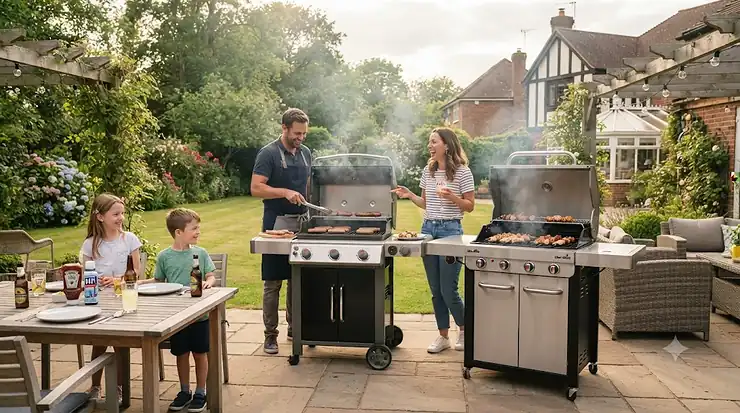
There’s a particular kind of garden-centre paralysis that sets in the moment you’re stood between a Weber and a Char-Broil, price tag in one hand, half-remembered advice from a mate in the other. Both brands turn up in nearly every “best BBQ” list going. Both have devoted followings who’ll defend their choice like it’s a football team. And both, frustratingly, make genuinely decent grills — which is exactly why the decision is harder than it should be.
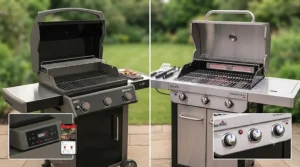
The short version, before we go any further: weber vs char broil isn’t really a fight between a good brand and a bad one. It’s a fight between two different philosophies. Weber leans hard into build quality, consistent heat retention and a long ownership life, and prices accordingly. Char-Broil leans into value, clever infrared technology, and getting you cooking sooner for less outlay. Neither approach is wrong; they just suit different gardens, different budgets and different levels of patience for maintenance.
This guide puts real models from both brands side by side, then widens the lens to five genuine alternative brands worth knowing about if neither Weber nor Char-Broil quite fits — because the best bbq brand for your specific garden isn’t always one of the two everyone mentions first. Expect honest specs, honest trade-offs, and no pretending one brand wins every single category, because it doesn’t.
What’s the Difference Between Weber and Char-Broil?
Weber and Char-Broil are both long-established American outdoor cooking brands, but they compete on different strengths. Weber, founded in 1951, is generally regarded as the premium mainstream choice, built around heavier materials, porcelain-enamelled components and long warranties. Char-Broil, dating to 1948, competes primarily on price and its proprietary TRU-Infrared cooking system, which reduces flare-ups and is fitted across much of its mid-range.
According to independent testing by Which?, price and brand name don’t automatically predict cooking performance — some of the strongest-scoring gas barbecues in their tests have come in well under £500, which is worth keeping in mind before assuming the more expensive name is automatically the better cook.
Weber vs Char-Broil: Quick Comparison Table
Here’s the fast version if you already know roughly which category you’re shopping in.
| Brand & Model | Best For | Fuel Type | Price Range |
|---|---|---|---|
| Weber Spirit E-310 | Best all-round premium gas grill | Propane gas | £500-£550 range |
| Weber Original Kettle Premium 57cm | Best classic charcoal barbecue | Charcoal | £200-£250 range |
| Char-Broil Advantage CORE B | Best budget TRU-Infrared gas grill | Propane gas | £250-£320 range |
| Char-Broil Gas2Coal 330 Hybrid | Best hybrid gas-and-charcoal option | Gas and charcoal | £350-£450 range |
| Napoleon Rogue 425 | Best Weber alternative for even heat | Propane or natural gas | £500-£600 range |
| Broil King Baron 440 | Best premium alternative for serious cooks | Propane or natural gas | £600-£750 range |
| CosmoGrill Pro Deluxe 5 Burner | Best budget large-capacity gas grill | Propane gas | £200-£400 range |
Scanning the table, the pattern is fairly clear: Weber Spirit E-310 and Char-Broil Advantage CORE B sit at broadly comparable “everyday family grill” positioning but roughly £200-£250 apart in price, which is really the crux of the whole weber char broil comparison most shoppers are actually trying to resolve. The three alternative brands — Napoleon Rogue 425, Broil King Baron 440 and CosmoGrill Pro Deluxe 5 Burner — exist specifically to challenge that binary, either matching Weber’s build quality at a similar price (Napoleon, Broil King) or undercutting Char-Broil on raw cooking capacity for the money (CosmoGrill).
💬 Just one click — help others make better buying decisions too!😊
Top 7 Barbecues: Weber, Char-Broil & Premium Alternatives — Expert Analysis
Research for this section combined manufacturer specifications, aggregated Amazon UK and retailer customer sentiment, and independent testing data from Which? and Consumer Reports. Where genuine review data wasn’t verifiable for a specific claim, that’s flagged honestly rather than presented as confirmed fact.
1. Weber Spirit E-310 — best all-round premium gas grill
The Weber Spirit E-310 is Weber’s entry point into gas grilling for 2025-26, and it’s a genuinely strong illustration of what the brand’s premium pricing buys you. Three stainless steel burners sit beneath porcelain-enamelled cast-iron cooking grates, delivering a 51 x 46cm cooking surface, and Snap-Jet ignition lets you light each burner individually with one hand rather than fumbling with a separate igniter button.
Based on the spec comparison with Char-Broil’s equivalent tier, what most buyers overlook about the Spirit E-310 is where the money actually goes: not into raw heat output, but into heat consistency and component longevity. The cast-aluminium cook box resists rust and peeling in a way painted steel simply can’t match over years of UK weather, and the stainless steel Flavorizer bars are specifically engineered to vaporise drippings evenly rather than pooling grease in one spot.
Aggregated review sentiment for the Spirit range is mixed but leans positive, with a genuinely useful pattern worth reporting honestly: several reviewers praise consistent, even heat across the cooking area, while a recurring minority — including at least one detailed account of Weber UK’s direct-order delivery process — flag delivery and customer service friction as a bigger pain point than the grill itself. On the product itself specifically, reviewers consistently note reliable one-hand ignition and easy cleanup via the front-access grease tray.
Pros:
- ✅ Cast-aluminium cook box resists rust and peeling long-term
- ✅ Snap-Jet ignition lights each burner individually, one-handed
- ✅ 10-year limited warranty on individual components
Cons:
- ❌ Premium pricing relative to comparable Char-Broil models
- ❌ Some reports of delivery and customer service friction on direct orders
At £500-£550, the Weber Spirit E-310 is the benchmark most people are actually picturing when they say “I want a Weber” — solid, consistent and built for years rather than seasons.
2. Weber Original Kettle Premium 57cm — best classic charcoal barbecue
Charcoal loyalists rarely need convincing about the Weber Original Kettle Premium 57cm — it’s the design that effectively defined the modern kettle barbecue shape back in the 1950s, and the current version refines rather than reinvents that formula. A 2,342cm² cooking area handles food for six to eight people, and the hinged, plated-steel cooking grate flips up on either side so you can top up charcoal mid-cook without lifting the whole grate off.
What the spec sheet doesn’t fully convey is how much of the design is quietly about heat retention rather than cooking area alone. The porcelain-enamelled bowl and lid hold temperature more consistently than a plain steel equivalent, and the adjustable lid and bowl dampers let you fine-tune airflow without lifting the lid and losing heat — a detail that matters considerably for longer indirect cooks like a whole chicken or a pork shoulder.
Reviewer sentiment is broadly strong but genuinely mixed on long-term durability, which is worth stating plainly rather than glossing over: several long-term owners report the grill lasting well beyond a decade with only minor maintenance, while at least one detailed review describes a Kettle Premium’s grill surface and ash catcher deteriorating within a few years of regular use, despite the same 10-year component warranty applying. Whether that reflects a genuine manufacturing variance or differing storage and care habits between owners isn’t verifiable from the review text alone.
Pros:
- ✅ One-Touch cleaning system sweeps ash into a removable catcher
- ✅ Hinged grate allows mid-cook charcoal top-ups without disassembly
- ✅ 2,342cm² cooking area suits family-sized gatherings
Cons:
- ❌ Reported durability varies noticeably between individual units
- ❌ No gas convenience — full charcoal lighting and cleanup each use
In the £200-£250 range, the Weber Original Kettle Premium 57cm remains the standard reference point for charcoal flavour purists, even against far pricier specialist smokers.
3. Char-Broil Advantage CORE B — best budget TRU-Infrared gas grill
The Char-Broil Advantage CORE B is where Char-Broil’s value proposition is at its clearest: three burners, TRU-Infrared cooking technology, and a side burner, all at a price that typically undercuts Weber’s entry-level gas offering by £200 or more. TRU-Infrared works by directing burner heat through a perforated emitter plate rather than straight onto the food, which genuinely does reduce the flare-ups that come from dripping fat hitting an open flame directly.
Based on the spec comparison with Weber’s equivalent tier, the honest trade-off here is material grade rather than cooking technology. Char-Broil’s mainstream range typically uses a lighter-grade painted steel cabinet rather than Weber’s cast aluminium, which keeps the price down but is more exposed to rust over time, particularly around welded seams and screw points, if left uncovered through wet UK winters.
Aggregated review sentiment describes the TRU-Infrared system as genuinely effective at what it claims to do — reviewers consistently note less charring and more even cooking on foods like chicken and sausages compared with open-flame grills at a similar price. A recurring minority theme in longer-term feedback concerns painted components showing surface rust within 18-24 months, particularly on side shelving, even with a fitted cover.
Pros:
- ✅ Significant price saving over comparable Weber models
- ✅ TRU-Infrared genuinely reduces flare-ups from fat drippings
- ✅ Side burner included at this price point, which Weber typically omits
Cons:
- ❌ Painted steel components more prone to rust over multiple winters
- ❌ Cast-iron grates can chip at corners if scraped with metal tools
At £250-£320, the Char-Broil Advantage CORE B delivers a genuinely strong proportion of premium-grill performance for considerably less outlay, provided you’re willing to cover it religiously and expect a shorter working life than a Weber equivalent.
4. Char-Broil Gas2Coal 330 Hybrid — best hybrid gas-and-charcoal option
Rather than forcing a choice between fuel types, the Char-Broil Gas2Coal 330 Hybrid lets you switch between gas and charcoal cooking on the same unit, with a swap-out grate system that converts between the two. Three gas burners handle everyday convenience cooking, while the charcoal tray slots in when you specifically want that smoke flavour for a weekend cookout.
What most buyers overlook about hybrid grills generally is that they’re a genuine compromise on both sides rather than the best of both worlds outright — the charcoal cooking area on a hybrid is typically smaller than a dedicated charcoal grill like the Weber Kettle above, and the gas side doesn’t quite match a purpose-built gas grill’s burner layout efficiency. That said, for someone who genuinely can’t decide between fuel types, or wants gas for weeknight convenience and charcoal for weekend flavour without owning two separate grills, the trade-off is a reasonable one.
Aggregated reviews for the Gas2Coal range are among the more consistently positive in Char-Broil’s UK lineup, with the hybrid functionality specifically praised as working as advertised rather than feeling like a marketing gimmick. A minority of reviews note the conversion process between fuel modes takes longer than expected on a first attempt, though most reviewers report it becoming quick and routine after the first few uses.
Pros:
- ✅ Genuine gas-to-charcoal conversion, not just a marketing claim
- ✅ Avoids needing to own two separate grills for different occasions
- ✅ Strong aggregated review sentiment relative to Char-Broil’s range
Cons:
- ❌ Smaller charcoal cooking area than a dedicated charcoal grill
- ❌ Conversion process has a learning curve on first use
In the £350-£450 range, the Char-Broil Gas2Coal 330 Hybrid suits households genuinely torn between fuel types rather than those who already know which they prefer.
5. Napoleon Rogue 425 — best Weber alternative for even heat
Napoleon is a Canadian manufacturer that’s built a strong reputation specifically as one of the more credible weber alternative brands, and the Napoleon Rogue 425 illustrates why. Three main burners sit beneath cast-iron WAVE cooking grids, delivering 425 square inches of primary cooking space, and the JETFIRE battery-free ignition system lights every burner reliably without relying on a battery that can die at an inconvenient moment.
Based on the spec comparison with both Weber and Char-Broil, Napoleon’s positioning is deliberately in between the two: a fully welded cast-aluminium firebox that resists corrosion similarly to Weber’s approach, at a price point closer to Weber’s entry tier than its mid-range. The wave-pattern cooking grids provide more even heat transfer across a greater surface area than traditional straight-rod grates, according to Napoleon’s own engineering claims, which independent reviews broadly support.
Reviewer sentiment is strongly positive on longevity specifically — Napoleon’s 15-year warranty is unusually generous for this price bracket, and multiple long-term owners report grills lasting well over a decade with routine maintenance. A recurring, more technical criticism from detailed independent testing notes a measurable temperature difference between the front and back of the cooking chamber on some Rogue models, which is worth knowing if perfectly even heat across the entire grate matters to your cooking style.
Pros:
- ✅ Unusually generous 15-year warranty for the price bracket
- ✅ Battery-free JETFIRE ignition avoids a common gas-grill failure point
- ✅ Cast-iron WAVE grids provide genuinely even heat transfer
Cons:
- ❌ Measurable front-to-back temperature variance reported in independent testing
- ❌ Less widely stocked at UK retailers than Weber or Char-Broil
At £500-£600, the Napoleon Rogue 425 is the strongest single recommendation in this guide for anyone specifically asking “what’s a good weber alternative brand” — genuinely comparable build quality, at a broadly similar price.
6. Broil King Baron 440 — best premium alternative for serious cooks
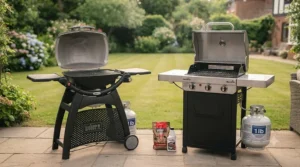
Where Napoleon competes closely with Weber on price, the Broil King Baron 440 sits deliberately higher, positioning itself among the premium bbq brands aimed at owners who grill often enough to justify the outlay. Four dual-tube stainless steel burners deliver up to 40,000 BTU across a 630 square inch total cooking area, split between 430 square inches of primary grilling space and a stainless steel warming rack.
What sets the Baron 440 apart in practice, based on the spec comparison with the other grills in this guide, is the reversible cast-iron cooking grid — one side pointed for classic sear marks, the other grooved to capture juices, letting you switch cooking styles without swapping equipment. The Flav-R-Wave cooking system vaporises drippings instantly across the full burner width, which independent lab evaluation from Consumer Reports has rated favourably for heat evenness during preheat, high and low temperature testing specifically.
Aggregated review sentiment is strongly positive across multiple retailers, with owners specifically praising heat retention and consistency during longer cooking sessions like ribs or slow-roasted joints. Broil King’s tiered warranty structure — lifetime on the cook box, ten years on the burner system — reflects genuine confidence in the build, though it’s worth noting this is among the pricier options in this guide and arguably overspecified for occasional, casual grilling.
Pros:
- ✅ Reversible cast-iron grids for sear marks or juice retention
- ✅ Independently tested strong heat evenness across preheat and cooking
- ✅ Tiered warranty including a lifetime cook box guarantee
Cons:
- ❌ Highest price point of any grill in this guide
- ❌ Genuinely overspecified for light or occasional grilling use
At £600-£750, the Broil King Baron 440 is the pick for owners who grill frequently enough that the extra investment pays back in consistency and longevity rather than sitting unused most of the year.
7. CosmoGrill Pro Deluxe 5 Burner — best budget large-capacity gas grill
The CosmoGrill Pro Deluxe 5 Burner takes a different approach entirely from the other brands in this guide: maximise cooking capacity and features per pound spent, using a UK-based retailer model rather than a long-established global manufacturer. Four main stainless steel burners plus a side burner deliver a combined 12.5kW output across a 62 x 42cm cooking area, large enough to cater for around 15 people at once according to the manufacturer’s own guidance.
Here’s what needs to be said honestly about this category of budget large-format grill: the value proposition is genuine on paper, but aggregated review sentiment is more polarised than any other product in this guide. Many reviewers specifically praise the sturdy construction and cooking results relative to the price, with the double-walled hood and built-in thermostat singled out as unusually well-specified for the cost. However, a detailed minority of longer-term reviews describe control dial quality feeling notably cheap and report the grill’s overall condition deteriorating within roughly two years of regular use — one detailed account specifically noted feeling the price had crept up over time without a corresponding improvement in build quality.
Based on the spec comparison with the rest of this guide, this is the clearest example here of the classic “buy cheap, buy twice” trade-off discussed throughout this article: strong short-term value, genuinely uncertain long-term durability, and a build quality gap versus Weber, Napoleon or Broil King that becomes more apparent the longer you own it.
Pros:
- ✅ Large 62 x 42cm cooking area at a genuinely budget price
- ✅ Double-walled hood and built-in thermostat unusual at this price point
- ✅ Four independently adjustable burners plus a side burner
Cons:
- ❌ Control dial quality reported as noticeably cheap by some owners
- ❌ Reported durability concerns emerging within roughly two years
In the £200-£400 range depending on bundle, the CosmoGrill Pro Deluxe 5 Burner is best suited to buyers prioritising immediate cooking capacity over long-term ownership cost, or as a lower-commitment way to test whether large-format grilling suits your household before spending Weber or Broil King money.
Practical Usage Guide: Setup, Gas Safety & First Cook
Getting the first few cooks right, and setting up gas safely, matters more for long-term satisfaction than the specific brand you’ve chosen. For any gas barbecue, Gas Safe Register’s BBQ safety guidance recommends always changing the gas cylinder outdoors, checking joints for leaks with a leak detection solution before first use, and turning off the cylinder valve before the burner controls when finishing, so any residual gas in the pipeline burns off safely rather than lingering.
Assembly varies significantly by model — Weber’s kettle grills typically go together in under an hour, while larger gas grills with side cabinets, like several models in this guide, can take 90 minutes to two hours and genuinely benefit from a second pair of hands for the firebox and cabinet steps. Season new cast-iron or porcelain-enamelled grates with a light coating of cooking oil before the first proper cook — this helps prevent food sticking and builds a protective layer against rust over the barbecue’s working life.
For anyone new to gas barbecues specifically, it’s worth understanding the broader regulatory picture around the fuel itself. According to the Health and Safety Executive’s guidance on LPG, propane gas is heavier than air and can settle in low spots like drains or basements if leaked, which is part of why outdoor-only use and proper ventilation matter beyond simply following the barbecue’s own instructions.
Real-World Scenarios: Which Brand Suits Your Grilling Style?
If you’re a weekend host who grills for six to eight people every couple of weeks and wants a barbecue that will still be performing well in a decade, the Weber Spirit E-310 or Napoleon Rogue 425 both make more sense than a budget option — the extra outlay buys consistency you’ll notice every single cook.
If you’re new to gas grilling, cooking for a smaller household, and genuinely uncertain how often you’ll actually use a barbecue, the Char-Broil Advantage CORE B lets you get real cooking experience without committing premium-grill money to something that might end up under a tarpaulin by autumn.
If you host large garden parties several times a summer and raw cooking capacity matters more than long-term build quality, the CosmoGrill Pro Deluxe 5 Burner delivers genuinely useful cooking area for the price — just budget mentally for a shorter working life than the premium alternatives in this guide.
Problem → Solution: Common Grill Ownership Issues
Problem: my gas grill won’t heat evenly across the whole surface. This is often down to burner tube blockages or worn Flavorizer bars rather than a fundamental design flaw — clean burner ports thoroughly before assuming the grill itself is faulty, and check for the front-to-back variance some models, including certain Napoleon Rogue units, are known to show.
Problem: my grill’s paintwork or side shelves are rusting after a year or two. This is more common on painted steel components than porcelain-enamelled or cast-aluminium ones — a fitted, breathable cover used consistently, even through short dry spells, meaningfully slows this process.
Problem: I can’t decide between gas convenience and charcoal flavour. A hybrid model like the Char-Broil Gas2Coal 330 Hybrid genuinely solves this rather than forcing the choice, though it’s worth accepting the compromise on charcoal cooking area versus a dedicated kettle grill.
Problem: my budget grill’s control dials feel cheap and unreliable within a couple of years. This is a recognised pattern with lower-cost large-format grills specifically — if this happens, it’s often more economical to move up a tier on your next purchase than to keep replacing components on a budget unit.
How to Choose Between Weber and Char-Broil
Working through this decision systematically beats going on brand reputation alone:
- Set a realistic budget band first, not a brand. Decide what you’re comfortable spending before comparing specific models, since both brands span a wide range.
- Decide how much you value long-term build quality versus upfront savings. Weber and Napoleon lean toward the former; Char-Broil and CosmoGrill lean toward the latter.
- Consider your actual grilling frequency honestly. Occasional use rarely justifies premium-tier spending; frequent entertaining usually does.
- Check cooking area against your typical group size. A grill too small for regular entertaining gets frustrating fast.
- Factor in maintenance commitment. Painted steel components need more consistent covering and care than cast-aluminium or porcelain-enamelled equivalents.
- Look at warranty length as a genuine quality signal. Longer warranties, like Napoleon’s 15 years, generally reflect manufacturer confidence in component durability.
- Read current, verified reviews for your specific model. Manufacturing consistency can vary between production runs even within a trusted brand.
Weber vs Char-Broil: Build Quality & Materials Compared
The core material difference between these two brands explains most of the price gap and most of the long-term durability difference reported in reviews throughout this guide. Weber’s mainstream range typically uses cast-aluminium cook boxes and porcelain-enamelled cast-iron grates, both genuinely more resistant to rust and warping over years of UK weather than painted steel. Char-Broil’s comparable tier generally uses painted steel cabinets, which keep costs down but are more exposed to corrosion at welds and screw points if left uncovered.
| Factor | Weber | Char-Broil |
|---|---|---|
| Typical cabinet material | Cast aluminium | Painted steel |
| Cooking grate finish | Porcelain-enamelled cast iron | Porcelain-enamelled cast iron |
| Flare-up control | Flavorizer bars | TRU-Infrared emitter plate |
| Typical warranty | Up to 10 years | Shorter, varies by model |
| Best For | Weber Spirit E-310, Weber Original Kettle Premium 57cm — long-term durability | Char-Broil Advantage CORE B, Char-Broil Gas2Coal 330 Hybrid — value and flare-up control |
Reading that comparison, both brands use genuinely similar grate technology, which is part of why the actual cooking results are closer than the price gap might suggest — the real difference sits in the surrounding cabinet and burner materials, which is where Weber’s extra spend goes and where Char-Broil’s savings come from.
Weber Alternative Brands: Napoleon, Broil King & Beyond
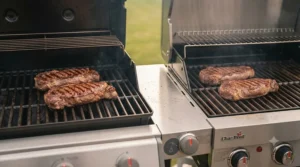
If neither Weber nor Char-Broil quite fits, several established manufacturers compete credibly in the space between and around them. Napoleon, as covered above, is the closest direct Weber alternative on both price and build philosophy, with the added benefit of an unusually long warranty. Broil King pushes further upmarket with heavier-duty burner systems and reversible cooking grids aimed specifically at frequent, serious grillers rather than occasional weekend use.
Beyond the two covered in the Top 7 above, it’s worth knowing the broader landscape exists: pellet-and-smoker specialists like Traeger occupy a different category entirely, built around wood-fired flavour and app-controlled temperature rather than direct gas or charcoal grilling, while UK-based budget retailers beyond CosmoGrill — such as Outback — compete on similar value-first positioning. The right choice among these alternatives comes down to the same factors covered in the choosing framework above: budget, frequency of use, and how much long-term build quality genuinely matters to your household.
Best BBQ Brand for Your Budget: Premium vs Value
There’s no single best bbq brand that fits every budget, and pretending otherwise does readers a disservice. At the premium end, Weber, Napoleon and Broil King consistently deliver the strongest aggregated long-term reliability sentiment across the review data referenced throughout this guide, at prices generally starting around £500 and climbing considerably higher for larger or more feature-rich models. At the value end, Char-Broil and CosmoGrill deliver a genuinely reasonable proportion of the cooking experience for considerably less outlay, with the honest trade-off being component longevity rather than immediate cooking performance.
The practical framework worth applying here: if you grill more than roughly once a week through the season, the premium tier’s extra cost per use works out lower over several years than repeatedly replacing a budget grill. If you grill occasionally, or you’re not yet certain barbecuing will become a regular habit in your household, starting at the value tier and upgrading later is a genuinely sensible, low-risk approach.
Common Mistakes When Comparing BBQ Brands
The most common mistake is comparing headline BTU figures across brands as if they’re directly equivalent — a higher BTU rating doesn’t automatically mean better cooking performance, since heat distribution and grate material matter more than raw output. A second frequent error is assuming premium pricing guarantees perfect reliability; as covered in the individual reviews above, even Weber and Napoleon models have documented durability variance between individual units. A third mistake is under-covering a grill through winter regardless of brand, which accelerates corrosion on painted steel components specifically faster than most owners expect. Finally, many first-time buyers skip reading current, verified reviews for their exact model and size, relying instead on general brand reputation that may not reflect a specific production run’s quality.
Manufacturer Quality Review: Warranties, Materials & Long-Term Reliability
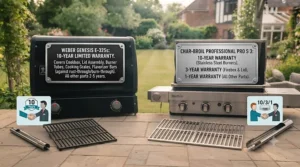
Warranty length is one of the more honest signals of manufacturer confidence available to shoppers, since companies generally don’t offer long component guarantees on parts they expect to fail early. Weber’s 10-year limited warranty on individual gas and charcoal barbecue components, and Napoleon’s 15-year bumper-to-bumper coverage on the Rogue range, both reflect genuine confidence backed by cast-aluminium or fully welded firebox construction. Char-Broil and CosmoGrill’s shorter warranty windows aren’t necessarily a red flag on their own, but they do align with the painted-steel construction more exposed to weather-related wear discussed throughout this guide.
On materials specifically, the consistent theme across every product reviewed here is that porcelain-enamelled cast iron performs similarly well for cooking regardless of brand — the meaningful quality differentiation sits in the surrounding cabinet, burner tube material and ignition system reliability, not the grates themselves. That’s a genuinely useful thing to know if budget is tight: a value-tier grill with painted steel siding but the same porcelain-enamelled grate technology as a premium model will often cook comparably well in its first few seasons, even if it doesn’t last as many years overall.
✨ Don’t Miss These Exclusive Deals!
🔍 Take your outdoor cooking to the next level with these carefully selected barbecues. Click on any highlighted item to check current pricing and availability. Whichever brand you choose, these picks will help you grill with confidence all season long!
Safety, Regulations & Long-Term Value
Gas barbecues in the UK fall under general consumer gas safety guidance rather than a barbecue-specific mandatory certification scheme, which places real responsibility on owners to follow manufacturer instructions and basic safety practice. London Fire Brigade’s barbecue safety advice is unambiguous on placement specifically: position any barbecue on level ground rather than decking, well away from sheds, fences or trees, and never use one on a balcony, since flames and sparks can spread quickly to the building itself. The Brigade also recommends keeping a bucket of water or sand nearby and ensuring coals or embers are fully out, since smouldering ash can give off dangerous carbon monoxide fumes even after visible flames have died down.
On long-term value, the maths across this guide consistently favours matching spend to actual grilling frequency rather than buying the most expensive option available or the cheapest by default.
| Approach | Upfront Cost | Typical Lifespan | Long-Term Value |
|---|---|---|---|
| Budget grill, frequent heavy use | Lowest | 2-3 years before real wear | Frequent repurchases add up |
| Mid-range grill, moderate use | Moderate | 5-8 years with proper care | Best balance for most households |
| Premium grill, frequent use | Highest | 10+ years with routine maintenance | Strongest value if used regularly |
Reading that table, the households getting the poorest long-term value are typically those buying budget grills for frequent, heavy use — the repurchase cycle there tends to cost more over five years than a single mid-range or premium purchase would have.
FAQ
❓ Is Weber really better than Char-Broil, or is that just brand reputation?
❓ What is the best Weber alternative brand for similar quality?
❓ Do premium BBQ brands actually cook food better than budget ones?
❓ How long should a gas barbecue realistically last?
❓ Is a hybrid gas-and-charcoal grill worth it over choosing one fuel type?
Conclusion
The weber char broil comparison at the heart of this guide doesn’t really have a single winner, and any article claiming otherwise is oversimplifying a genuinely nuanced decision. The Weber Spirit E-310 and Weber Original Kettle Premium 57cm earn their premium pricing through materials and longevity that show up clearly in long-term ownership reviews. The Char-Broil Advantage CORE B and Char-Broil Gas2Coal 330 Hybrid deliver a genuinely fair proportion of that experience for meaningfully less money, provided you’re realistic about the shorter working life. And for anyone specifically hunting for premium bbq brands beyond the two names everyone mentions first, the Napoleon Rogue 425 and Broil King Baron 440 both stand up to close scrutiny, while the CosmoGrill Pro Deluxe 5 Burner proves genuine cooking capacity doesn’t have to cost a fortune, even if it won’t last as long as the rest of this list.
Match your choice to how often you’ll actually use it, how much long-term maintenance you’re willing to commit to, and what your garden genuinely needs rather than what’s loudest in the marketing. Do that, and either of these two famous rivals — or one of the credible alternatives sitting between them — will serve your garden well for years to come.
Recommended for You
- Gas vs Charcoal BBQ Running Costs 2026: 7 Grills Compared
- 7 Best BBQ for Large Family Picks in 2026: Feed 10+ Easily
- 7 Best BBQ for Small Garden Picks UK 2026
Disclaimer: This article contains affiliate links. As an Amazon Associate, I earn from qualifying purchases. If you purchase products through these links, we may earn a small commission at no additional cost to you.
✨ Found this helpful? Share it with your friends! 💬🤗
